Tag Archives: Fantasy

“X-MEN: DAYS OF FUTURE PAST” Review (✫✫✫✫)

The next stage in superhero cinema evolution. 

X-men: Days of Future Past ranks among the best superhero sequels I’ve ever seen, one I would instantly compare to that of Spider-man 2 or The Dark Knight. There were so many things that needed to be done, so many risks that needed to be taken, and so many ways this movie could have failed. It didn’t. From the opening sequence to its last breathtaking moment, my mind was blown and the comic-book nerd in me was absolutely filled with joy. The movie did more than simply expand the franchise: it redefined it.

We open on a post-apocalyptic future that hasn’t been this catastrophic since James Cameron’s 1984 film The Terminator. Years after X-men: The Last Stand took place, humans are now being hunted by the same weapons they created in the first place: the Sentinels, a coalition of dangerously armed robots who can track and exterminate any mutant they can find on planet earth. Amongst the ruins of battered buildings and fallen icons, the human race has now been collected into a sort of concentration camps: all that’s left for the mutants then is the mass graves filled with the dead bodies of their kin.

Lifelong frenemies Charles Xavier (Patrick Stewart) and Magneto (Ian McKellan) collaborate on a plan they would like to enact. Besides having the ability to phase through walls and objects, Kitty Pryde (Ellen Page) has recently developed the ability to transfer someone’s consciousness into their younger bodies in the past, allowing them to change the future and avoid the unfortunate outcomes that might become of them. Kitty has been able to use this ability on multiple occasions now to save her friends, but now Professor X and Magneto want to go back into the past (1970, to be exact) to prevent the event that triggered this horrifying future and save human and mutantkind as they know it.

Problem is, Kitty can only send someone back a few days or weeks at a time. Any further than that and she risks tearing apart the mind of the person she’s sending back to the point beyond repair. Luckily, Wolverine (played by Hugh Jackman, who else?) has the ability to heal himself at a faster rate. So Professor X and Magneto decide to send Wolverine back into the past to coerce their younger selves (portrayed by James McAvoy and Michael Fassbender, respectively) to stop the triggering event and save the future.

Serving as a sequel to both X-men: First Class and X-men: The Last Stand, and incorporating characters and actors from both translations, X-men: Days of Future Past is, in a word, a game changer. It brings in all of its key players, from the original cast members and its most revered director Bryan Singer, to the newcomers who’ve newly defined their roles, including McAvoy as Xavier and Fassbender as Magneto. Everyone meshes so perfectly with each other, especially Jackman once again, who essentially has to react to characters from two different time zones. There hasn’t been a cast this big since Joss Whedon’s The Avengers, and I’m tempted to say the movie is better because of it.

Do I really want to stand here though, and compare Days of Future Past to that of The Avengers? Yes I do. The Avengers was a bold, brave step forward in comic book evolution, combining characters from five different movies to make a superhero epic that hadn’t been tried before. Days of Future Past follows that same model, bringing in characters from six of its movies, but the end result is vastly different. There’s a much deeper plot going on here, a vastly intelligent and contemplative story that elaborates on its recurring themes of racism and, once again, bringing in the consequences of discrimination to the forefront. I loved X2 for this very reason, for it being more than just a comic book movie and focusing itself more as a political thriller with comic book elements thrown into the mix. This movie is that to, like, the tenth power.

Oh yes, this movie will fill comic fans with glee everywhere. Similar to the small little easter eggs that can be picked up in other Marvel movies (Note: The Doctor Strange reference in The Winter Soldier), this movie too has sweet little moments that comic fans can pluck from the ground and take a moment and appreciate the aroma. My favorite had to be a moment where a mutant named Peter (Evan Peters), who can run at supersonic speeds, rests in an elevator with the younger Magneto as he’s helping him escape from prison, and makes a comment about his long-lost father. That’s just the tip of the Bobby Drake-iceberg. There’s so many moments I can pull from that filled me with joy and happiness, while others filled me with dread and angst. The film orchestrates its emotions wonderfully, and in every fabric of the film I felt what I was supposed to feel.

I’m going to go out on a limb and say this is the best X-men movie in the series so far. Bold claim, I know, but it deserves it. From its first moment to its last, Days of Future Past is completely, utterly, fascinatingly mind-blowing and involving. From its quietly hinted-at themes of xenophobia and extermination to its climactic action scenes where we don’t see how on earth our heroes can win, Days of Future Past combines the best parts of all of the movies and makes itself the best entry out of them. Many audiences have recently been experiencing superhero movie fatigue, with movies such as Man of Steel and The Amazing Spider-man 2 recently being met with mixed reaction amongst audiences and in the box office. Days of Future Past is one of those movies that restores your faith in the genre.

Tagged , , , , , , , , , , , , , , , , , , , , , , , , , , , , , , , , , , , , , , , , , , , , , , , , , , , , ,

“X-MEN: THE LAST STAND” Review (✫✫✫)

How can you “cure” what was intended as a gift?

There’s an obvious danger with the production of second sequels made with planned trilogies: how do you keep things fresh and interesting and make sure none of the material isn’t stretched out or forced? For many trilogies, the third entry is the one filmmakers are usually least concerned about. Why should they be? They’ve already made their biggest impact with the first two films and people will go and see it anyway, so why should they extend any effort? I like to call this “the trilogy curse,” and it explains why so many second sequels end up letting down their entire franchise (*cough* Terminator 3 *cough*).

The best thing that can be said for X-men: The Last Stand is that it does a good job avoiding the trilogy curse. While some may be frustrated by the liberties it took and the deviations it made from the source material, I for one found it to be very liberating. It changes things up a bit, made things different, and did one huge thing that many comic book movies can’t do: it made it unpredictable. Because of this, the stakes were higher, the action was more involving, and it made you invest yourself more in the characters rather than waiting for everyone to hold hands in the end for that “happily ever after” ending many films get trapped into. X-men: The Last Stand accomplished something important: it proved that comic-book movies can deviate from their source material and still be good.

After saving both human and mutantkind at the shrouded site where Wolverine (Hugh Jackman) gained his metal claws and lost his memory many years ago, X-men: The Last Stand takes place as the X-men still try to cope with the death of their beloved Jean Grey (Famke Jannsen), who sacrificed herself to save her friends as she became engulfed by a sea of raging waters. Most affected by this is her boyfriend Scott “Cyclops” Summers (James Marsden), who can still hear her voice in his head as he sits in their bedroom reminiscing about her.

The X-men, however, have a much more pressing issue at hand: a company called Worthington Labs has recently invented a mutation antibody that basically attacks mutant cells and nullifies them. The public dubbed it as a “cure,” and it essentially turns mutants into regular human beings, forever granting themselves the life of normalcy they’ve so long desired. Of course, this new invention stirs up quite a controversy among the mutant community, especially regarding Magneto (Ian McKellan) and his extremist brotherhood of mutants. When mutants come to terms with this cure and what it means for all of them, they must make a decision of whether or not to fight against the cure, or fight for humanity’s survival at all.

The first out of the X-men series not to be directed by Bryan Singer, filmmaker Brett Ratner (The Rush Hour series) steps in to fill in the reigns of Singer’s mostly definitive first two installments. How does he do? Well, the good news is that he holds his own pretty well, and makes a movie that he can call all his own. Ratner poses an important question here that I think the other two films mostly sidesteps: if you have an unwanted gift, should you keep it? For me when I watched the movie, I saw an image deeper than that of a mutant standing in line to take a shot that would take away their powers. I saw a pregnant teenager waiting in line for an abortion for that baby that she never intended to have in the first place, or an image of a man going in for a gender change because he doesn’t feel comfortable in his current body.

Controversial? Yes, but that’s how the film intends for it to be. Much like its predecessors, The Last Stand handles its political side well, and is being more ambitious by taking a different spin from the standard supremacist/racism themes that they explored in the earlier installments.

The cast is good, but that’s standard at this point. We expect Jackman to be good as Wolverine. We expect Patrick Stewart and McKellan to be convincing as the leaders for their own specific causes. We expect Storm (Halle Berry) to be the strong female hero that she is, and we expect Iceman (Shawn Ashmore) to be the kind-hearted, considerate teenager while Rogue (Anna Paquin) remains the estranged and desperately shy mutant who continuously questions keeping her abilities. The one we should notice more than anyone else is Janssen as Jean Grey. Yes, she’s back, and she has a much more villainous spin on her that comic fans may or may not be happy to see. She’s much more versatile in this movie, bouncing brilliantly in between angry and hateful to scared and grief-stricken. Without giving too much away, I really liked her role in this movie as both a protagonist and antagonist, and I think X-men fans will be just as pleased with her performance as well.

The only thing I don’t like with this movie is its climax. The buildup earlier in the film was so much better, with the backstory of Jean Grey, Professor X and Magneto culminating so ingeniously into a plot where all the danger was real and there was no way to predict who lived and who died. Another great scene with excellent buildup was when Wolverine went searching for Jean, fighting a small group of mutants within the confusion of a lush, maze-like forest. The final fight, however, could not have been more standard and one-note if it tried. It plays out exactly as you would predict it to, dragging out into a disarray of violence and loud noises until finally it ends in explosions and agonizing screams. Enough already. The rest of the movie did a good job building up anticipation: did you really have to give in right before the end?

Still, I had fun with this movie. I know “fun” is a very loose term that can be used within the film community, especially when you’re speaking about a potential deal breaker such as this. Still, I’m going to say it: this movie was fun. Why am I saying that? Because I enjoyed it, that’s why. I genuinely liked it. I liked the big, boisterous action scenes orchestrated on a grander scale in which I don’t think would have been possible six years ago. I liked the darker, more thematic moments between characters where they took time to build up the stakes and what was on the line here. Mostly however, I liked how it humanized the mutants, and made them genuine flesh-and-blood human beings that could be killed and harmed. It didn’t immunize them from death because of their fans’ love for them: it made them mortal, and it presented a real, legitimate threat in the film because of that.

I know many people who are going to disagree with me, and that there will be many who love these characters too much to be able to see them get killed off and just be okay with it. Let me set the news down with you easily: if you’re that bothered by seeing a character’s death in a movie, maybe you shouldn’t be watching that movie in the first place. These filmmakers set out to make a convincing movie where the threat was imminent and real: not to please the comic-book die hard who gets frustrated if a comic book character’s hair isn’t the right color. Maybe that was Ratner’s second goal beyond making a good sequel, to see how many changes he could make before the fans starting writing death threats to his home mailbox.

Tagged , , , , , , , , , , , , , , , , , , , , , , , , , , , , , , , , , , , , , , , , , , ,

“X2” Review (✫✫✫1/2)

A social commentary disguised as an action blockbuster.

X2 is science-fiction brilliance, a sequel that is relentlessly exciting, smartly written, intelligently designed, and jam-packed with so many involving action scenes and stunning visual effects that it could potentially work as a stand-alone movie, rather than a direct sequel to its predecessor X-men. Like Lord of the Rings and Harry Potter, this movie serves as an expansion for the universe that it is in and as an opportunity to provide fan service to its dedicated readers and lovers of the iconic source material. I’m not very much for sequels, and I definitely don’t want this to become a superhero monopoly, but if we have to have sequels packaged with every superhero installment in the near future, more filmmakers should pull inspiration from X2.

X2 picks up just short of a few months after X-men originally left off. After the combined efforts of the X-men defeated Erik Lenshurr, a.k.a. “Magneto” (Ian McKellan), and imprisoned him within a special plastic cell (Countering his ability to manipulate metal), the X-men go about their (ab)normal lives as teachers at Xavier’s School for Gifted Youngsters, educating mutants on how to control their powers and not be afraid of who they are. Only Logan, a.k.a. Wolverine (Hugh Jackman) sets out to Canada to seek out answers for his long-forgotten past, and even then he comes up empty: the lab where he was supposedly experimented on has long since been abandoned.

Soon, however, a new figure from everyone’s past re-emerges: William Stryker (Brian Cox), a government official who has experimented on mutants for as long as mutants existed. After pitching his program to the President and revealing that Xavier’s School For Gifted Youngsters is a front to the X-men operation, the X-men and the Brotherhood of Mutants must band together to save each other from Stryker’s plot, and quite potentially the rest of mutant kind with them as well.

Directed and co-written by Bryan Singer, who also directed X2’s predecessor X-men, X2 is a highly involving, irreverently fascinating superhero epic. Functioning just as much as a political thriller as it does a superhero action flick, Singer is careful to deliberate and balance everything effectively in the movie, from its themes of xenophobia and racism to its highly-exciting action sequences where mutants go flying, flipping, and teleporting in every which way and under.

Funny, the first time Singer tried X-men, balance was a problem for him. He put a greater emphasis on the action and the visuals of the mutant’s powers more than what they meant for them individually, quite possibly because that’s more of what the audience wants to see anyway. Here, balance is not an issue. He does a great job at both not only giving us a healthy dose of action-packed sequences of grandeur and excitement: he also does a great job giving us heartfelt, genuine emotion, showing these character’s internal reactions just as much as their external.

Example: After escaping from an attack on themselves and the rest of the X-men earlier in the movie, Wolverine takes himself and a small group of mutants to Bobby “Iceman” Drake’s (Shawn Ashmore) home, where he’s forced to essentially come out to his family that he is, in fact, a mutant. After seeing the emotion and disparity of his family reeling in with the shocking revelation of Bobby’s abilities, the police pull up to the house, and an explosive battle results between these X-men and the officers.

See, this is what I’m talking about: there isn’t a single moment in the movie where the action outweighs the drama, or the drama outweighs the action. For every scene where something emotionally weighty or significant is revealed, there is another scene where something exciting or thrilling happens that jump-starts your interest all over again. Whether it’s a scene involving dialogue between characters, a narrator giving exposition on a conniving plot, or another scene where some sort of grand, explosive battle takes place doesn’t matter. It’s always moving, it’s always doing something different, it always keeps up its interest and it is never boring.

I’m very happy with this movie. In a world where so many sequels make the mistake of replacing genuine emotion with an overdose of action and visual effects, X2 is a clear standout. While not necessarily perfect, and still incapable of escaping from some of the cheesy, ham-fisted moments that I rued in the first movie, it definitely stepped up its game as a far as drama goes, and has deeper contexts to offer regarding the xenophobia/racism issue that inspired the series as a whole since its comic book creation. In that sense, X2 is more than a superhero blockbuster. It’s a social commentary on judging another person for who they are and the destructive consequences that can come from it as a result.

Tagged , , , , , , , , , , , , , , , , , , , , , , , , , , , , , , , , , , , , , , , ,

“X-MEN: FIRST CLASS” Review (✫✫)

Pretend G-men trying to skip out of class.

The very first shot of X-men: First Class is the exact same scene of the Holocaust, frame-by-frame of the very first X-men movie directed by Brian Singer. Not a good way to start off your movie by copying another one, isn’t it? The very next scene after briefly skipping through that one is a young Charles Xavier’s encounter with a young, hungry blue-skinned mutant named Raven who was trying to steal food from his refrigerator. Talking to her in a very sincere, comforting voice, he assures her that she doesn’t have to steal, and reaffirms it by saying that she’ll never have to steal again. Touching. I wonder how this conversation went over with his mother?

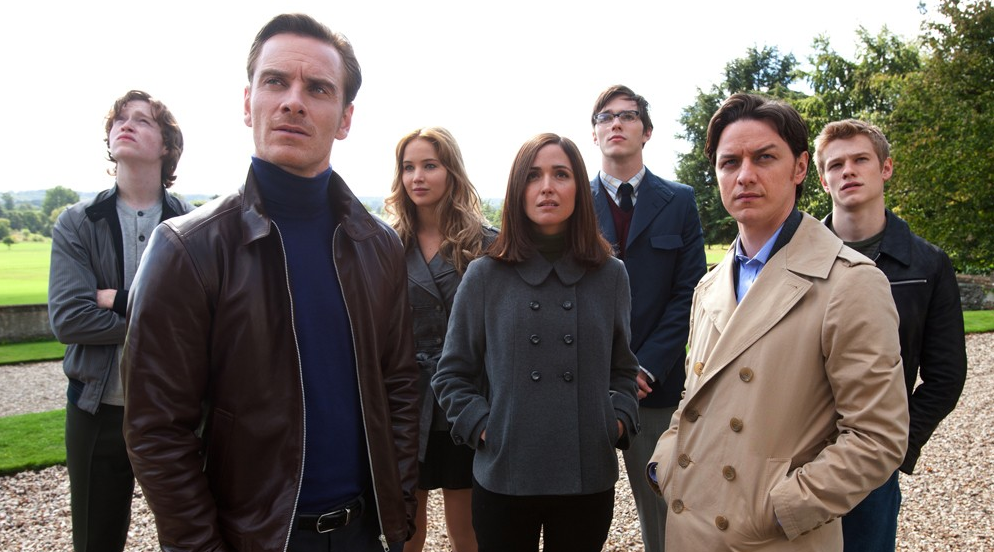
Years pass, and we’re reintroduced to the characters we’ve come to know for the past few movies now. Erik Lenshurr (Michael Fassbender), the man soon to become Magneto, is out on the hunt, looking for the man who killed his family and tortured him as a child back when he was a Jew in the concentration camps. Charles Xavier (James McAvoy) is now in college with the now much more mature Raven (Jennifer Lawrence), who is pursuing his masters degree in psychology.

There’s a mutual enemy that unites these three individuals together: Sebastian Shaw (Kevin Bacon), a menacing and conniving mutant with the ability to absorb and redistribute energy. That means a grenade can explode in his hand and he can transfer the explosion straight into you with a touch of his finger. Shaw is the man who tortured Erik back when he was a young child, and Xavier discovers a sinister plot that Shaw is setting to unveil upon the world. Erik and Charles combine their resources and their efforts to form a mutant team to work together and stop Shaw.

And how exactly does Shaw plan to carry out this giant, dastardly plan? By conspiring and coercing the Cuban Missile Crisis among nations, that’s how. How original. I wonder if these guys considered overthrowing the Chinese government while they were at it?

Hypothetical question. If you hear the term “prequel” being used, what’s the first thing that comes to mind? For me, its the word “beginning”. Beginning, as in, the start of the story. Beginning as in, the start of a legacy. Beginning as in, filling in the holes of all the ambiguous stuff we were told in the original trilogy, and beginning as in making sure everything fits into a nice, nifty little package by the time the end credits roll.

As a superhero blockbuster alone, X-men First Class succeeds. It’s exciting, it’s visually stunning, it features everyone’s favorite X-men that they’ve come to know and love, and it has enough comic book lore in it to make even Kevin Smith giggle with glee. As an action movie meant to please summer movie lovers, it is fine. As a prequel to the critically-acclaimed series that it is based on, however, it is utter and absolute failure.

Three of the biggest goofs that completely and utterly frustrated me. 1) There were flashback scenes in X2, X-men: The Last Stand, and Origins: Wolverine where Xavier is clearly seen as to being able to stand. Yet at the conclusion of First Class (spoiler alert!) Erik deflects a bullet into Xavier’s spine, permanently paralyzing is legs. 2) In the first X-men, Professor X audibly said to Wolverine that him and Magneto helped build Cerebro together, while in this movie it is very clear that a mutant named Hank McCoy (Nicholas Hoult) was the one who built it instead of them. Magneto’s helmet also didn’t exist prior to X-men, whereas here it already does. And lastly 3) a cameo appearance of a certain three-clawed mutant meeting Xavier and Erik about halfway through the movie at a bar. Wouldn’t they have remembered him thirty years later, especially since one of them is a telepath?

These ignorances to the plot show me that instead of providing an accurate prequel to a highly-revered superhero series, the filmmakers were more interested in letting loose and having fun rather than making something straight-laced and refined. I’m all for fun and high-octane action movies, but if you go in ignoring everything else that happened in the movies previous to your own, you’re being disrespectful to the franchise.

Oh, the cast was more than exceptional, I won’t deny that. McAvoy portrays the younger Professor X wonderfully here, passing himself off as a sort of young Patrick Stewart that’s more reckless and immature than his older self. Bacon is smug and charismatic as Shaw, and even though his role wasn’t as compelling as Ian McKellan’s was in the original trilogy, it still served its purpose in the film.

I especially enjoyed Fassbender’s performance as the angry, relentless, and grief-stricken Erik Lenshurr. The staple performances in the series overall belong to Patrick Stewart and Ian McKellan, there’s no doubt beyond that. Still, Fassbender gives it his all here. You notice the effort he extends here, the passion and the fire he instills in this character. McKellan’s rendition of Magneto was calm, collective, and calculated, a great foil to the equally intelligent but more morally aligned Xavier. Here, Fassbender is neither calm nor calculated. He is simply a raging, hateful man, a mutant who has been in pain and alone all his life, desperately seeking some sort of way to fill the emptiness within his cold, solemn heart. I genuinely liked and appreciated his take on the character, even though he bends missiles in one scene that look about as realistic as a Tom and Jerry cartoon.

“But wasn’t it fun?” is a common argument I get from a lot of moviegoers. “Fun” is such a subjective word, and can mean any one of different things. In the aspect of simple, plain, straightforward blockbuster fun, I guess this movie satisfies. The problem is I didn’t go into X-men: First Class expecting a brainless blockbuster. I went into this expecting this to be exactly what it claimed to be: a start to the X-men’s journey, an insightful and hot-blooded prequel that showed perspective on how their story began. This wasn’t even close to being a prequel, ending with more questions where there should have been answers. Fox has already announced that a sequel is currently in the works to be released sometime in 2014, and here I am, thinking that these kids need to go to summer school before even thinking about going into the second semester.

Tagged , , , , , , , , , , , , , , , , , , , , , , , , , , , , , , , , , , , ,

“THE AMAZING SPIDER-MAN” Review (✫✫✫1/2)

♪Does whatever a spider can♪

If I were to have a reboot of one of my favorite superhero films made just ten years ago, The Amazing Spider-man would be that reboot. What can I say about the film that will accurately do it justice? That it is exciting, suspenseful and displays visual effects that leaves the old one in the dust? That the writing is just as acute and skilled as the direction is? That Andrew Garfield has perfect chemistry with Emma Stone? No. Instead, I will describe the film by simply using just one word: amazing.

When Peter Parker was a young, bright-minded child, he lived in the content and warmth of his parents home. When his house was broken into, his father’s office searched through in every crook and cranny, his father Richard (Campbell Scott) quickly packs a suitcase, drives Peter to his Uncle Ben (Martin Sheen) and Aunt May’s (Sally Field) house, and tells Peter him and his mother will be gone for a while. A few days later, the plane that Peter’s parents were on was reported to have crashed. They didn’t make it out.

Twelve years later, Peter (Now played by Andrew Garfield), now in his teen years, is in high school, gets picked on by the local bullies every now and then, and has a crush on this pretty blonde-haired genius named Gwen Stacy (Emma Stone). While in the basement one day helping his Uncle unclog the water pipe, Peter makes an interesting discovery: his father’s briefcase, filled with notes, theories, and algorithms Peter has never seen before. While looking and studying the notes his father left behind, Peter realizes everything points to one scientific company in particular: Oscorp.

From there, Peter snoops around, goes into a lab he wasn’t supposed to go into, a radioactive spider bites him, and well… you probably already know where it goes from there.

If we look at the story, it is on repeat from the first Spider-man. But the repeat isn’t what we care about. The Amazing Spider-man is done with a new style, energy, and enthusiasm to it than the original one was. Funny, I didn’t expect this movie to be as energetic as it is. This film is directed by Mark Webb, who to date, his only directing experience being music videos and the 2009 romantic-comedy 500 Days of Summer. Quite a difference in genres, I know, but Webb handles the transition well. He makes Spider-man as he sees it, as a young man coming out of puberty using his powers for playful, mischievous reasons rather than the heroic acts of courage and responsibility that most heroes are known for. This Spider-man is more jokey and sarcastic than the original one, spitting witty one-liners while arresting a criminal or web swinging past bystanders.

He fuels the action scenes, inspires laughs, and is the source for original entertainment. If Tobey Maguire is the more emotional Spider-man, this Spider-man is the more sporadic and amusing one.

Andrew Garfield does a great job in portraying this Spider-man in a totally different dynamic. His character is definitely different, retorting to puns, jokes, and one-liners that would only result with awkward silences if Tobey Maguire tried to pull off the same thing. Garfield, however, is more talented than a one-dimensional joker. Like any great actor, his character portrays a flurry of emotions, and he portrays all of these emotions well. We can tell exactly when he is troubled or concerned, when he is angered and enraged, when he is happy and content, or when he is saddened and alone. Peter experiences many tragedies in this movie, and Garfield does a good job expressing the emotions for all of them. Emma Stone, equally, is incredible in this movie, providing the film’s beautiful, smart heroine. Together, their chemistry is irreplaceable, and forms a romance that rivals that of the chemistry Maguire and Dunst made in the original Spider-man movies.

Here is, regardless of pre-conceived opinions, a great movie. It is a blockbuster that does a great job balancing in between spectacular action, heartfelt emotion, and genuine humor, all combining into a reboot that makes it not only fun, but unique in its own right.

From a technical perspective, this film has no flaws. It, however, is not about what it did wrong; its a matter of who did it better.

The biggest weakness with The Amazing Spider-man is its release date. This is ten years after the first movie came out, and five years after its most recent one. Why did it need a reboot? It cannot help but bring up the comparison game when you watch this movie. And what happens when you compare things? You recognize which one did things better, and which one did things weaker. In comparison to the old one, The Amazing Spider-man cannot help but look inferior.

But how, exactly? The flaw exists in the writing, dear reader. There are just simply not enough moments in the film that are as emotionally real or relevant as there was in the first two Spider-man movies. Take, for example, the scene in the original Spider-man where Peter’s Uncle Ben dies because Peter did nothing to stop a criminal that ran past him. In the original film, this was a tragic, painful, and heartbroken realization for Peter that it was not the burglar who killed Uncle Ben, but Peter’s inaction and lack of doing the right thing. Here, it’s just on repeat as something that Peter needs to go through in order to become Spider-man. Peter, however, never acknowledges his responsibility in the matter, and neither does he ever even confront the criminal. How, then, does the issue ever become resolved? Answer: it does not. At the end of the film, everything is resolved except for that one specific conflict.

That’s the film’s only real weakness. I don’t want to go on about this weakness, though, because I’d be beating the bush. The main point: The Amazing Spider-man is still utterly fantastic. It is action-packed, suspenseful, energetic, relentless, exciting, humorous, and highly, highly entertaining. The production is all-around strong, the cast is even stronger, and the story is as driven and purposeful as it has ever been, despite a few moments of misplaced emotion. This is a reboot to one of my favorite superhero films of all time, and the surprise is I wouldn’t mind seeing a sequel to it in the slightest.

Tagged , , , , , , , , , , , , , , , , , , , , , , , , , , , , , ,

“THE WORLD’S END” Review (✫✫✫)

These poor dims have had too much to drink.

We’ve all known that kid somewhere in our high school years. Yes, you know who I’m talking about. That kid. That kid as in, the troublemaker. The smart talker. The womanizer. The drinker. The guy who turns heads and raises eyebrows, the guy whose only concerned with having a good time and not much else. They act on impulse, spontaneity, paying no second thoughts to doubt or common sense. They don’t think about their future or what they’re going to do after high school. They don’t live in the future. They live in the moment.

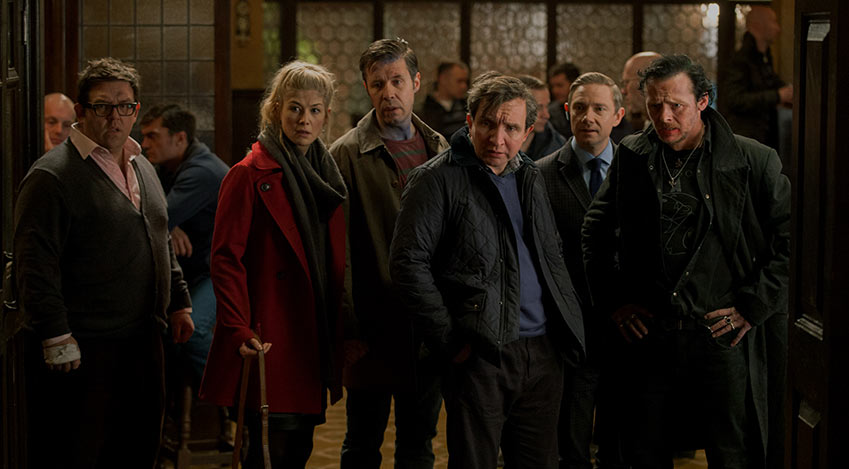
That same trouble-making, lady-loving, drink-guzzling, bad-mouthed rebel is known in this movie as Gary King (Simon Pegg), a poor old sap in rehab who misses the old days and just wants them back again. In order to do this, he reaches out to his old british friends from high school to go and complete “The Golden Mile”, a long pub crawl of twelve different pubs in his old town of Newhaven, where the crawl ends at the most popular pub of all, appropriately called “The Worlds End.”

His friends are now all estranged successful businessmen, but they all lack the energy and perhaps foolhardy excitement that Gary loves to constantly express. Perhaps the best of his friends, however, is one Andy Knighly (Nick Frost), a once-cheerful young fellow, now an old, depressed office worker trying to win back the affections of his wife and children. The last thing he needs is to go on this trip with Gary, but if there’s one thing Andy knows, its that you don’t say no to the King.

They go to their hometown where they started the Golden Mile, and they notice a lot of things have changed since they were last there. Why? Well, that’s because alien robots have taken the town over.

……WHAT?!?!?!? No, dear reader, I am not drunk. Alien robots took over Newhaven, and Gary King discovers this by knocking one’s head off after he slid on his own urine in the bathroom. When he recoups with his friends later on at the bar, they decide that they need to keep going on their route so as not to raise suspicion, and later quietly slip out of town. Sounds pretty simple, right? Not when you have four drunk guys traveling along a total fool. Good luck with that, fellas.

Co-written and directed by Edgar Wright, The World’s End is the birth child of an unofficial trilogy of Pegg, Wright, and Frost’s previous work together, including Shaun Of The Dead and Hot Fuzz. For those who’ve seen those previous movies and are expecting a pompous, outlandish experience just like those pictures, you’re not far off. The World’s End is, by every definition, a ridiculous, ludicrous, and far-out experience, a preposterous and purposefully silly picture to the point where it surpasses being stupid and starts being funny. It’s like those older television skits by Monty Python: they undeniably immature and stupid by nature, but there’s an inherent wit and silliness to them that can’t help but make them so much fun.

Case in point: Simon Pegg and Nick Frost’s chemistry. In the past, their character’s relationship involved a budding romance in a cheesy “You’ve Got A Friend In Me” type of ordeal. Here, the relationship is more strained, almost like Frost is a babysitter and its his turn to supervise little baby Simon so he doesn’t eat sand from the playground. Their characters are hilarious because they’re polar opposites: because Pegg plays the ambitious, over-the-top party boy while Frost is the more conserved, more easily frustrated business man.  Remember the chemistry between John Candy and Steve Martin in Planes, Trains, and Automobiles, where the frustrated business guy (Martin) keeps having to monitor the guy (Candy) who is oblivious, foolish and hopeless? Same case here, although the roles are more or less switched between the two actors.

And then the robots. Oh my God, are they hilarious. In Shaun Of The Dead we had zombies, and in Hot Fuzz we had crooked cops. Now, we have supernatural alien robots, although they hilariously keep insisting that they are not robots because they have sentiment and free will. Anyhow, the funniest thing is how the group reacts to them, tearing off their body parts, whacking themselves with their arms, legs, and anything else they can pull off of their bodies. It’s like someone combined the Lego minifigures with Whack-A-Mole and then decided to throw blue kool-aid somewhere into the mix. Just trust me, it gets messy.

I’m overanalyzing this. The question I should be answering is this: did it make me laugh? The answer: Yes it did, consistently and abundantly, and what’s even more important is that it had something more to offer than simply entertainment. It had a deeper message to tell its audience, and instead of celebrating foolishness and drunkenness, it decided to touch upon a deeper subject involving friendship and true happiness.

I won’t spoil the segment for you, because for me it was the best scene out of the whole movie. I will say this though: most movies, including Project X, 21 And Over, and the dreaded Hangover series take alcoholism and play it out like its fun, like a big party with no consequences or repercussions to the people involved with them. This movie had the opportunity to play it out in that same fashion, but it chose a different direction. It decided to take alcoholism and show it in a more realistic light, maybe even a tragic one. This sequence genuinely touched me, as well as the conversation two characters shared about their life and what exactly they mean to each other. It did more than entertained me: it genuinely surprised me.

As far as comedy and drama goes, I can name a number of films this year that have both made me laugh harder and feel more, among them including the explicit Don Jon, the tamer Monsters University and the other horror-comedy Warm Bodies. Should I take off points, however, if the movie doesn’t match up to the standard of other pictures? The point is that this is a good movie. It had more to offer than just pointless swearing and debauchery: the movie is funny, touching, and original, and there’s a lot of moral truth to it, aside from all of the alien robots mucking everything up.

Tagged , , , , , , , , , , , , , , , , , , , , , , , , , , ,

“FROZEN” Review (✫✫1/2)

The Snow Queen: The Musical

Good news first: Frozen will please its core audience. It’s a cute, cuddly little fairy tale movie with a lot of music and a lot of misplaced optimism. Kids will enjoy it, and there’s a solid chance that the parents might enjoy it too. The bad news: It’s the same Disney Princess movie you’ve seen for the past 50 times now.

Based loosely on the Danish fairy tale “The Snow Queen”, Frozen follows the story of two princess sisters, Anna (Kirsten Bell) and Elsa (Idina Menzel). Being enclosed in a castle all of her life, Anna is a cheery, energetic, happy and overly-optimistic princess who would marry a man after getting to know him for just one day.

Elsa, however, does not have the luxury of being optimistic. Cursed with the ability to create snow and ice at a young age, Elsa has soon realized that she cannot control her powers and decides to escape before she does her kingdom, and her sister, any harm. Now determined to find her sister and mend the relationships that were shattered long ago, Anna sets out with a ice picker named Kristoff (Johnathon Groff), his reindeer Sven and an animate snowman named Olaf (Josh Gad) to find Elsa and save the kingdom.

Written by Jennifer Lee (Wreck-It Ralph) and co-directed by Chris Buck (Tarzan), Frozen is by definition, a family movie. It’s driven by a childish energy, a lively and undiminished spirit that fills children with joy through its wonderful music and its bright, colorful animation.

The characters are enthusiastic (at times, annoyingly so), with the most likable character being a midget snowman called Olaf. Olaf is just funny. He’s the kind of oblivious, clumsy snowman that bumbles around like a lego stick figure, losing his body parts every five minutes, stumbling to get them all back together, and put it on straight before the snow monster eats him. “Go! I’ll distract him!” his head said in one scene as everyone ran away, including his body. “No! Wait! Not you! I was talking to them!”

He also has a ironic fascination to the sun, fire and heat, not realizing what effect they have on snow.

All in all, Frozen is a fun movie. But if you’ve seen Tangled, then you’ve already seen Frozen before. The two movies are so similar, so mirrored in appearance, character, story and animation that the only real difference in between both is that Frozen takes place in a winter wonderland.

See, the problem doesn’t exist in the movie itself: the problem exists in what earlier Disney movies did first and better. Tangled is not the only movie where we’ve seen this story about self-discovery and relationship building. Look at virtually any other Diseny Princess movie on their filmography, including Brave, Mulan, Pocahantus, Princess and the Frog, etc etc. No, none of those movies deals with the theme of sisterhood, but does it need to? Those movies are still so similar in personalities, humor and musical numbers that the story becomes a copy-and-paste convenience rather than an original pleasure.

However, understand that this is not a critical observation of the movie, but rather a neutral one. I stress this point again: this movie will please its core audience, which is little children, the parents of those children and the hardcore Disney lovers. By all means, if you want to see the movie, go ahead and see it. Chances are you’ll enjoy it more than this Scrooge going “Bah humbug” in the corner of the newsroom.

Tagged , , , , , , , , , , , , , , , , , , , , , , , ,

“MY NEIGHBOR TOTORO” Review (✫✫✫✫)

My name isn’t Totoro, kids.  It’s Hayao Miyazaki. 

Now this is what we’re supposed to get when we go in to see an animation picture.  My Neighbor Totoro is everything you expect it to be, and equally as much everything you don’t expect it to be.  This is definitely a kids movie, intended to fulfill the needs of the most innocent and simple-minded of younger viewers.  But this is a rare treasure for adults too, a film that is equally fulfilling and emotionally appealing to older audiences as it is upbeat and joyous for the younger ones.

Taking place in 1950’s Japan, My Neighbor Totoro follows the story of two young sisters named Satsuki and Mei (English dub by Dakota and Elle Fanning), who are moving into their new home with their father Tatsuo (Tim Daly) in order to be closer to their mother in the hospital, Yasuko (Lea Salonga).  Their mother has been sick with an unknown disease for quite some time, and it really concerns the girls because they can’t even get her home for a visit.  Most affected is Satsuki, because her father is always busy, Mei is painstakingly afraid that her mother will leave them, and Satsuki is forced to be the strong one during this time of hardship.

Deep in the forest though, the girls encounter strange beasts of wonder and splendor.  There are these small, darkly black fuzz balls called soot spirits, who hibernate from one dark spot to another.  There are two bunny-like creatures, one white young one who can phase through objects like a ghost, and an older blue one who carries a knapsack of acorns with her everywhere.  Most fascinating though, is a giant, loud, gray beast called Totoro (Frank Welker), a gentle-hearted forest spirit who loves nothing more but to sleep and play on his flute in the silence of the night.  The girls are at first afraid of Totoro’s large, intimidating appearance, but through his gentle, kind-hearted spirit, learn to appreciate him and become friends with Totoro and the forest creatures.

Written and directed by Hayao Miyazaki, My Neighbor Totoro is a rare animated film where the characters are as vibrant and colorful as the beautiful animation that is being expressed on screen.  You really just need to see these little girls in action: they’re one of the most energetic, emotional, endearing, and inspiring little characters I’ve ever seen.  I knew from the first moment I saw them that I would like them: they are these little oddballs of energy, two cute girls who are literally exploding with energy and enthusiasm as they run across the front lawn, or explore the mysteries of their upstairs attic.

The best moments, however, come from when the little girls encounter Totoro.  Looking from a straightforward perspective at Totoro, its a case of what you see is what you get.  He’s a big, fluffy creature who loves to eat, dance, fly, talk (and by talk, I mean roar loudly), and more than anything else, sleep.  If this were any other animated film, I would say the character was another interpretation of Garfield.

I, however, think Totoro is required for more fervent analysis.  I can’t help but look at Totoro like an emotional recompense for the girls, almost like an imaginary friend to distract them from the pain they experience everyday through their sick mother.  Kids with only one parent will know what I’m talking about: when the one you love is in pain or worse, they want everything in the world to distract them from the reality of what they are experiencing.  Its simply too painful for them to take in all at once.  They need something to distract them, to divert them from reality, and so the younger ones try to focus on something fictional that will put their mind at ease, like an imaginary friend for them to talk with.

Totoro reminds me of that imaginary friend.  Unlike an imaginary friend, however, Totoro is real, and this is proven through the interactions he has with the girls.  He is not just a simple-minded, unintelligent forest animal.  He is considerate towards the girls.  He cares for them.  He expresses real and genuine affection for the girls, and he shows this by dancing with them in the middle of the night, growing trees with them in their backyard, or by letting them ride his Cat Bus in cases of emergency.  Even though Totoro is fictional, he’s the most real thing in the movie, taking the girls story filled with hardship and tragedy and filling it with energy, enthusiasm, and life that cannot be faked in a movie.

Every single fiber of me wants to look at this movie and say it is a perfect film, but something stops me.  What is it?  It certainly isn’t the characters, the animation, the story, or the emotion being expressed on screen.  What is it then, if its none of the above?

Of course, I think.  Accessibility.  The weakness with this film, much like the stark foreign language films and the ancient black-and-white silent films, is that it strictly appeals to a certain audience.  You know what I’m talking about: what is the typical american viewer going to see, a boisterous and explosive action movie with big name actors starring in it, or some independent animated film made by some guy whose name they can’t even pronounce?  The weakness here is this: people who don’t like anime won’t like it, and probably shouldn’t see it, because this film mainly appeals to that same audience and culture through its story and through its execution.  Because of that, Totoro will lose some viewers in its audience.

But even then, is that the fault of the filmmaker for not conforming to their tastes, or the audiences for not being open about it?  Regardless of what you think, My Neighbor Totoro is a magical little film, an uplifting and wonderful fantasy that taps into the inner child in all of us, and in many ways reflects the behavior of children: animate, lifelike, endearing, sincere, and visually expressive.  It’s a movie whose characters are so precious and lifelike that a live-action portrayal couldn’t have been as real as this.  It’s a film that allows us to believe in miracles, even if we don’t necessarily believe in them.  And at the heart of it all is Totoro, a warm, fluffy forest spirit that only loves children more than he does sleeping on his favorite moss bed.

Tagged , , , , , , , , , , , , , , , , , , , ,

“SNOW WHITE AND THE HUNTSMAN” Review (✫✫✫)

And thank you, Thor, for keeping up appearances.

Take a deep breath and say it with me: Snow White And The Huntsman.  Doesn’t sound very promising, does it?  Like most fantasy films, Snow White And The Huntsman seemed set up for failure.  It’s centered around a very popular character portrayed by Bella Swan, the film is based around a fairy tale known universally in every person’s mind, and it seemed tempted to fall for a formula and let down its audience.  Believe me, that was the movie I was expecting when I went into the theater.  The movie, however, is much better than the title suggests.

Based on the famous original fairy tale by brothers Grimm, Snow White And The Huntsmanfollows the story of Snow White (Kirsten Stewart), a kind and beautiful princess of the land Tabor who would one day inherit the kingdom and the throne from her father King Magnus (Noah Huntley).  Before she was born, the narrator tells us that her mother pricked her fingers on a rose outside of her castle, with three drops of blood staining the snow.  Her mother told herself that she wanted a daughter as white as the snow, lips as red as the blood, and a spirit as strong and defiant as the rose she prickled.

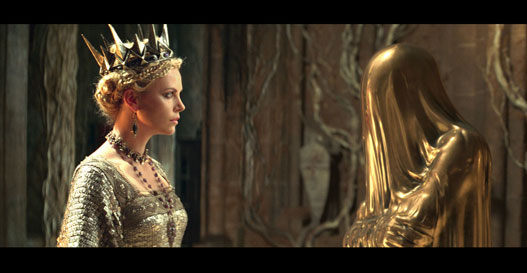
This opening sequence was both fascinating and revealing, a deeper introspect into Snow White’s history that I don’t believe has been visited before.  Her mother eventually died giving birth to Snow White, and so King Magnus marries a strikingly beautiful woman named Ravenna (Charlize Theron), whom he rescued from a dark army made out of glass soldiers that tried to invade his kingdom.  Magnus is so stricken by Ravenna’s beauty, in fact, that she becomes his queen in less than two days.

You already know where this is going, don’t you?  Ravenna is, in fact, the dark and conniving witch leader of the dark army.  After killing Magnus in his bed, she takes Snow White, forces her into the upstairs dungeon, and seizes power over the kingdom as the newly appointed Queen of Tabor.

Years past, and the kingdom of Tabor falls into desolation and poverty.  Snow White has now become of age to become the new queen of Tabor, and has been blessed with the gift of kindness that will ultimately dethrone Ravenna from the throne.  Snow White eventually escapes from the dungeon, flees from Ravenna, and escapes into the dark forest, a place where people slowly lose their sanity and, in time, their life.

Raevenna cannot go to this place to kill Snow White, so she hires somebody who can: a huntsman by the name of Eric (Chris Hemsworth), a man who lost his wife to death’s hand long ago.  Nothing could convince this angry, tired old drunk to take this job willingly, but he takes the job nonetheless in the hopes of that the evil witch can revive his dead wife with her dark powers.  And so the adventures of Snow White and the Huntsman begin.

The biggest thing Snow White And The Huntsman has going for it is two things: its visuals and its handling of the premise, in that exact order.  Rubert Sanders, who is making his director debut through this picture, is very smart and very careful with his visuals, using very precise and expertly-detailed CGI in things like the Magic Mirror or in the dark army made out of glass.  But it isn’t just the visuals that makes the picture what it is: Sanders is smart enough to make the visuals mean something, and just like the camera he’s using to record the picture, the visuals are a tool he uses to tell a story and to instill some deeper meaning in the audience.

Take, for example, how Sanders uses the color of white in the picture.  The color itself only appears three times in the picture: once where Snow White rides and abandons a white horse on the beach, another time where she encounters and caresses a magnificent and beautiful white stag, and the last one being where she dies and is resurrected while being in a white funeral dress.  Go back and look at the pictures again and try to look at it through a more symbolic scope.  I promise you, if you see the picture as I do, you will see a princess abandoning her kingdom, returning to her kingdom, and finally, becoming the queen and leader that the kingdom deserves.

To find such complexion in a picture as this was both shocking and surprising, and the cast delivers just as much as the visuals do. Charlize Theron was menacing, evil, and conniving as the dark witch, and gives a stellar performance that would have had the animated version relieving in her pants.  Stewart, shockingly, is very grounded in her take as Snow White, and embodies everything her mother says she has: strength, beauty, courage, kindness, and heart, and this especially shows in the last half hour of the picture.  Hemsworth was equally as emotional and convincing as the huntsman named Eric, although there are a few brief moments where he breaks character and acts more like Thor from The Avengers.

There was another Snow White movie released earlier this year called Mirror Mirror, and it starred the lovely Lily Collins and Julia Roberts in roles opposite Stewart and Theron.  That movie was too silly and immature for its own good.  Here, we have the opposite problem: this film is dreary, dark, sullen, and bleak, a movie that for the first half of its runtime, fills us with dread, angst,  and sorrow.  Starkly different tone from the whimsical, uplifting veins of the original Disney classic don’t you think?  Whatever happened to Doc, Grumpy, Happy, Sleepy, Bashful, Sneezy, and Dopey?

Still, its a good movie.  When there is color in the picture, it reaches out to you in striking detail, the cast is extremely strong, and the visuals and the camera angles combine to make a very provocative picture and a very sharp visual experience.  All you need left is Mjolnir and the rest of the Avengers, and you’ll be all set.

Tagged , , , , , , , , , , , , , , , , , , , , , ,

“PAN’S LABYRINTH” Review (✫✫✫✫)

The perfect blend of fantasy and reality. 

Now here’s one you’re not going to be expecting.  Here is a spanish-language fantasy film that blends elements of reality and war drama with that of horror and psychological thrillers.  It’s rated R with a healthy amount of blood, violence, and language, it has a child as its lead character, and it is a fantasy film with no cuddly creatures and no misplaced sense of optimism.  It’s also in spanish, one of my most frustrating languages.  And it is also probably one of the best films of its kind.  Maybe the only one of its kind.

Written and directed by spanish filmmaker Guillmo Del Toro, Pan’s Labyrinth is a post-Spanish civil war story about a young girl named Ofelia (brilliantly portrayed by Ivana Bacquero), who is fascinated and enticed by the many stories and fables she finds in her books and novellas.  Her mother, Carmen (Ariadna Gil) is pregnant with her unborn brother, and they have been ordered to move to an outpost located on the outskirts of Mexico so the boy can be born next to his father: Captain Vidal (Sergi Lopez), a cruel and heartless product of war that knows nothing of decency, morality, kindness, or human life.  This is a man who would kill a father and his son thinking that they lied about being hunters, and a second later pulls out their quarry in the bottom of their knapsack.

This is the situation Ofelia is trapped in: the cruelty and strictness of Captain Vidal, and the negligence and weakness of her pregnant mother.  In the stories that she reads, however, Ofelia finds escape: she soon discovers a cave hidden deep within the gardens of the outpost, unnoticed to the human eye.  It is here deep within the cave where she finds odd inscriptions, a plethora of fairies, and even an anonymous Faun (Portrayd by Doug Jones, voiced by Pablo Adan), who informs her of her true destiny: that she is the lost princess Moanna of their sacred kingdom, and she must complete three specific assignments tasked by the Faun in order to become a princess once again.

This is the kind of story Pan’s Labyrinth is: the kind that deftly blends elements of wondrous fantasy with that of tragic reality.  This is rare treasure for foreign-language cinema: a film that while it is visually expressive, it is also a deep and personal commentary on the tragedies of war and its effects on a torn country.  Del Toro has elaborated on such subjects before: his 2001 film The Devils Backbone also took place during the Spanish Civil war, and it also featured a child in great distress.  Here though, I feel that he has a better handling of his premise, and if it is not better, it is at least more creative and dynamic in approach.

The visuals reach out in stellar, gritty, and striking details, the fairies light and whimsical, the faun towering, ancient, and brutish.  There are so many visually stunning scenes in this movie, at times it is overwhelming.  Del Toro, with the help of his cinematographer Guillermo Navarro, do something rare here: they paint a world here as fascinating as it is dangerous, a mesmerizing and gripping world that hypnotizes you with its appeal and its imagination.  One might say Pan’s Labyrinth is an adult version of Alice In Wonderland: I disagree with that.  I think this is the realistic version of Alice In Wonderland.

Why do I say this?  It might be because the movie is very deserving in its R rating.  Besides the occasional F-word uttered in spanish, there is a great deal of gore and violence in the movie, some of it aimed towards children.  I’ll be the first to admit, Pan’s Labyrinth is heavy on violence.  People are shot frequently in the film, often in very bloody manners.  People’s limbs get cut off.  In once scene, a man smashes a farm boy’s nose in with the butt of an alcohol bottle.  And in one terrifying scene, Ofelia is fleeing capture from a pale man-eating monster, who proves his monstrosity by biting the heads off of the fairies assisting her.  Don’t take your kids to this, folks: the movie is extremely violent.

While I would normally take points of a film for using excessive violence, here I believe it is warranted.  Through every gunshot, through every murder, and through every droplet of blood, Del Toro is saying something provocative about war and innocence, most of it being things we need to hear of.  I don’t believe Pan’s Labyrinth is just memorable, stunning, and poignant entainment: I believe it is relevant storytelling.

And at last, we come to the films conclusion, which is so mesmerizing and emotionally overpowering that we don’t know what to make of it.  Did Ofelia complete all of her tasks?  Was the Faun telling the truth?  Did she become the fabled princess?  Was it all a ruse?  Or did she simply become a victim of the earthly world from which she was born of?  The ending is eloquent, vast, and beautiful, open for many possible interpretations.  You decide which one fits you best once you see the movie.

Tagged , , , , , , , , , , , , , , , , , , , , , , ,