Tag Archives: Drama

“SNOW WHITE AND THE HUNTSMAN” Review (✫✫✫)

And thank you, Thor, for keeping up appearances.

Take a deep breath and say it with me: Snow White And The Huntsman.  Doesn’t sound very promising, does it?  Like most fantasy films, Snow White And The Huntsman seemed set up for failure.  It’s centered around a very popular character portrayed by Bella Swan, the film is based around a fairy tale known universally in every person’s mind, and it seemed tempted to fall for a formula and let down its audience.  Believe me, that was the movie I was expecting when I went into the theater.  The movie, however, is much better than the title suggests.

Based on the famous original fairy tale by brothers Grimm, Snow White And The Huntsmanfollows the story of Snow White (Kirsten Stewart), a kind and beautiful princess of the land Tabor who would one day inherit the kingdom and the throne from her father King Magnus (Noah Huntley).  Before she was born, the narrator tells us that her mother pricked her fingers on a rose outside of her castle, with three drops of blood staining the snow.  Her mother told herself that she wanted a daughter as white as the snow, lips as red as the blood, and a spirit as strong and defiant as the rose she prickled.

This opening sequence was both fascinating and revealing, a deeper introspect into Snow White’s history that I don’t believe has been visited before.  Her mother eventually died giving birth to Snow White, and so King Magnus marries a strikingly beautiful woman named Ravenna (Charlize Theron), whom he rescued from a dark army made out of glass soldiers that tried to invade his kingdom.  Magnus is so stricken by Ravenna’s beauty, in fact, that she becomes his queen in less than two days.

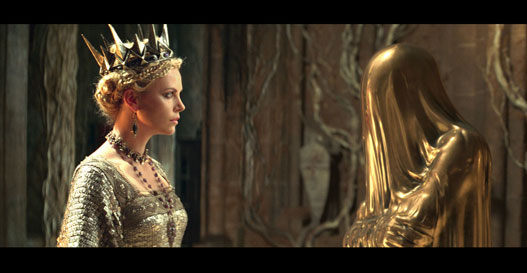
You already know where this is going, don’t you?  Ravenna is, in fact, the dark and conniving witch leader of the dark army.  After killing Magnus in his bed, she takes Snow White, forces her into the upstairs dungeon, and seizes power over the kingdom as the newly appointed Queen of Tabor.

Years past, and the kingdom of Tabor falls into desolation and poverty.  Snow White has now become of age to become the new queen of Tabor, and has been blessed with the gift of kindness that will ultimately dethrone Ravenna from the throne.  Snow White eventually escapes from the dungeon, flees from Ravenna, and escapes into the dark forest, a place where people slowly lose their sanity and, in time, their life.

Raevenna cannot go to this place to kill Snow White, so she hires somebody who can: a huntsman by the name of Eric (Chris Hemsworth), a man who lost his wife to death’s hand long ago.  Nothing could convince this angry, tired old drunk to take this job willingly, but he takes the job nonetheless in the hopes of that the evil witch can revive his dead wife with her dark powers.  And so the adventures of Snow White and the Huntsman begin.

The biggest thing Snow White And The Huntsman has going for it is two things: its visuals and its handling of the premise, in that exact order.  Rubert Sanders, who is making his director debut through this picture, is very smart and very careful with his visuals, using very precise and expertly-detailed CGI in things like the Magic Mirror or in the dark army made out of glass.  But it isn’t just the visuals that makes the picture what it is: Sanders is smart enough to make the visuals mean something, and just like the camera he’s using to record the picture, the visuals are a tool he uses to tell a story and to instill some deeper meaning in the audience.

Take, for example, how Sanders uses the color of white in the picture.  The color itself only appears three times in the picture: once where Snow White rides and abandons a white horse on the beach, another time where she encounters and caresses a magnificent and beautiful white stag, and the last one being where she dies and is resurrected while being in a white funeral dress.  Go back and look at the pictures again and try to look at it through a more symbolic scope.  I promise you, if you see the picture as I do, you will see a princess abandoning her kingdom, returning to her kingdom, and finally, becoming the queen and leader that the kingdom deserves.

To find such complexion in a picture as this was both shocking and surprising, and the cast delivers just as much as the visuals do. Charlize Theron was menacing, evil, and conniving as the dark witch, and gives a stellar performance that would have had the animated version relieving in her pants.  Stewart, shockingly, is very grounded in her take as Snow White, and embodies everything her mother says she has: strength, beauty, courage, kindness, and heart, and this especially shows in the last half hour of the picture.  Hemsworth was equally as emotional and convincing as the huntsman named Eric, although there are a few brief moments where he breaks character and acts more like Thor from The Avengers.

There was another Snow White movie released earlier this year called Mirror Mirror, and it starred the lovely Lily Collins and Julia Roberts in roles opposite Stewart and Theron.  That movie was too silly and immature for its own good.  Here, we have the opposite problem: this film is dreary, dark, sullen, and bleak, a movie that for the first half of its runtime, fills us with dread, angst,  and sorrow.  Starkly different tone from the whimsical, uplifting veins of the original Disney classic don’t you think?  Whatever happened to Doc, Grumpy, Happy, Sleepy, Bashful, Sneezy, and Dopey?

Still, its a good movie.  When there is color in the picture, it reaches out to you in striking detail, the cast is extremely strong, and the visuals and the camera angles combine to make a very provocative picture and a very sharp visual experience.  All you need left is Mjolnir and the rest of the Avengers, and you’ll be all set.

Tagged , , , , , , , , , , , , , , , , , , , , , ,

“THE LAST STAND” Review (✫✫)

Stuff blowin’ up real good in Redneck City. 

The Last Stand is an actioneer’s action movie, a film so overstuffed with explosions, gunshots, profanity and testosterone that it might have been more appropriate as a video game rather than a movie. I had a friend of mine describe the movie as being “The guyest guy guy movie you’re ever going to see”. That much is true. Whether its the best one, or even a good one, is up to you.

Sheriff Ray Owens (Arnold Schwarzeneggar) has been the sheriff of Summertown for many years now after having quit his profession of being a cop in Los Angeles.  Summertown is a quiet place, a small town where crimes range from the Mayor parking his car in a fire lane to deputies firing at slabs of meat during lunch time.  In a small, quiet town such as this, Ray finds little excitement in his day to day routines and he is perfectly fine with that.

But one day, he receives unwelcome news from the FBI: a nation-wide criminal named Gabriel Cortez (Eduardo Noriega) escaped from the FBI’s hands and is fast on his way to the Mexican border, where he will be out of the FBI’s reach.  The only thing blocking his path: Summertown, which also sits on the United States border to Mexico.  Owens now has to rise up to the challenge to defend his home.  To defend its citizens.  This is the last stand.

This is Arnold’s first lead role after his 10 year hiatus as California’s governor.  Before that hiatus, Arnold was a standout in a slew of memorable action roles, including (but not limited to) Predator, Total Recall, True Lies, Last Action Hero, and my personal favorite, The Terminator and its sequel.  All of those movies are memorable, exciting, suspenseful, and sport great blockbuster entertainment.

Now look at The Last Stand.  This movie cannot help but look shoddy compared to those titles because of its plot, its only inconsistently funny and exciting, and whats worse, it depends on the forumula of repetitive action.  Wonderful.  We certainly don’t get enough of those, now do we?

Let’s take a deeper look at Arnold real quick.  The man has had a great career.  Before going into office, he was asked to be in these tense, highly riveting action roles, and he was damn good in all of them.  Now, he’s been dilluted to just standing tall and read lines as everyone else turns to him asking what to do when a drug cartel is ready to tear through his town.  Guys, come on.  This is the 42nd governor of California, not Angus MacGyver.

The rest of the characters aren’t really that helpful or compelling.  Zach Gilford portrays Officer Jerry, a guy who wants to see more action than he does but then gets his nose broke by the recoil of a gun.  Luis Guzman plays as a chubby mexican officer, and he’s so stereotypical he might as well have been portrayed by Anthony Anderson.  Rodrigo Santoro and Jaimie Alexander share a forced romantic conflict in the middle of all the bullets and gunfire, and while they’re coincidentally dodging all of the bullets amist their kissing, all I could think to myself was “Hey kids!  Find a shower!”

The worst miscalculation, however, is in the film’s villains: Eduardo Noriega as Gabriel Cortez and Rodrigo Santoro as his goatee, ponytail lackey.   Noriega is worthless as the main villain, and is just stuck to driving a car recklessly for more than two-thirds of the movie until the last 20 minutes where the climax calls for a chase scene.  But even worse is his lackey, who seems completely lacking basic motivation of reasoning behind his actions.

Take a look at the only three things he does in the movie: kill a farmer, build a bridge over to Mexico, and strike a raid across Arnold’s town.  Explain to me A) Why he killed the farmer and clued the detectives into his plan, considering the construction of the bridge was nowhere near the farmland, B) How the bridge to Mexico only took around 24 hours to complete, C) Why waste resources building a bridge when he can just bring in a helicopter for the escape, and D) What is the relevance for attacking the town when it means nothing toward Cortez’s escape?  His actions seem senseless, almost like his decisions are delegated by the script just for the sake of action sequences and explosions.  Why must an action film like this seem so mindless, so pointless in its structure and so artificial in its writing?

The film’s most entertaining character is a man named Lewis Dinkam, portrayed by Jackass star Johnny Knoxville.  Highlight, embolden, and underline Jackass.  This guy is the opitimy of stupid, most of it portrayed humorously so.  This guy is an absolute psycho, shooting off pistols and machine guns named “Betty” and “Nazi Killer” with his pajamas on and tearing off electric polls by climbing them and chainsawing the electric wire.  Is he the smartest character in the bunch?  No, but he is the funniest, although I don’t understand why he’s wearing a woolly hat in the middle of the summer.

Ultimately, I’m at a loss with The Last Stand.  There’s no doubt entertainment value here, but it is severrely misguided, almost like a misfired Colt.  Half of the film is used to just set up its premise with predictable scripting and bad acting, while the other half is used for repetitive and monotonous action, gunshots, and F-bombs.

“But David”, one fellow viewer pointed to me, “That’s entertainment!  People need entertainment because real life sucks!”  This is true that people need entertainment, and The Last Stand will satisfy some viewers.  For others however, they will be left yearning for a better story, more original action, and a more worthwhile experience.  In the meantime, what you see is what you get: if its action you want, boy oh boy, it action what you’re going to get.

Tagged , , , , , , , , , , , , , , , , , ,

“AMERICAN PSYCHO” Review (✫)

Sex, murder, and the decrease of the human condition.  

American Psycho is a vile, sickening experience, a gruesome and aching film incapable of human thought, feeling, comfort, or emotion.  This shouldn’t come as too much of a surprise considering the book in which it is based on inspired this same controversy.  Regardless, its achievement cannot be denied: the filmmakers have somehow concocted an experience as brutal, uncomfortable, disturbing, half-lapsed, misogynic, and morally reprehensible as this that they’ve come to completely disconnect with their audience.  I rarely feel this upset about a movie like this.

American Psycho follows the story of Patrick Bateman (Christian Bale), a successful businessman who works in his high-level office by day and parties fiendishly with his friends by night.  On the surface, Bateman looks like a normal upper-class bachelor.  He eats out at expensive restaurants, drinks exquisite martinis, has sex with beautiful women, enjoys swearing gleefully with his friends, and listens to a variety of experimental music.  In appearance, Bateman is the visible representation of the upper class: stoic, upright, eloquent, fashionable, and spoiled.

As the plot progresses, however, we come to understand more about the darker side of Bateman’s personality.  He doesn’t just have sex with beautiful women: he mutilates them.  He tortures them and fantasizes about killing them in horrible ways and playing with their bodies after he’s done dismembering them.  His kitchen pantry contains axes, blades, and tools he uses for his killings.  He draws his victims in a notebook he leaves at work.  A female head sits next to his ice cream in the freezer.  If there wasn’t wine in his alcohol bottles, it would probably be blood.

Ugh.  Just talking about the premise nauseates me.  Why do we need to experience this?  Bateman is a sickening character, a man who would dismember the head of one unfortunate female and chew off the genitals of another.  Why?  For what purpose?  His motivations are never explained in the movie and his reasonings for murdering women are a mystery to us.  Is there a reason for this?  Is there a reason for being so non-inclusive with your audience? Why must everything be shrouded in secrecy?

This is the film’s biggest problem, besides the violence and the sexuality: Patrick Bateman is a deplorable character, difficult to understand and impossible to sympathize with.  You might think its impossible to sympathize with a murderer of women anyway, but it isn’t really.  We’ve ben asked to sympathize with deplorable characters before, including a psychotic war veteran in Taxi Driver to ruthless murderers and drug dealers in Goodfellas.  Sympathy and interest worked with those characters because one character was struggling to find a line of morality and righteousness to follow, and another was hesitant and even regretful over the actions that he’s done.

Bateman doesn’t regret his decisions nor chooses to change them.  He kills instinctively, almost like he’s trying to prove some territorial point to the people around him.  To put it out there in gruesome, violent fashions like this though is just torturous.  Who wants to sit there, eyes on the screen, watching him laughing as a petite blond girl in front of him cries pleading for her life?

But American Psycho isn’t just sickening, repulsive, and pungnent: the film’s logic is half-lapsed, incomplete, and flawed, incomprehensible to the viewer and extremely frustrating to those trying to figure out.

I’ll give you an example.  There’s one scene where’s Bateman is chasing one of his victims through the hallways of a hotel, half naked, screaming manically, and revving his chainsaw like Leatherface from Texas Chainsaw Massacre. Someone explain to me how no one from the hotel hallway heard the ruckus from outside their rooms, or anyone from the two floors above and beneath him?  Here you have Jack Torrence running through the hallways screaming at the top of his lungs with a lawn mower, and nobody even bothers to call the police.  What?  Are the wooden doors sound-proof?  Who knows, maybe they’re afraid of poking their heads out the door so that they won’t get their heads chopped off.

Due to a revelation revealed later on in the plot, one could argue this is a “dream sequence”, or a “vision” Bateman had.  But how is there any way to know?  With Bateman’s maniacal, wretched mind, dreams feels like reality and reality feels like dreams.  How is there any way to read the subtext when you’ve made your narrative so damn hard to figure out?

And this is a movie that is being hailed as a dark comedy.  A comedy for what, exactly?  The film is two graphic hours of bloody, sickening, gruesome violence and pornography.  When, at any point, is it set up to inspire laughs?  In movies like Pulp Fiction and Fight Club we are at least given subtle moments of clever dialogue to clue us in to the humor, and even though stomach-curling things are happening on screen, we are able to suspend that  briefly in order to enjoy the humor.

American Psycho is not subtle, smart, clever, humorous, or any of the related adjectives.  There’s a point director Mary Harron is trying to express through the film, but that point is convoluted, vague and shockingly illiterate.  As a result, what we’re ultimately watching is an idle, pointless, and misconstrued film, and our reward for watching is hours of punishment, nudity, sexual immorality, blood, torture, macabre violence, and sickening indecency.  To be fairly honest, I probably need a second viewing in order to fully understand the picture, but the plain fact is that the movie doesn’t deserve a second viewing.  If I end the film feeling as punished and as mutilated as Bateman’s unfortunate victims, why on earth would I want to subject myself to that again?

At the end of the film, Bateman himself admits that he finds neither closure nor catharsis for his bloody, violent, sexually immoral and murderous journey.  For that matter, neither do we.

Tagged , , , , , , , , , , , , , , , , , , , , ,

“PAN’S LABYRINTH” Review (✫✫✫✫)

The perfect blend of fantasy and reality. 

Now here’s one you’re not going to be expecting.  Here is a spanish-language fantasy film that blends elements of reality and war drama with that of horror and psychological thrillers.  It’s rated R with a healthy amount of blood, violence, and language, it has a child as its lead character, and it is a fantasy film with no cuddly creatures and no misplaced sense of optimism.  It’s also in spanish, one of my most frustrating languages.  And it is also probably one of the best films of its kind.  Maybe the only one of its kind.

Written and directed by spanish filmmaker Guillmo Del Toro, Pan’s Labyrinth is a post-Spanish civil war story about a young girl named Ofelia (brilliantly portrayed by Ivana Bacquero), who is fascinated and enticed by the many stories and fables she finds in her books and novellas.  Her mother, Carmen (Ariadna Gil) is pregnant with her unborn brother, and they have been ordered to move to an outpost located on the outskirts of Mexico so the boy can be born next to his father: Captain Vidal (Sergi Lopez), a cruel and heartless product of war that knows nothing of decency, morality, kindness, or human life.  This is a man who would kill a father and his son thinking that they lied about being hunters, and a second later pulls out their quarry in the bottom of their knapsack.

This is the situation Ofelia is trapped in: the cruelty and strictness of Captain Vidal, and the negligence and weakness of her pregnant mother.  In the stories that she reads, however, Ofelia finds escape: she soon discovers a cave hidden deep within the gardens of the outpost, unnoticed to the human eye.  It is here deep within the cave where she finds odd inscriptions, a plethora of fairies, and even an anonymous Faun (Portrayd by Doug Jones, voiced by Pablo Adan), who informs her of her true destiny: that she is the lost princess Moanna of their sacred kingdom, and she must complete three specific assignments tasked by the Faun in order to become a princess once again.

This is the kind of story Pan’s Labyrinth is: the kind that deftly blends elements of wondrous fantasy with that of tragic reality.  This is rare treasure for foreign-language cinema: a film that while it is visually expressive, it is also a deep and personal commentary on the tragedies of war and its effects on a torn country.  Del Toro has elaborated on such subjects before: his 2001 film The Devils Backbone also took place during the Spanish Civil war, and it also featured a child in great distress.  Here though, I feel that he has a better handling of his premise, and if it is not better, it is at least more creative and dynamic in approach.

The visuals reach out in stellar, gritty, and striking details, the fairies light and whimsical, the faun towering, ancient, and brutish.  There are so many visually stunning scenes in this movie, at times it is overwhelming.  Del Toro, with the help of his cinematographer Guillermo Navarro, do something rare here: they paint a world here as fascinating as it is dangerous, a mesmerizing and gripping world that hypnotizes you with its appeal and its imagination.  One might say Pan’s Labyrinth is an adult version of Alice In Wonderland: I disagree with that.  I think this is the realistic version of Alice In Wonderland.

Why do I say this?  It might be because the movie is very deserving in its R rating.  Besides the occasional F-word uttered in spanish, there is a great deal of gore and violence in the movie, some of it aimed towards children.  I’ll be the first to admit, Pan’s Labyrinth is heavy on violence.  People are shot frequently in the film, often in very bloody manners.  People’s limbs get cut off.  In once scene, a man smashes a farm boy’s nose in with the butt of an alcohol bottle.  And in one terrifying scene, Ofelia is fleeing capture from a pale man-eating monster, who proves his monstrosity by biting the heads off of the fairies assisting her.  Don’t take your kids to this, folks: the movie is extremely violent.

While I would normally take points of a film for using excessive violence, here I believe it is warranted.  Through every gunshot, through every murder, and through every droplet of blood, Del Toro is saying something provocative about war and innocence, most of it being things we need to hear of.  I don’t believe Pan’s Labyrinth is just memorable, stunning, and poignant entainment: I believe it is relevant storytelling.

And at last, we come to the films conclusion, which is so mesmerizing and emotionally overpowering that we don’t know what to make of it.  Did Ofelia complete all of her tasks?  Was the Faun telling the truth?  Did she become the fabled princess?  Was it all a ruse?  Or did she simply become a victim of the earthly world from which she was born of?  The ending is eloquent, vast, and beautiful, open for many possible interpretations.  You decide which one fits you best once you see the movie.

Tagged , , , , , , , , , , , , , , , , , , , , , , ,

“ARGO” Review (✫✫✫✫)

“Argo”: The science-fiction epic that didn’t exist

In 1980, political instability and rebellion shook the grounds of Iran, a once prosperous city run dry by the greed and evil of its former shah, Mohammad Pahlavi.  When the U.S. agreed to house Pahlavi in southern California after he contracted cancer, the Iranian people stormed the U.S. Embassy in a furious rage and took everybody inside hostage.  Only six Americans escaped with their well-beings intact.

This is the true story of Argo, a political thriller based on the Iranian hostage crisis of 1980.  After barely escaping the U.S. embassy just before it is overran by Iranians, the Americans flee and take refuge inside Canadain Ambassador Ken Taylor’s (Victor Garber) house as social and political stability continues to crumble outside of the Taylor household. They remain stuck there for 69 days.

Enter the CIA. The intelligence agency plots ways to try and rescue the Americans and get them home to safety, but no luck. Their best ideas involve riding bicycles and meeting them at the border with gatorade. All hope seems lost until Tony Mendez (Ben Affleck) hatches the idea of disguising the American’s as a film crew scouting for locations out in Iran. As the Secretary of State asks Tony Mendez, “You got any better bad idea than this?”

“This is the best bad idea we have sir. By far.”

Here is a movie that knows how to utilize suspense and tension to the fullest effect. Similarly to how Kathryn Bigelow sets up the stakes of the film within the establishing shot of the 2009 best picture winner The Hurt Locker, Argo similarly sets up its stakes with a tense, horrifying sequence of the Iranians overrunning the U.S. Embassy in the beginning shot. They jump over walls and tear down the gates as they storm through the front lawn. They break through doors and windows as they charge into the building, screaming as they hold up picket signs and crow bars. They bind their hostages in rope and cloth as they grab and shake them all while screaming into their ears and breaking furniture around them. In the world of film, the goal is to put audiences into the scene, into the moment of the picture. We are not just put into the environment of Iran in Argo: we are immersed in it.

At the same time though, this is a movie that knows how to expertly balance drama with humor and comedy. Two essential roles in this movie help achieve this: John Goodman as make-up artist John Chambers, and Alan Arkin as movie producer Lester Seigel. These two are the C-3PO and R2-D2 of filmmakers, a duo who argue and bicker over the smallest, funniest of details. In one scene where they were looking over scripts for the operation, Lester complains as to how they are all of poor quality.

John: “We’re making a fake movie here.”

Lester: “If we’re making a fake movie, I want it to be a fake hit.”

This is one of those rarities of films where it transcends merely being labeled as a “movie” and has graduated to being something as an “experience”.  Argo is a tense, nerve-wracking film.  It keeps you on the edge of your seat, cringing, waiting, teeth chattering, spine tingling with every tense moment of the film pulsating through your entire body.  Ben Affleck directs this film with alluring precision, utilizing jump-cuts and precise cutaways to the greatest effect during this American horror that is a true story.

Very few films match the precision and craftmanship that this film possesses.  Combine that with the film’s smart, witty dialogue, as well as its great spirit for humanity, and what you have is one of, if not, the best drama film of the year.

Tagged , , , , , , , , , , , , , , ,

“LIFE OF PI” Review (✫✫✫)

A boy, a boat, and his bengal tiger.  

If there is any film that will stick out in your mind more than any other film in 2012, its going to be Life Of Pi.  How could it not be?  With spectacular visuals, daring execution, and a solid story, Life Of Pi may very well be one of the most memorable experiences of the year, even though that doesn’t strictly mean it is of the highest standard in movies.

Based on the novel of the same name by Yann Martel, Life Of Pi follows the story of Pi “Piscine” Patel (Suraj Sharma), a young indian boy who is a believer in many religions, including Hinduism, Christianity, and Islam.  To Pi, all of these religions lead to the same path: a greater understanding and relationship with God.  In one wonderful moment of the film, he described faith like a mansion, with room for both belief and doubt on every floor.

Besides being a follower of many faiths, Pi’s family also runs a local zoo in India, an exotic place filled with vibrant species and animals of all kinds.  Most significant to Pi is a 450-pound bengal tiger named Richard Parker, who got his name after the hunter tha caught him switched the names around by accident, with the hunter’s name appearing on the sheet as “Thirsty”.  The name stuck on Richard Parker ever since.

Eventually, the day has come where Pi’s family can no longer support themselves in India and have to move themselves and the animals to Canada, where they can hopefully find a living and start anew.  But when the ship his family and livestock are on crashes and sinks into the Pacific Ocean, Pi ends up stranded on a lifeboat all alone with Richard Parker. Now, armed with little more than a life-vest and the clothes on his back, Pi must find a way to not only co-exist with Richard Parker, but to also find a way to tame him and stay alive in the lonely abyss of the ocean.

The best thing about this movie is its faithfulness to the original novel, in how it portrays Pi as a strange, introverted, religiously diverse human being but also a spiritually focused young adult.  Pi’s story is a unique one, with the film dwelving into his story with such emotional maturity and observation, that we cannot help but understand Pi and his spiritual connection to God.

I especially loved one line Pi said to a friend at one point at the film, but when looking at it through a closer lens, maybe he was saying it more to himself:

“Even when God seemed to have abandoned me, he was watching.  Even when he seemed indifferent to my suffering, he was watching. And when I was beyond all hope of saving, he gave me rest. Then he gave me a sign to continue my journey.”

I also like the connection Pi shares with this 450-pound man-eating animal named Richard Parker: dare I say they have chemistry with one another? Yes I can, because the tiger is rendered here with such precision and detail that he actually looks like a living, breathing man-eating animal, not just another CGI creation. The rest of the movie is no exception, as it takes us  through many wonderfully dazzling visual moments that are just as impressive as when we watched James Cameron’s Titanic for the first time.

Here is, truthfully, a genuinely good movie.  The score is settling, ambient, and beautiful.  The visuals are transcendent, amazing, and stunning.  And the underlying context Ang Lee adapts from Yann Martel’s novel retains its strength, as Lee knows how to balance emotional relevance with visual splendor.

Unfortunately, the greatest strength of this film is also its greatest weakness: it follows too closely to the original novel.  Thinking back to when I read the book back in high school, I remember a story that was ambitious, daring, creative, deep, emotional, spiritual, and unique all at once.  It wasn’t just another survival-fantasy-advenure: it was a spiritual journey that has as much to do with faith and God as it does with friendship and sacrifice.

The movie doesn’t reach into this idea as deeply as the book does.  That’s to be expected, considering books are typically more in-depth than their movie counterparts.  Still though.  Haven’t other book-to-movie adaptations benefitted moreover their novel counterparts when they branched out and embraced other possibilities the original writers didn’t?

I bring two other novel adaptations from earlier this year as an example: The Hobbit and The Hunger Games.  Those movies, unlike Life Of Pi don’t just retell their stories: they rework them.  They change it to better fit their narrative, and they expand upon the stories they are helping to re-create within their own cinematic universes.

Life Of Pi doesn’t do that.  It relies too heavily on its novel-based counterpart, it refuses to branch out any more than the pages of Yann Martel’s novel will allow it to, and it has one of the slowest beginnings ever known to mankind.  The scenes where an older Pi converses with a young novelist searching for a story were especially unnecessary: why not just replace thirty-minutes of exposition with a simple narrative voice-over?

Again, I will stress this: Life Of Pi is the most memorable film of the year.  That does not mean that it is the best film of the year, and that does not mean that everybody will enjoy it.  It just simply means that when somebody watches the movie, it will mean something to them.  Whether that’s a good or bad thing remains to be seen.

Still though, to have a movie that actually says something for a change is significant enough.  Take the ocean Pi is trying to survive itself as an example.  One could say it is symbolic to everyone’s spiritual journeys in life: there are quiet moments, and then there are chaotic ones.  But your journey is never truly complete, even if you do end up washing onto the shore.

Tagged , , , , , , , , , , , , , , , , , , , ,

“LINCOLN” Review (✫✫✫✫)

A man, not a monument, named Lincoln.

I’m rarely made more aware of what Lincoln was in history than what this powerful biopic reminds me: Lincoln was a man.  He wasn’t a fable.  He wasn’t a myth.  He wasn’t some sanctified holy figure that was crowned with solely freeing the slaves.  He wasn’t even technically honest Abe.  Abraham Lincoln was, solely, earnestly, realistically, the 16th President of the United States.  He was for the Union, he despised slavery, he was humble on approach, and he always fought intently for the things that he believed in: the things that he thought were right.

Depicting the final months of Lincoln’s presidency, including the end of the civil war and the abolishment of slavery, Lincoln is a very personal view of the final months of Abraham Lincoln’s life.  In that period Lincoln pushed for african freedom, dealt with conflicting opinions of his cabinet, sought peace negotiations with the confederacy, managed an entire union, and was in a state of emotional grief with his family after the recent death of Lincoln’s middle child, Willie.  If you told me that Lincoln had an easy time during his term as American president, I would call you grossly inaccurate.

In this drama-driven biopic, Daniel Day-Lewis portrays Abraham Lincoln.  When you watch him in this movie, I guarantee you that you won’t recognize him.  Day-Lewis doesn’t just portray the famous president: he embodies and embraces Lincoln’s spirit on every possible level, from the weariness in his voice to the hunch in his back.  His performance is so acute, there is barely any indication that he even is Daniel Day-Lewis.  For two and half hours he disappears into his role, and we briefly witness the miraculous resurrection of Lincoln through Daniel Day-Lewis.  The film lives and breathes on Daniel Day-Lewis’ performance.

Even then, a great actor cannot do anything without great material.  Enter Steven Spielberg and screenwriter Tony Kushner.  Kushner, who co-wrote Spielberg’s earlier history epic, Munich returns here to compose a story that is as complex and insightful as it is dramatic and informative.  Speilberg obviously needs no introduction.  For a decade-defining career as Speilberg’s, and for a project as personal to Spielberg as Lincoln, its obvious he would pay as much attention and focus to this era as he would with Schindler’s List or Saving Private Ryan.

Even then, I’m surprised at Spielberg’s role in this movie.  He’s effective as a director with this film, but he’s not the highlight.  He kind of takes a backseat to Kushner’s screenplay and Day-Lewis’ performance, with him serving as the production’s moderator rather than their visionary.

Which believe me, I’m fine with that.  At times, a director must learn to step back and just let the production flow into place.  Here, Spielberg is a great moderator, carefully directing Day-Lewis through Kushner’s fragile, elaborate script and always making sure he never takes the wrong step along the journey.  It isn’t like Spielberg’s previous films where it relies on flashy effects and CGI: this film is carefully paced through revealing dialogue and personal character development.  While it’s a step out of Speilberg’s comfort zone, it more than works for this production.  Lincoln is one of Spielberg’s most personal and most effective works to date.

The film’s only problem: pace.  Because this film relies on dialogue and performance as its greatest assets, there are times where the film becomes so muddled within its political kurfuffle and babbling that at times its hard to keep track of all at once.  You should know what I’m talking about: Senators and Congressmen shout and babble about to each other in such incoherent conversation that our ears zoom out for a bit and miss some key information we’ll need to remember later on.  This will be a problem for some viewers in the audience, as it will be difficult for some people to be hooked on the beginning of Lincoln’s story because of its slow, slow, slow pace.

But even then, I’m so absorbed into Lincoln’s story and Day-Lewis’ performance that I don’t even care about this minute fault.  The one thing that defines this film, the one thing Spielberg, Kushner, and Day-Lewis got right more than anything else is Lincoln’s compassion, his character, and his humanity.

I remember an interview Speilberg and Day-Lewis gave to Yahoo!Movies earlier this year.  When asked about the gravity of the challenge of bringing Lincoln’s legacy to life on the big screen, Spielberg had this to say about his lifelong dream project:

“…we have a big responsibility in telling the story,” Spielberg said. “And we determined that we didn’t want to make a movie about a monument named Lincoln, we wanted to make a movie about a man named Lincoln.”

A man.

Tagged , , , , , , , , , ,

“LES MISERABLES” Review (✫✫✫1/2)

An opera of unexpectedly epic proportions.  

The first thing that crossed my mind while watching Tom Hooper’s Les Miserables is that this entire story is based around truth.  Not a true story, mind you, but rather the truth about 1800’s great Britain.  In that time period, the country was engulfed in sadness, desperation, and revolution.  The rich outmatched the poor.  The sick and the hungry dominated the streets.  Employment was scarce.  In times like these, misery seemed to inhabit every dark corner, and God was hard to find in the shrinking light.

Perhaps this is also a metaphor for today’s world, but that’s besides the point.  Les Miserables shocked me with its energy, its spirit, and its mature handling of its subject matter.  If the film industry was a railroad, and the train is Les Miserables, Tom Hooper is the conductor, and he’s taking me through a roller-coaster of emotions that range from shock, to sadness, to grief, to anger, to loss, to laughter, and ultimately, to happiness.  How was I supposed to know that I would begin the film with a sulk as low as Russell Crowe’s beard and end the film with a smile beaming as brightly as the sun?

This is the kind of film that Les Miserables is: the kind that finds the light shining through the cracks in the concrete.  Based on both the original novel by Victor Hugo and the subsequent musical by Claude Schonberg, Les Miserables follows the story of Jean Valjean (Hugh Jackman), a convicted criminal in 1815, Great Britain who was put away nine years ago for stealing a loaf of bread.  After being released from prison and breaking parole, Javert (Russell Crowe) is tasked with finding him and imprisoning him once again.

But somewhere along the way, Jean’s hardened heart changes. He encounters Fantine (Anne Hathaway), a sick prostitute mother who greatly fears for what will become of her daughter Cosette (Isabelle Allen). After hearing her dying wish pleading for Cosette’s safety, Jean vows to find Cosette and raise her in the world as if she were his own child.

This is an emotion-stirring epic that is vast and grand beyond all comprehension. Directed by Tom Hooper, Oscar-winner for 2010’s The King’s Speech, Les Miserables is a movie that juggles emotional tensity with visual splendor and grandeur, with Hooper’s dignified set pieces shining brightly all over the place in a broadly dignified fashion.  The opening sequence in itself is bold and spectacular, beginning deep in British seawaters and lifting itself out of the water to show a view of British prisoners pulling a ship into the bay.  With the visua effects, there is a great historical context within this picture, focusing attentively to many issues in 1800’s France, including criminal treatment, poverty, child neglect and the French revolution.

At the same time though, this movie thrives as an aesthetic piece, with these characters conveying their thoughts and emotions through their powerful performances and voices through the film.  Russell Crowe is upright and stoic as Javert, a man committed to law and order to the point where it is almost inhumane and cruel.  Anne Hathaway is affectionate and masterful as Fantine, and her character is one of the more tragic characterizations I’ve come across in recent cinema.

Hugh Jackman, however, steals the show as Jean Valjean. He is a man who has experienced cruelty and unfairness firsthand and has hardened his heart so much just so he can survive in this world. But he is also a man who has gone through a change, a man who experienced a kindness and love that no one has shown him for so long. Jackman is brilliant in the lead role, and a powerful spiritual connotation is told through his fantastic, emotional journey through the perilous land of France.

Admittedly, the film is at times overly expressive, and the music is also overwhelming to the story. The plain and simple fact is that there’s too much of it in the picture: 98% of all of the performances in the film involve singing and music, and only one or two lines are spoken through lines of actual dialogue in this movie. Won’t people get tired of hearing just relentless music numbers one after the other?

But the important thing is that Les Miserables has the emotion to match the dramatic tension that is heard through the music. As far as story and character goes, Les Miserables is unparalleled, and draws in its viewer through the drama and tragedies the characters are experiencing.  I’ll admit, balance is an issue, and people might have trouble staying interested in a two-and-a-half hour musical.

This isn’t just a musical though. This is an opera of unexpectedly epic proportions.

Tagged , , , , , , , , , , , , , , , , , , , , ,

“OZ: THE GREAT AND POWERFUL” Review (✫✫✫)

Follow the yellow brick road down the rabbit hole.  

I was five years old when I saw Victor Fleming’s The Wizard Of Oz for the first time in my life. I remember that exact moment like it was yesterday. My mother held me in her lap, our dog Sandy lay in mine, my father was laying on his couch sipping a cup coffee, and they would both tell me all the wonderful memories they have of watching that movie growing up. Those memories would eventually become mine as I now recount all of the joyous times I was transported to Oz every time I watched that fantasy classic. I would eventually go on to name that film as one of  best movies ever made.

Now here I am, 15 years later, recounting my memories of watching the original and am now watching its prequel Oz: The Great and Powerful”and judging it with the same fairness as I did with the original. My verdict? It’s a good prequel, but Oz fell a little too far down the rabbit hole if you know what I mean.

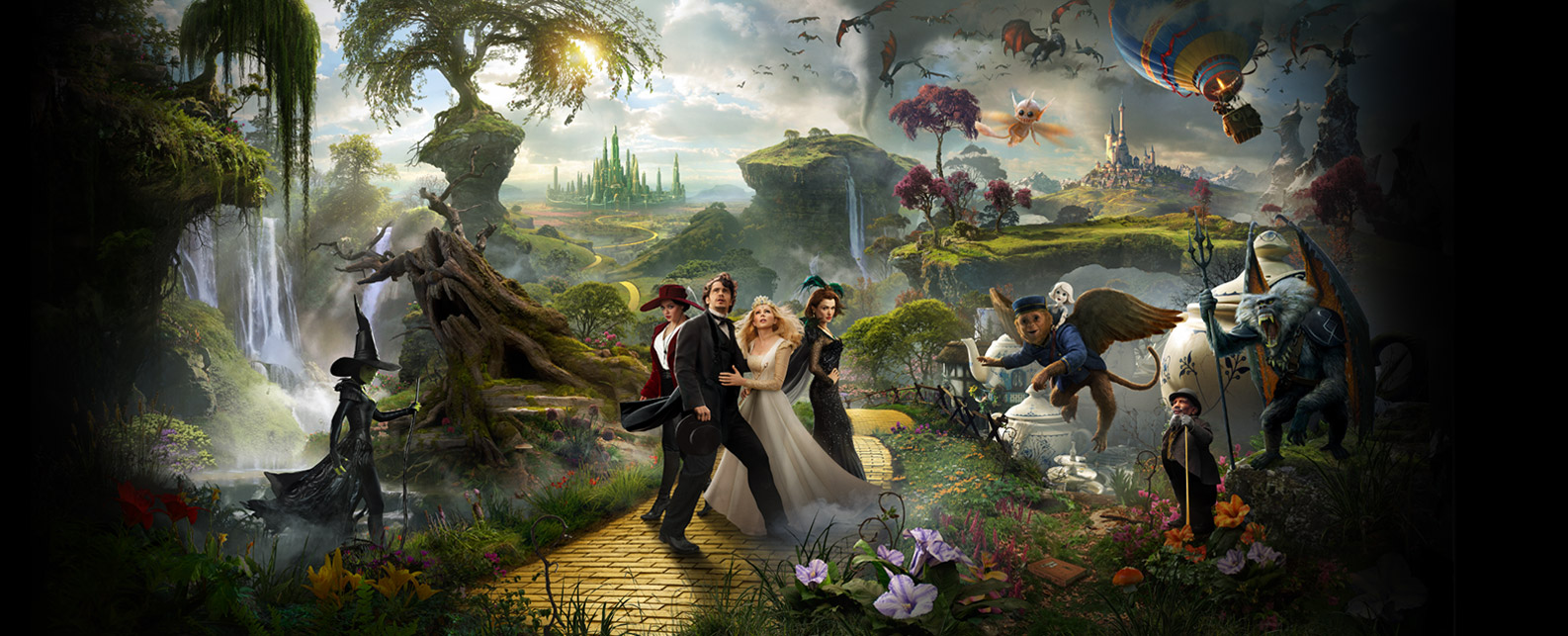
Preceding the events of the fantasy classic The Wizard Of Oz by whatever-something-amount-of-years, Oz: The Great and Powerful follows the story of Oscar Diggs (James Franco), a struggling magician in a traveling circus who dreams of rising above mediocrity and amounting to greatness in the world.

Unfortunately, Diggs is also a crook and a womanizer. When he escapes a few enraged circus freaks by stealing a hot air balloon, he’s gets trapped in a whirling tornado that transports him to a place he’s never seen — Oz, the wonderful land of munchkins, emeralds and yellow brick roads. It is here where Diggs discovers he’s part of an ancient prophecy: that a wizard named after the land of Oz will descend onto the land, and free the people from the tyranny and evil of the Wicked Witch of the West.

Here is a movie that functions as an appropriate prequel, a good movie that actually fits into the magnificent story of The Wizard Of Oz  and makes it work within the established timeline. Co-Written by Tony award-winning writer David Lindsay-Abaire (who wrote both his stage and screen adaptations of Rabbit Hole), the plot in Oz: The Great and Powerful can be defined in adjectives to the first movie: traditional. Imaginary. Creative. Dynamic. Classic. Every piece fits into this puzzle, and ultimately adds up to what is a straightforward prequel that provides background for the first movie, even if it wasn’t needed before.

The cast is strong here as well, with James Franco shining the most out of a cast list that consists mostly of women. Here he portrays a spirited man, a man full of charisma and humor that makes the screen vibrate with his very presence. Both his energy, his passion and his kindness is contagious with other characters, and the end result is a near-flawless chemistry with every character on-screen (with the exclusion of the Wicked Witch of the West, who I felt was severely miscast in this film. I dare not spoil it though by telling you who it is).

As a movie and as a prequel, this film succeeds. The plot is enjoyable, the cast is skilled in both vocal and physical performance and the visual effects reach out and dazzle you with its many bright colors and details that instantly transport you to a land of fantasy and wonder (Even though it is a little too resemblant of the art direction in Tim Burton’s Alice In Wonderland).

The biggest problem with the film, however, is its balance. Director Sam Raimi (who is most known for the Evil Dead and Spider-man trilogies) is the visual effects master behind this film, but unfortunately, he depends too much on it. The most enjoyable moments of this film involved Oscar displaying his joy and humor through his energetic and witty dialogue with other characters, which was both affectionate and entertaining at the same time. Everything else was overdone, and at times Raimi depends on the visual aspect of his film as if its the only thing it has going for it.

The last 40 minutes of the film especially becomes so redundant and prolonged, dragging out a scene of conflict between the munchkins and the witches just to provide action and flashy effects. This part of the film doesn’t seem to have purpose or motivation in mind, and the reptition of visual effects and CGI eventually becomes dizzying and nauseating.

My recommendation: Don’t go into this movie expecting it to be the masterpiece that The Wizard Of Oz is. You’re setting yourself up for disappointment and inevitable failure. Instead, see Oz: The Great and Powerful for what it is: a charming, ambient and lively prequel to the original fantasy classic made 74 years after its original release. When looking through that perspective, the return to Oz couldn’t be more glorious, even though the yellow brick road now looks more like a green screen rather than a stage set.

Tagged , , , , , , , , , , , , , , , , , , , ,