Tag Archives: Drama

“DON JON” Review (✫✫✫)

Oh, Donnie boy…

 “There’s only a few things I really care about in life,” a rich, deep boston voice says as we look at him staring  at his bright laptop screen shirtless in a dark room. “My body, my pad, my ride, my family, my church, my boys, my girls, and my porn.”

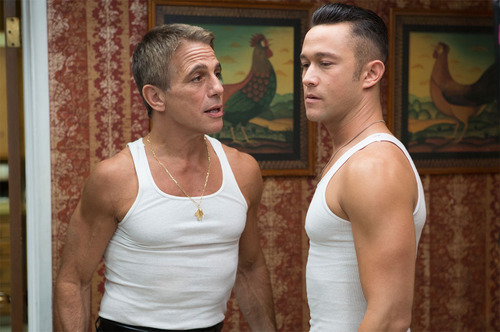
That last one doesn’t really belong there, but whatever, its in there.  The man we are looking at is Joe Martello (Joseph Gordon-Levitt), a thick, cut, and strongly appealing young man who has a slick, black haircut and a grin on his face that looks like he just finished up business in the bedroom.  His friends call him “The Don” because he’s able to score “dimes” on the weekends, which is another way of saying “That woman is a ten!”

One night in the bar, Donnie meets the best dime he’s ever seen: Barbara Sugarman (Scarlett Johansson), a beautiful blonde bombshell that turns heads and raises attention everywhere she goes.  To Donnie, this is simply another case of trying to score a hot night, but Barbara isn’t that easy.  She wants something more meaningful than just a one-night stand: she wants an affectionate, fairytale relationship, the cheesy kind you see in those unbearable romantic comedies starring Anne Hathaway and Channing Tatum.

So Donnie takes a deep breath and waits it out, hoping for her to come around eventually and give him the chance to slip under the covers with her.  The more time he spends with her, however, the more his addiction to pornography gets in the way and stops him from having a more meaningful relationship.  Now conflicted between his feelings between Barbara and his dependency on pornography, Donnie needs to figure out which is more important to him before she leaves him and all he has left is his laptop and his internet wifi.

Before I continue, let me issue a short disclaimer.  If you do not like R rated movies, do not watch this movie.  If you don’t like looking at nudity, do not watch this movie.  If you don’t like swearing, do not watch this movie.  And if you don’t like movies about sex, DEFINITELY do not watch this movie.  This is a picture stuffed to the mouthful with sex, nudity, T&A, F-words, censored and uncensored pornography to the point where I believe it deserved, and should have been rated, NC-17.

The only reason I issue this warning is because I know my readers, and the majority of my readers do not appreciate sexually explicit films that make jokes about the male/female anatomy and what goes on inside the bedroom.  Their views are warranted, and in many ways I share many of those same views with my readers.  I, however, am not as close-minded to this idea if it means not enjoying Don Jon, and believe me, that is a very hard thing to do.

That’s probably the worst word I could have used to describe this picture just now, but nevermind.  Don Jon is good.  Very good.  How good?  So good that it made me, a conservative reviewer who hates excessive nudity, enjoy it very, very much.  Trust me, I am not easy to please.  If you don’t believe me, you will when I tell you I rated The Hangover as the worst picture of 2009.

I find it interesting how effective Gordon-Levitt is here as a filmmaker.  His writing is fresh, fun, and original, exercising dialogue that is both clever and witty while at the same time being deeply meaningful and expressive.  The cast is equally brilliant, as their charismatic portrayals breathe life into these characters in ways that not even an animated rendition could do.

What I find more interesting, however, is how Gordon-Levitt handles this film as a director, using space and situations in his film to define Jon’s character and to show what sort of emotional state he’s in.

For instance, look at how he shows Jon’s everyday routine.  When Jon wakes up in the morning, he cleans his room the best way a bachelor knows how, he drives to Church, he goes to confession, he eats lunch with his family, he works out at the gym, he goes to a club to meet some beautiful lady, and then he ends his nights watching a skimpy porn video.

Got it?  Okay, now look at the variations of this same routine shown throughout the film.  At first its just the same thing over and over again, but later as Jon’s character changes, so does how he behaves during his routines.  When he’s depressed, his room get messy.  When he’s excited, he sings to Marky Mark in the car.  When he’s optimistic, he exercises with other people when he goes to the gym.  But what remains consistent in all of these sequences is him going to confessional and confessing his sins to the Catholic Priest he’s never met, hoping one day to have a clean slate in the eyes of the father.

I don’t think this movie is about a man struggling with his addiction to pornography.  I think this movie is about a man struggling between his lusts and sexual desires and the guilt he silently feels he needs to be redeemed from.  Think about it for a second.  Why else would he go to Church so frequently despite his promiscuous lifestyle?  He’s a grown man, he knows he doesn’t have to go to church if he doesn’t want to.  So why does he go so frequently even though his lifestyle isn’t congruent to that of a catholic?  There’s a deepness developing silently to Don Jon that can only be barely noticed, and if you don’t look out for it, it will slip you past you.

There’s obviously the negative element of watch a movie about pornography, and I would be the first to agree with you.  Even though the pornography is at times censored, its still there, and we can’t help but visualize everything because we’re seeing a rendition of it on the screen.

Still, since we’re talking about pornography, let me retaliate with another film that is also about addiction: a 2011 film titled Shame, starring Michael Fassbender and directed by Steve McQueen.  Like Don Jon, Shame is about a man who holds an unsatiated lust for porn and sex, and his life sinks into a swamp of sadness and depression because of his unsatiated hunger.  Unlike Don Jon, however, Shame is downtrodden, depressing, sickening, despicable, ugly, demeaning, and has no redeeming qualities whatsoever, outside of the acting and the composition.

Don Jon is different.  Unlike Shame, it is upbeat, energetic and joyous, and even though there are dramatic moments in the movie, there is never a moment that feels ugly, sickening, or unclean.  Don Jon is a stylish, articulate, and simply brilliant dramedy.  It is not only a film filled with clever dialogue and solid character development: it actually has a good, wholesome message to take away from the story, something to make you appreciate the small things in life that you never really notice.  I know some people are going to look at this movie from a first glance and ask “Why would I want to watch a feature-length pornography?”  Believe me, fellow reader, if this film can even be categorized as a pornography, its probably the best of its kind.

On a closing note, please don’t tell my mother.

Tagged , , , , , , , , , , , , , , , , , , , , , , ,

“THE BUTLER” Review (✫✫✫✫)

A humble heart living through harsh times.  

When we watch movies like The Butler, we are reminded of our history and why we must never return to the horrible origins that we came from.  When I say that, I am saying that regardless of race.  The film is obviously centered around the issues of slavery, segregation, and racism, and asks us to feel sympathy towards the African population for all of the horrible things they’ve been through.  But the movie evokes a more powerful emotion from me personally, a deep sense of regret and shame that my own race, the Caucasians, were at one point responsible for all of the death and cruelty we inflicted upon our own African brothers.  And why?  Because they have a different pigment than us?  That’s the sort of hate and bias that lead us to World War II when Adolph Hitler led the Third Reich against the Jews.

Based on the career of real-life butler Eugene Allen, The Butler follows the story of Cecil Gaines, a black butler who grew up during the slave era, growed up learning how to be a white man’s servant, got a job at the White House, and continued to serve there for almost 35 years. Throughout his career he witnesses history unfold in itself, from President Dwight D. Eisenhower’s (Robin Williams) decision to enforce desegregation laws in Arkansas, to witnessing the assassination of John F. Kennedy (James Mardesen), to seeing the rise of the Ku Klux Klan and the Black Panthers, to the assassination of Martin Luther King Jr., to the eventual inauguration of Illinois Senator Barack Obama into office.

The Butler is an earnest, humble film, parts approachable and observant yet equally ambitious and honest. Like movies such as Ghandi, The Hurricane, and The Shawshank Redemption, this is a movie that looks into the reality of situations and shows them exactly how they were, no matter how tragic or heartbreaking those circumstances were.

Take, for example, the scene where the Ku Klux Klan is introduced.  During his college years, Cecil’s son Louis (wonderfully portrayed by David Oyelowo), was on a bus to protest against a racist Alabama.  While on their way, their bus stops suddenly as they stare at the white-robed, torch-bearing Klan staring at them with their hateful eyes.  Equal parts petrified and terrified, the protestors desperately tried to escape before the Klan started igniting the bus with fire and molotovs.

I sat there watching these scene, equally infuriated and enraged as I was emotional and mournful.  How could this be our country?  How could this have once been our land, our people who so hypocritically claimed to be the land of the brave and home of the free?

To watch these scenes and to incur such an emotion takes great skill and courage, and I think Lee Daniels does a great job orchestrating these scenes in ways that makes them so emotional and powerful.  Daniels, who was nominated for an Oscar in 2009 for Precious took quite a fall last year when he made Paperboy, a idyllic, preposterous, and morally reprehensible film that was anything except relevant, coherent, and well, good.  Here Daniels redeems himself, and leads a star-studded cast through such a gripping, overwhelming story that I think it surpasses his accomplishes even with 2009’s Precious.

Oh yes, the cast.  The cast is what makes this picture, but you already know that if you take the time to simply read the cast list.  Jane Fonda as Nancy Reagan.  Alan Rickman as Ronald Reagan.  John Cusack as Richard Nixon.  Liev Schriber as Lyndon B. Johnson.  Minka Kelly as Jackie Kennedy.  John Mardesen as JFK.  Robin Williams as Dwight Eisenhower.  Alex Pettyfr as a plantation owner.  Terrence Howard as Cecil’s neighbor.  Cuba Gooding Jr. as a head butler.  For Pete’s sake, Mariah Carrey is in the film as Cecil’s mother and she doesn’t even say a line of dialogue.

The best performances, however, are the lead ones by Forest Whitaker and Oprah Winfrey.  Whitaker, who won the academy award for The Last King Of Scotland in 2006, steals the show in every single scene he’s in, showing the still portrait of a man who is tired, weary, and emotionally strained, a man who has seen endless ages of wrongful suffering but can do little to change it because he’s worrying about himself and his family.  Winfrey is equally as striking as his wife Gloria, a woman who is also hurting and in deep suffering because of her situation and because of a drinking problem she has long struggled with.  Both of these characters are central and integral to the plot and to the progression of the story, and at many times, they’re the only ones carrying the movie through as a whole.

The Butler is one of the best films of the year.  Period.  I know there’s a lot of movies about African-American history being released later on this year (Such as Mandela: Long Walk To Freedom and 12 Years A Slave), but there’s no denying the power, drama, or the history the movie so brilliantly provides us.  Yes, there are some inaccuracies to the butler’s real-life story (Starting with his name, with the real name being Eugene Allen), but the fact that it is loosely told is the best asset Daniels has towards his narrative. Since the figure is so little-known in today’s world, it allows Daniels to let loose and tell the story that he wants to tell, not the story that he’s committed to tell.  This is a movie that shows the history of a great man and a humble servant who was simply trying to support his family and to get through the days of wrongful judgement and discrimination.

Tagged , , , , , , , , , , , , , , , , , , , , , , , , , , , , , , , , , , , , , , , , ,

“THE GREAT GATSBY” Review (✫✫✫)

Nice to see you again, old sport.  

When you sit and think about the character of Jay Gatsby, there is never a simple answer to define him and his purpose in The Great Gatsby.  Some people have cited him as a post-modern interpretation of Romeo And Juliet, in the aspect that the character is going through a romantic struggle that always ends in nothing but tragedy.  Others have viewed him as a representation of the roaring twenties, as a pioneer who emboldens and defines the industrial image of the 1920’s and their status as they faded away into the 1930’s.  Others see him more like an enigma, an image of the upper class and the bleak loneliness that comes with it.  Whatever you believe to see, Jay Gatsby is no simple character.  For all we know, he could be one or none of these things.  Or all of them.

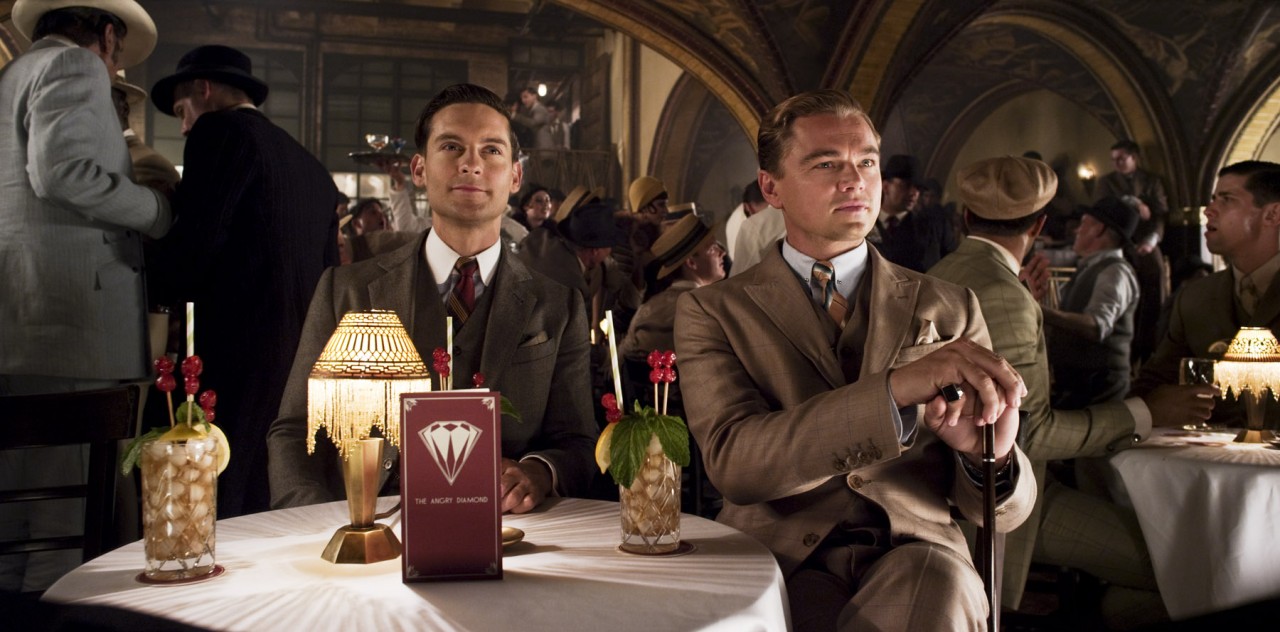
The fact that this film knows, respects, and acknowledges that makes me appreciate this movie, and hope that others can appreciate it too through DiCaprio’s performance and the mythology being revisited here.  Those who read the book should already know the story: a 1920’s bond salesman and struggling writer named Nick Carraway (Tobey Maguire) moves into New York city, where he learns of his rich next door “neighbor” named Jay Gatsby (Leonardo DiCaprio).

I put “neighbor” in quotations because Nick never actually sees Jay Gatsby in the beginning of the film.  All he ever sees of his estranged, self-secluded neighbor is a man looking behind some curtains and holding lavish parties in his mansion in the cool of midnight.  All he ever hears of him is scandalous rumors and war stories about a man many people haven’t met either.  The more Nick lives in his lonely little house, the more he questions if Mr. Gatsby even exists.

Eventually, Mr. Gatsby of course does introduce himself, but not as the host of the party, but rather, as a humble servant who offers Nick a drink on a plate of beverages.  As Nick becomes more familiar with Mr. Gatsby and his lifestyle, he soon learns the truth of Mr. Gatsby’s past and the reasons he really came to New York.

When I first heard of another Great Gatsby picture being made, my first reaction was excitement and anticipation.  How could it not be?  From the creative mind of F. Scott Fitzgerald and the many politics and emotions he makes you feel in his novel, it sounded like this movie was going to be a home run for both fans and non-fans of the book.

Then I learned that Baz Lurhmann was writing and directing.  And then bowed my head and uttered a long, dubious groaaannnn.  Lurhmann, who is most known for directing 1996’s Romeo + Juliet and 2008’s Australia, is commonly remembered as a director who abuses style over substance.  With the previous films I just mentioned, not only are they silly, soupy, and sappy menial dramas: they fail to even attain interest, and are extremely forgettable in a line of much better romantic dramas, including Titanic and the 1968 Romeo And Juliet by Franco Zeffirelli.

Note: Okay, I’ll admit I haven’t seen his 2001 film Moulin Rouge!.  Does it matter though, when out of his entire filmography, that’s the only film he can really brag about?  

The beginning of The Great Gatsby, much like Luhrmann’s other pictures, also suffers from this case of style over substance, with its overly boisterous parties and distracting art sequences making no coherent sense or adding anything to the picture overall.  What I found interesting, however, is that the first act barely matters.  When Jay Gatsby is finally introduced, the film takes a sharp turn of interest and invigorates the audience with new energy, almost like the character changes the entire tone of the film simply by him just being there.

I imagine this is the kind of Jay Gatsby that Fitzgerald would have wanted cast: the type that dresses in nice suits, stands straight with his chin up, and one who enters a room with such stillness that you could hear a penny drop.  The casting directors knew that their casting decision would be crucial to the film, and I think Fitzgerald would be pleased with the end result.  DiCaprio hits every single note dead-on this fascinating character, and just by sheer appearance, demeanor and dialect does he inhabit the character of Jay Gatsby and allow audiences to slip into his conscience and feel what he is feeling.

Oh, I won’t deny everyone else is good in this movie.  Joel Edgerton is effective as the antagonist, and even though he’s an industrial pioneer much like Gatsby is, he has such a hateful energy about him that makes you just want to run him over with a yellow beetle.  Carey Mulligan is good as Gatsby’s love interest, and perfectly shows all the innocence and indecisiveness of her character in the midst of all the ruckus.  Maguire, as well, is perfect as Nick Carraway, not as a character in himself, but as a silent observer, a passive voice who quietly watches over the scene, acting as the audience’s eyes and ears in this third-person narrative.  But its DiCaprio who sucks us in, DiCaprio who winds us up and plays us like a record as he asks us to sit through this tender, emotionally captivating journey that serves as a metaphor for the wealthy and for the industrial era.

And don’t worry, I’ll give Luhrmann credit too.  This film would not have survived without his writing or directing, as he has such reverence for the book and a great fear from deviating from it that the movie functions more as a love letter to Fitzgerald than it does as a strict book-to-movie adaptation.

Regardless, there’s only one person who shines the most here.  DiCaprio made this movie, and through his performance we were able to identify with a character that struggles with his past, his wealth, his love, and the deepening sadness that he hides behinds his warm, welcoming smile.

Tagged , , , , , , , , , , , , , , , , , , , , , , , , , , , , , , , ,

“MY NEIGHBOR TOTORO” Review (✫✫✫✫)

My name isn’t Totoro, kids.  It’s Hayao Miyazaki. 

Now this is what we’re supposed to get when we go in to see an animation picture.  My Neighbor Totoro is everything you expect it to be, and equally as much everything you don’t expect it to be.  This is definitely a kids movie, intended to fulfill the needs of the most innocent and simple-minded of younger viewers.  But this is a rare treasure for adults too, a film that is equally fulfilling and emotionally appealing to older audiences as it is upbeat and joyous for the younger ones.

Taking place in 1950’s Japan, My Neighbor Totoro follows the story of two young sisters named Satsuki and Mei (English dub by Dakota and Elle Fanning), who are moving into their new home with their father Tatsuo (Tim Daly) in order to be closer to their mother in the hospital, Yasuko (Lea Salonga).  Their mother has been sick with an unknown disease for quite some time, and it really concerns the girls because they can’t even get her home for a visit.  Most affected is Satsuki, because her father is always busy, Mei is painstakingly afraid that her mother will leave them, and Satsuki is forced to be the strong one during this time of hardship.

Deep in the forest though, the girls encounter strange beasts of wonder and splendor.  There are these small, darkly black fuzz balls called soot spirits, who hibernate from one dark spot to another.  There are two bunny-like creatures, one white young one who can phase through objects like a ghost, and an older blue one who carries a knapsack of acorns with her everywhere.  Most fascinating though, is a giant, loud, gray beast called Totoro (Frank Welker), a gentle-hearted forest spirit who loves nothing more but to sleep and play on his flute in the silence of the night.  The girls are at first afraid of Totoro’s large, intimidating appearance, but through his gentle, kind-hearted spirit, learn to appreciate him and become friends with Totoro and the forest creatures.

Written and directed by Hayao Miyazaki, My Neighbor Totoro is a rare animated film where the characters are as vibrant and colorful as the beautiful animation that is being expressed on screen.  You really just need to see these little girls in action: they’re one of the most energetic, emotional, endearing, and inspiring little characters I’ve ever seen.  I knew from the first moment I saw them that I would like them: they are these little oddballs of energy, two cute girls who are literally exploding with energy and enthusiasm as they run across the front lawn, or explore the mysteries of their upstairs attic.

The best moments, however, come from when the little girls encounter Totoro.  Looking from a straightforward perspective at Totoro, its a case of what you see is what you get.  He’s a big, fluffy creature who loves to eat, dance, fly, talk (and by talk, I mean roar loudly), and more than anything else, sleep.  If this were any other animated film, I would say the character was another interpretation of Garfield.

I, however, think Totoro is required for more fervent analysis.  I can’t help but look at Totoro like an emotional recompense for the girls, almost like an imaginary friend to distract them from the pain they experience everyday through their sick mother.  Kids with only one parent will know what I’m talking about: when the one you love is in pain or worse, they want everything in the world to distract them from the reality of what they are experiencing.  Its simply too painful for them to take in all at once.  They need something to distract them, to divert them from reality, and so the younger ones try to focus on something fictional that will put their mind at ease, like an imaginary friend for them to talk with.

Totoro reminds me of that imaginary friend.  Unlike an imaginary friend, however, Totoro is real, and this is proven through the interactions he has with the girls.  He is not just a simple-minded, unintelligent forest animal.  He is considerate towards the girls.  He cares for them.  He expresses real and genuine affection for the girls, and he shows this by dancing with them in the middle of the night, growing trees with them in their backyard, or by letting them ride his Cat Bus in cases of emergency.  Even though Totoro is fictional, he’s the most real thing in the movie, taking the girls story filled with hardship and tragedy and filling it with energy, enthusiasm, and life that cannot be faked in a movie.

Every single fiber of me wants to look at this movie and say it is a perfect film, but something stops me.  What is it?  It certainly isn’t the characters, the animation, the story, or the emotion being expressed on screen.  What is it then, if its none of the above?

Of course, I think.  Accessibility.  The weakness with this film, much like the stark foreign language films and the ancient black-and-white silent films, is that it strictly appeals to a certain audience.  You know what I’m talking about: what is the typical american viewer going to see, a boisterous and explosive action movie with big name actors starring in it, or some independent animated film made by some guy whose name they can’t even pronounce?  The weakness here is this: people who don’t like anime won’t like it, and probably shouldn’t see it, because this film mainly appeals to that same audience and culture through its story and through its execution.  Because of that, Totoro will lose some viewers in its audience.

But even then, is that the fault of the filmmaker for not conforming to their tastes, or the audiences for not being open about it?  Regardless of what you think, My Neighbor Totoro is a magical little film, an uplifting and wonderful fantasy that taps into the inner child in all of us, and in many ways reflects the behavior of children: animate, lifelike, endearing, sincere, and visually expressive.  It’s a movie whose characters are so precious and lifelike that a live-action portrayal couldn’t have been as real as this.  It’s a film that allows us to believe in miracles, even if we don’t necessarily believe in them.  And at the heart of it all is Totoro, a warm, fluffy forest spirit that only loves children more than he does sleeping on his favorite moss bed.

Tagged , , , , , , , , , , , , , , , , , , , ,

“THE BOURNE LEGACY” Review (✫1/2)

This movie has the wrong title.

The Bourne Legacy is a misconstrued mess, an absolute miscalculation and train wreck of a film that it has no business being made into a movie in the first place.  I hated this idea months before this was released, and I hate it even more now after having seen it.  Who, in their right minds, thought it was a good idea to make a Bourne movie without Jason Bourne???  That was my biggest concern going into the movie.  Believe me though, fellow moviegoers: that is the least of your worries.

Taking place shortly after the events of The Bourne Ultimatum, The Bourne Legacy shows the repercussions of Bourne’s actions, how it affects Treadstone, and what marks it leaves on the people involved.  Erik Byer (Edward Norton) is a government official who was directly involved with the affairs of Treadstone during its days of operation.  Shortly after Jason Bourne escapes their custody, however, Byer believes that all of the agents now are a potential threat to the government, and is convinced that he needs to shut the project down in order to protect themselves.  By “shut the project down”, I really mean kill all of the agents in the field.

One of these agents is Aaron Cross (Jeremy Renner), an experienced field agent who is carrying out a mission in Alaska for Treadstone when the order was released.  While taking refuge in a wooden cabin with another fellow agent out in Alaska, they are suddenly attacked by robot jets, and Cross barely escapes with his life intact.  Surviving only because of the medication he is on (Treadstone agents are required to take two pills, a blue one for physical boosting, and a green one for mental boosting), Cross looked into his stash to realize that he only has a couple days worth of medication left.  Now low on food, supplies, and ammunition, Cross must now find a way to get back to America and survive against Treadstone long enough to find a way to counterattack their onslaught.

Let me start with the most obvious flaw here: Tony Gilroy.  Looking at his filmography, you would think he would be the best man for the job here.  He was credited as co-writer for the three previous Bourne movies, he wrote and directed the Oscar-winning drama-thriller Michael Clayton as well as the 2008 caper film Duplicity.  I enjoyed all of those movies, and thinking that this one would be the same, made the mistake of thinking that it would be just as good.

Trust me, this couldn’t be any more of a dissapointment.  Everything wrong with this movie has everything to do with Gilroy’s script and direction, which couldn’t be more forced, erratic, confusing, and half-lapsed than this.

The problems start with the premise: a Jason Bourne movie without Jason Bourne is a bad enough idea.  But let’s take a step back here and try to be open with this.  Let’s just say, for facetious effort, that Aaron Cross’ story is just as fascinating and compelling as Bourne’s is.  What are the conflicts?  In his first three movies, Jason Bourne’s struggle was against his morality, identity, and the confronting of his past.  What is Cross’ magnificent, epic struggle?  Survival by trying to find a green pill.  If this movie dwelved any more into the conflict than it did, I would have said Cross was a junkie.

“Funny”, I think.  “I don’t remember these pills being used in the original trilogy”.  Correction: I vaguely remember them.  In a brief flashback sequence in The Bourne Ultimatum, I remember Jason Bourne taking a blue and green pill during his initiation into Treadstone (this memory is hazy though).  Bourne obviously didn’t need to take the pills further because his body adapted to the drugs.  Here, Cross is dependent on the drugs like a junkie is on cocaine, and if he doesn’t get his daily dose of the green pill, he’ll apparently revert to the level of intelligence of Forest Gump, according to him.

Okay, that’s fine.  Jason Bourne isn’t in the movie, check.  Super pills gives Cross super powers, check.  I would be able to buy the premise and its characters if A) it were handled well, or B) it was anywhere near as smart, interesting, or even remotely readable as it was to The Bourne Identity.  Here, instead of intelligence we get confusion, instead of cleverness we get forced easter eggs to earlier movies, and instead of interest we get on-the-nose, ham-fisted writing.  The editing in this film is choppy, leaping all over the place, jumping from one timeline to another, one flashback to the next, and it becomes so repetitive and convoluted throughout the picture that by halfway through I stopped caring about it.

Oh, I don’t deny Jeremy Renner is a knockout in this role.  Neither do I deny the talents of Rachel Weisz, Edward Norton, and especially not Joan Allen or Albert Finney.  All of the performances are great, but the story is a complete wreck, and Gilroy clearly has no idea how to handle his premise or the cast he’s been given for this.  What more proof do you need, besides this convoluted script, an uninteresting story, and a tedious chase sequence at the end with a sharply abrupt cliffhanger?

This is exactly the reason why I hate sequels.  When done well, like the original Bourne trilogy, they are compelling, brilliant expansions furthering the story set up by the first one.  When done like this however, they are nothing but forced, awkward, nonsensical garbage.

Again, I ask this: why did this movie have to get made?  The Bourne Legacy is exactly what you expect it to be, a Bourne movie without Jason Bourne, equally without the compelling character drama or real conflict in it. And now they’re talking about a possible sequel to this mess.  Only if Jason comes back and kills Aaron Cross.  That’s the only way they can redeem themselves at this point.

Tagged , , , , , , , , , , , , , , , , , , , , , , , ,

“42” Review (✫✫✫✫)

Thanks, Jackie, for showing us white folks how its done.

You’re not watching a movie when you watch 42, you’re watching a legacy.  You’re watching one man’s story as he started from the bottom, as a black baseball player living during the accursed segregation era of our country, who is suddenly called to greatness and is demanded to be a bigger and better person than he thinks that he is.  It isn’t entertainment as much as it is a retelling of one man’s life, and everything he had to go through during the turmoil and cruelty of the 1940’s.

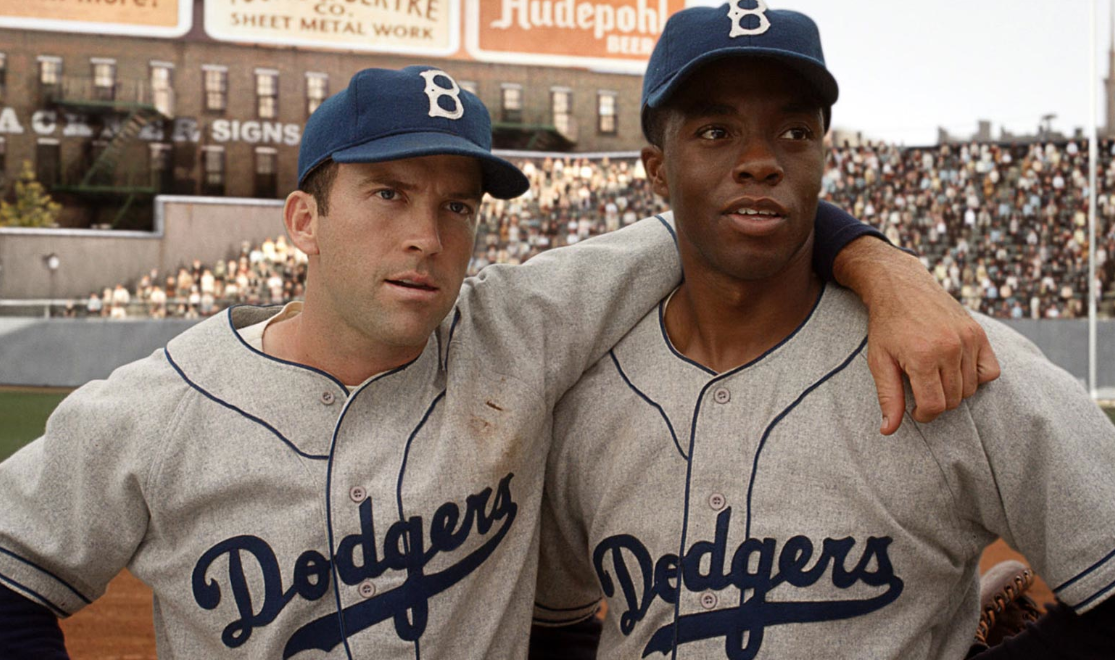
This man, of course, is Jackie Robinson, the black man who did to baseball what Rosa Parks did to buses.  Portrayed here by newcomer Chadwick Boseman, the movie starts off showing the beginning of  Robinson’s career with the Kansas City Monarchs, a primarily black baseball team who gets treated the same way at a gas station in the way a homeless man would be.  Robinson doesn’t stand for it, but it doesn’t matter: he is soon recruited by a man in a black van asking him to come with him to meet with baseball executive Branch Rickey (Harrison Ford), who wants to be the first man in American history to recruit the first African-American ballplayer onto the Brooklyn Dodgers.

His assistants are baffled.  “A black baseball player on a white baseball team”?  What are his reasonings?  Rickey makes multiple excuses, from the financial benefits to simply being different.  It isn’t until later in the film where a much deeper reasoning is found in Rickey’s baseball history, though I dare not spoil it just for the sake of you being able to experience it yourself.

Eventually, Robinson has his meeting with Rickey, and he’s surprised when Rickey tells him that he wants to recruit him on the Brooklyn Dodgers.  There’s only one condition Rickey has for Robinson: he wants him to control his fiery hot tempter when white players act out unfairly against him.

“I don’t want a man who has the guts to fight”, said Rickey.  “I want a man who has the guts not to fight”.

There are two things that make this movie stand out from the typical baseball-biography picture: the director, Brian Helgeland, and its lead, Chadwick Boseman.  Boseman, who is mostly a no-name actor, dives headfirst into his character, and inhabits the role so well that it is impossible to think of anyone else replacing him.  You just need to see this guy in action: the way Boseman puts himself out there is just like how Robinson would have played on the field, from digging his hands in the dirt to firm his grip, to stealing second, third, and home bases like he was taking candy from children.  It’s especially funny watching him getting ready to steal bases: he jogs his legs together and shoots a look at players with a face that says “Come at me bro” to which pitchers get obviously frustrated at him.  Jamie Foxx couldn’t have done better than Boseman did.

But its just not the movements, the pitches, and the home-run hits Boseman delivers that makes him a convincing actor: his expressions are flawless, his dialogue delivery spot-on, and his performance so affectionate, with his every spoken line coming across truthfully and genuinely from the heart.  I could name multiple scenes in the movie, on the field and off, that genuinely touched me.  Perhaps the most memorable with Boseman was when he was out on the field ready to bat when a baseball manager starting shouting racial expletives at him.  I’m not even kidding: if every other word he was shouting wasn’t a profanity, it was the N-word.

This scene was powerful, frustrating, and maddening all at once, and we could feel our anger channel through Boseman when he had to hold his tongue, when he had to walk off the field, and when he screamed in the locker room, breaking his bat against the walls in furious anger.

Oh yes, many emotions were felt in this movie, and writer-director Brian Helgeland does a great job at expressing all of them.  Surprising, I think, that the same man who wrote and directed the tonally inconsistent A Knight’s Tale was able to make a movie this sincere and heartfelt.  I’m being unfair though: I forgot that Helgeland also wrote the screenplays behind movies such as L.A. Confidential and Mystic River, and here he brings that same sense of grounded realism from those pictures into this one.  Throughout the course of the picture, Jackie Robinson grows as a person and as a player, and so do the people around him.  Relationships become bigger.  Bonds become stronger.  Intimate details are revealed through each character to Jackie, and through his stressful, agonizing, and roller-coaster emotion journey Jackie becomes the hero that nobody expected him to be: not even himself.

If a weakness exists, I’ll admit that 42 is straightforward storytelling, with little room for originality or surprises.  That’s only because we already know the history though.  What 42 lacks in innovation, it makes up for in emotion, in gripping and well-written storytelling with a great cast compelling us through it, with especially one of the performances being completely unexpected.  The best moment of the picture comes after Jackie grows closer to one of the players, the player encourage to not feel fear when openly associating himself with a black man.  As they run back out to their respective places in the field,  the player calls out to him: “Maybe tomorrow we’ll all wear the number 42.  That way they won’t tell us apart”.

Tagged , , , , , , , , , , , , , , , , , , , , , , , ,

“PITCH PERFECT” Review (✫✫)

Special appearance from the cast of “Glee”!  

Pitch Perfect is a predictable, formulaic film, a movie enveloped in its conventions, forcing in cliche characters, and bolstered only by its joyous music, which cannot help but seem misplaced in a movie like this.  It’s the sort of movie that doesn’t deserve the word “perfect” in its title.  I’d offer an alternative title, something shorter and more subtle such as simply Pitch, but I’ll advise against that for the fear of people mispronouncing it.

The story begins on a young and rebellious Beca Mitchell (Anna Kendrick), an aspiring DJ who dreams to one day become as popular as Skrillex or David Guetta (80’s kids, look them up on wikipedia).  Her father however, who just happens to be a professor at Barden University, encourages her to become more immersed in her education and to get more involved on campus.  Beca hates school and hates socializing even more, but will put up with it because her father will help her out with her DJ career if things don’t pan out at school like he wants them to.

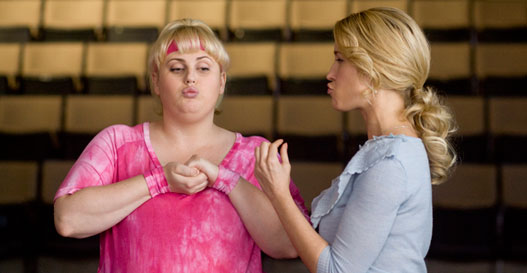
She gets a job as an intern at a radio station, and ends up joining the Bellas, a group of diversified female singers who all compete at an acappella competition at the end of the year.  These girls are Aubrey (Anna Camp), the snotty, stuck-up leader of the Bellas, Chloe (Brittney Snow), the more civil and more approachable Bella out of the group, and Fat Amy (Rebel Wilson), a woman who is determined to throw herself out there despite her weight and her unattractive appearance.  Just so you know, I’m not calling her “Fat Amy” on purpose.  That is the specific name she instructed the Bellas to call her when they mistakingly called her “Amy”.  I’ll bet her mother is proud of that, hearing her daughter wanting to be called Fat.

The Bellas were disqualified from the last competition because Aubrey vomited all over the front row of the audience last year (believe me, that wasn’t a pretty sight to see).  Aubrey, as a result, is even more strict about protocol, behavior, and song selection than before, and so now she functions as a sort of an acappella Hitler to these poor college girls who are just trying to find their place at this university.

Let me say something here: there is something seriously wrong with your picture if your best comedy comes from a girl called Fat Amy and the worst involves girls swimming in pools of vomit.  That’s not figurative, by the way, that is a literal reoccurring joke in the picture.  This is perhaps the biggest problem with the picture over everything else: the comedy is not funny.  It is not original, clever, precise, or even remotely well-written.  It is unbelievable, insincere, forced, and extremely ham-fisted.

Why do I say this?  Because not a single laugh was genuine.  Nothing was funny.  The jokes all involve typical cliches or moronic conventions, things you can find easily on a television network like ABC or Nickelodeon.  What other examples do I need to give, besides the vomit jokes?  How about awkward parents, preachy life lessons, bad singing, rapping, stereotypes, hazing and topics about sex?  I’ll thought I was watching a musical here, not an episode of “Kids In The Hall”.  

Oh yes, this film is not funny, but even worse are its characters, who are so unbelievable and overly-dramatized that they can only be in a movie.  These girls are an annoying, rambunctious sort, a group of absent-minded drama queens who worry only about what tradition they uphold or which boys they are sleeping with.  I know they’re meant to be seen as overly-expressive college archetypes, but for Pete’s sake, at least try to be more creative.  “High School Musical” had more interesting characters than this.

Anna Camp is both spoiled and paranoid, a woman who is an over-exaggerated negative picture of sorority girls.  Snow is meager, idle, and useless, there only to inspire Beca to join the Bellas, but not much else since she’s so passive when confronting Aubrey.  Kendrick is good as Beca, but not really that compelling, and even when she first appears on screen we get a sense that the script is going to force us through some deep, meaningful character romance even though it isn’t really that deep or meaningful.  The most compelling and talented actress here is Rebel Wilson as Fat Amy, who is so spirited and so enthusiastic in her role that she ends up more appealing than any of the other sorority brats in this movie.  Her attitude and her humor was uplifting and energetic, and I wouldn’t be surprised if she served as a sort of inspiration for overweight girls everywhere.  Dare I say I was turned on by her energy?  No, but she was close.  Really close.

Ultimately, Pitch Perfect is a flat, typical experience.  It provides nothing we haven‘t seen before and its immature handling only reveals more of its desperate copycat nature.  Why, then, am I giving it two stars when it’s story clearly deserves one?  That is because of the music.  If the movie accomplishes nothing else (and it doesn’t), it has the most beautiful covers and acappellas I’ve ever heard, even better than what most of what the TV show “Glee” produces.  There was one great moment where Kendrick even does an original acappella with only her voice, hands, and a plastic cup to use at her instruments.  That does not happen by insincere chance, fellow readers.  That is genuine, passionate talent, one that is evidenced in every beautiful note in these acappellas (although I don’t understand how a woman is capable of singing in baritone.  That’s another issue though).

Oh boy, am I going to get roasted for this.  What, I wonder, do people find so entertaining about this movie?  Look, I don’t expect a perfect film.  I don’t go into these things expecting to dislike them from the outset.  All I ask is that you have good singing, a solid story, and appealing characters for me to appreciate.  Here, the singing is incredible, but the dialogue is flat, the story is predictable, and the characters are more annoying and high-strung than the Kardashians.  Pitch please.

Tagged , , , , , , , , , , , , , , , , , , , , , , , , ,

“NOW YOU SEE ME” Review (✫✫✫)

And now you don’t.  

We open on a black screen, similar to how a magician opens up his show behind the secrecy of a red curtain.  A deck of cards can be heard flipping through the background with the presence of a calm, cool, and serene voice to accompany them.  “Pick a card”, he says.  “Any card”.  But before his volunteer can pick a card, he is quick to remind her “But look closely.  Because the closer you look, the less you will actually see”.

The words of a true magician, and the fact that he flipped this deck and actually picked the card I choose impressed me even more.  This character is named Atlas, who is played by Jesse Eisenberg, and he is a street magician on such a skill level to where he can make skyscrapers light up in the night.  As he impresses a crowd of ongoing viewers, one stands in the audience with a hood over his head quietly observing Atlas.  We can’t see his face and we don’t know who he is, but he carries a card in his pocket, and leaves it for Mr. Atlas at the end of the performance.

Atlas isn’t the only magician to receive special treatment: three other magicians have also been observed by this strange visitor and have been left cards for each of them.  There is the mentalist Meritt McKinney (Woody Harrelson), the pickpocket Jack Wilder (Dave Franco), and the escape artist Henly Reeves (Isla Fisher).  All four of these talented magicians have been recruited by a secret cult called “The Eye” to carry out a secret mission for them.  One year later, they come together in their first show as “The Four Horsemen”: and during their show, they rob a bank all the way in Paris while still performing in Las Vegas.

The FBI are called in to investigate, and they bring in Agent Dylan Rhodes (Mark Ruffalo) to arrest and interrogate the four horsemen.  Pressing as he is, the horsemen are equally as clever and deceptive.  Henly is spinning chairs, McKinney keeps reading his mind, and Atlas ends the interrogation by taking off his handcuffs and snapping them onto Rhodes.  The rest of the film shows Rhodes chasing the four horsemen, trying to figure out their plot, and to stop them before they succeed.

This film is all about style over substance, a movie that is more concerned with tricks and showcase over character depth and dimension.  Do I care about dimension, however, if the film is more than fun enough to take it over?  The success of movies do not just come from how deep or complex they are.  They also come from how well-made the picture is, how sharply the cut is edited, and how cleverly the narrative is structured.

And boy, if Now You See Me is anything, its definitely clever.  Directed by Lois Letterier (Transporter 2, The Incredible Hulk) and written by screenwriters Ed Solomon (Men In Black) and Boaz Yakin (Remember The Titans), Now You See Me is a movie driven to the brim with its cleverness, its wit, deceit, and effervescent charm in its characters, in what they do, and how they do it.  In many ways, this movie reminds me of caper films such as Oceans Eleven and The Italian Job: its a movie where characters cleverly trick and deceive their pursuers and expose them to their traps and their decisive plans.  They don’t use muscle, brawn, or big guys with guns to get what they want: they use their wits, their brains, and their thievingly cunning plans to accomplish their goals in the plot.

Of course, these plans weren’t inherently inspired by the four horsemen in themselves: someone from the shadows has helped them with this plan, and is always monitoring these horsemen from shadows of secrecy.  Tonally, the film achieves what it desires, and throughout the conniving plot we’re always wondering a key mystery: who is the fifth horseman?  Why did he enlist in the help of these four?  Who could it possibly be?  Is it one of the FBI or Interpol, pretending to be on one side while coyly playing for the other?  Or is it another mystery card player, one who has hidden behind a long-aged myth and has hidden himself from all cards in the field?

This isn’t just a caper film: it is a complex and fascinating mystery, and the cast of characters is all the rogues gallery in this police questioning.   Mark Ruffallo does well as Dylan Rhodes, and in small moments of intimate revealings he shows a man who was once a boy who will always hate those in higher power oppressing the helpless underdogs.  Michael Caine and Morgan Freeman make great cameos, and each play a role we don’t normally see from them, Caine being an antagonistic money monger and Freeman being an observant expose’ of schemes.  Eisenberg, as always, is a knockout in anything he does.  Here his character combines both the social awkward and invertedness of The Social Network, and the coy, cool, sleek confidence of Brad Pitt from Oceans Eleven.  Don’t ask me how he does it, okay?  He just does.

And this is a film that has been bombasted by critics.  For what?  A few quotes I pulled from Rottentomatoes:  “Overcooked, overcomplicated and underinteresting, this heist caper turns into a mess”, one critic said. “Complicated nonsense”, and “…a flimsy plot whose logic disappears faster than a rabbit in a hat”.

There is some truth here.  Yes, the film is overcomplicated.  Yes, it is elaborate and sometimes distracting.  Yes the characters are one-note and thinly written.  And yes, the twist ending is dangerous enough to make the entire narrative collapse on itself, let alone offering the threat of plot holes.

In other words, I’ll admit I don’t understand everything by the end of the picture.  And that’s precisely the point.  There isn’t any fun with a trick that has been exposed: the fun comes in with those trying to figure it out.

Tagged , , , , , , , , , , , , , , , , , , , , , , , ,

“TRANCE” Review (✫✫✫1/2)

The pocket watch is mightier than the magnum.  

Trance is a fantastic art film, a mesmerizing and fascinating thriller that uses twists, turns, hallucinations, and narrow corridors as its tools to build suspense, and dialogue and performances to form sympathy for its characters.  Its surreal, twisted, strange, nonlinear, and non-conventional, but to dust with conventionality.  This is a great picture.

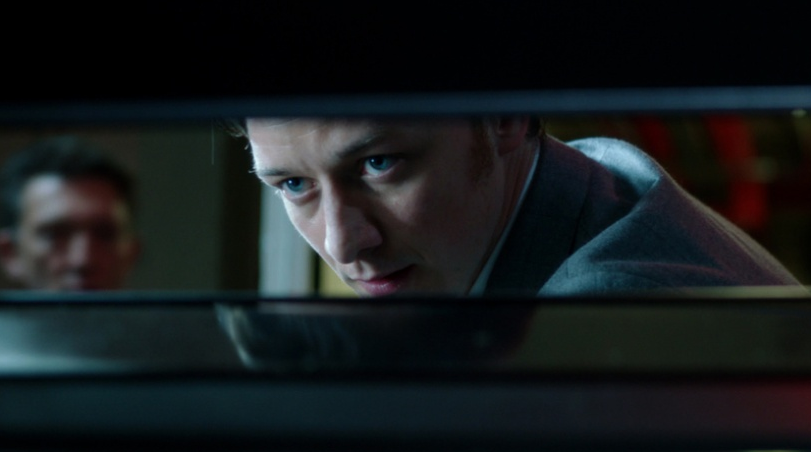
As the film fades in, we are introduced to Simon Newton (James McAvoy), an art auctioneer who takes us through the ropes of what his job entails.  He tells us of the extensive steps it takes to reserve a painting, the protocols his employers tell him to do when putting a painting up for auction and what steps he must take if a robbery takes place.  Their most valuable item is a painting by Francisco Goya called “Witches In The Air”, and his employers gave him precise instructions on how to preserve the painting if thieves do happen to come into the auction in an attempt to steal it.

Sure enough, thieves break into the auction and attempt to steal the painting.  This troop is lead by one named Franck (Vincent Cassel), and he is determined and headstrong into getting that painting.  Right before Simon puts the painting away, however, Franck cuts him off, a brief struggle happens between them, and Simon is knocked out, with Franck leaving with the stolen painting in tow.

When Simon wakes up, he realizes he lost his memory from the past two weeks.  When he’s finally released from the hospital, Franck pays him an unwelcome visit.  Turns out, all that Franck got on the day of the heist was just the frame of the painting, whereas the real article itself was transported to an alternative location.  Torturing him by peeling back his fingernails, Franck comes to find out Simon truthfully does not remember where he put the painting.  So he tries a different method of extracting information, one that involves psychology and hypnotherapy at the hands of one named Dr. Elizabeth Lamb (Rosario Dawson).  Together, they attempt to probe Simon’s mind, and begin their search for the painting Simon has kept hidden from them.

Here is a film that knows what it wants, a movie that knows its characters, their motivations, its story, and precisely how to tell it.  Director Danny Boyle, who is nearly a master at experimental cinema (if you don’t believe me, look at his hallucination sequences in Slumdog Millionaire or 127 Hours) does something very rare here: he intertwines and meshes characteristics of a narrative film with that of art and experimental cinema, making a truly absorbing, gripping, and fascinating experience.

Let me make something clear here, however: I hate experimental cinema.  Nine times out of ten they don’t make any sense, they seem relevant only to those making them, and they elicit a confused response rather than an emotional one from its audience.  Here though, the result is much different.  Everything is crystal-clear and fluid, the visuals dynamic and expressive, the editing cut together neatly and crisply. It’s like a mind game of cat-and-mouse, except the cat is willing to seek out help and the mouse is more lethal than both cats are lead to believe.

Oh believe me, my attention was unadverted throughout the entire picture.  While I didn’t understand everything immediately in the film, I understood what I needed to in the moment and the plot filled in the rest for me as time went on.  And what did I understand, more than anything else?  That these are sinful characters, decrepit criminals that lie, cheat, and connive their way to success and to financial gain.  Cassel was aggressive and talented as Franck, and while his character was despicable and loathsome at first, a softer side of him was later revealed so that the audience could come to terms with his character.  Dawson is as beautiful and motivated as ever, and while she too was at first a sympathetic figure, she later reveals a darker side to her character that even I didn’t expect.  I’m not even going to go into James McAvoy.  His performance was so specific and so wide-ranged that I was compelled to care for his character while at the same time hating him.

And yes, in case you didn’t pick up on it, the movie is deserving in its R rating.  It is violent, bloody, disturbing, graphic, and it has its vast share of nudity and sexuality, with some of the violence and sex combining in many gruesome scenes.  If this were any other picture, I would take off points for that.  But like Pulp Fiction and Taxi DriverTrance is a film that uses its bleak content as a tool to tell a story and define character, to show an encompassing yet tragic story of three fatally flawed individuals who will torture, manipulate, and kill to get whatever they want.  You have to watch a movie like this long enough to realize the point when it stops being a thriller and starts forming into something greater: when it starts forming into art.

Tagged , , , , , , , , , , , , , , , , , , , , , , , , ,

“WHITE HOUSE DOWN” Review (✫✫1/2)

You’d be crazy running for a second term, Mr. President.  

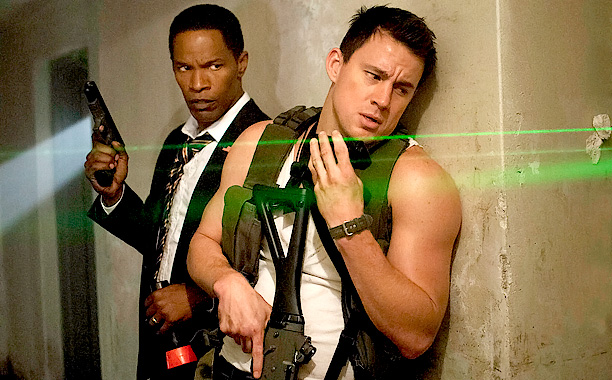
Now here’s a movie that would give President Obama a heart attack.  White House Down, much like a film released earlier this film called Olympus Has Fallen are both about the same thing.  The white house is under attack by a group of professional terrorists, the president is in danger, and our brawn yet brave hero must step in to save him.  All you need is a ripped shirt, a clean-shaven face, and a lot of guns on this guy (not just automatic) and you’re all set.

Unfortunately, that’s all the information I can give you.  This movie is so thinly written that that’s the deepest I can go without giving any spoilers.  The only other information I can provide that could give you any clue on to what this movie is like is that the brawn, brutish hero is played by Channing Tatum,  the president is played by Jamie Foxx, and Tatum owns a daughter portrayed by the sweet and talented Joey King.

I’m going to get this out of the way: Channing Tatum should never play the lead in any movie ever.  He cannot act.  There is no sincerity in his voice, no fluid movement of his body, no expression on his face to show he’s feeling anything except for when he’s shooting at something.  The fullest his acting capability reaches in the movie is the eyedrops you see in his cornea when he’s “crying” for his daughter. I’m not even kidding.  His acting is so terrible, the only use Tatum is in the movie is to provide meat for the female viewers in the audience.

(And I will admit my jealousy here: I will never look as good as Channing Tatum does.  I don’t think its possible for any man to).

Where was I again?  Ah yes, Tatum’s acting.  As always he is a stiff, awkward, and uncomfortable actor, a perfect reason why he should never be the lead character in a movie.  Admittedly though, the dialogue isn’t helping him much.  His best lines in the movie involve something like: “You have to go out there and be President”, or “If this guy keeps making those sounds, I’m going to start looking at him.”

If the above description makes this movie sound appealing to you, you should see it.  White House Down is a big case of what-you-see-is-what-you-get: a movie filled to the brim with excessive action, big explosions, cheesy dialogue, and mediocre acting, with the minor exception of Jamie Foxx, who has the most patriotic and humorous dialogue out of any other character in the movie.  In one scene, he’s reciting the history of America so beautifully to his secretary of defense over the phone that one could mistaken him as a Lincoln who underwent skin surgery.  In another scene, he’s following Tatum up an elevator shaft to evade capture when this exchange happens between them:

Foxx: What you do, I do.

(Channing Tatum ninja moves across elevator).

Foxx: I ain’t doing that.

Foxx’s character was the most appealing, the most intelligent, and the most charismatic character out of the entire movie.  Everyone other character was overly charismatic and grossly unrealistic.  One radical baddie is so stereotypical and so overpumped with tattoos, facial hair, ego, and steroids that I expected him to rip off his skin and reveal that he’s the Terminator.  A tour guide portrayed by Nicholas Wright is more worried about fine china and precious artifacts than he is about his own life and well being.  Tatum’s daughter, however, is probably the most frustrating.  She comes off as annoying, careless, and extremely absent-minded in this film.  You might say this is because she’s a child, but tell me something: how realistic is it that a teenage girl like this is smart enough to run her own youtube channel and know more about the white house than the tour guide, and yet, she doesn’t know when to stay in the bathroom or to leave a building when its going to blow up?

I remember an argument I had with a friend of mine in my first year of college.  He was an experienced videographer who understood more about the film industry than any of the professors did in that department.  We were arguing about the differences between film and art, and he told me a direct yet simple statement:

“Film is not an art” he argued.  “Film is a business.”

While I desperately want to prove him wrong through films such as Inception, Life Of Pi and Beasts Of The Southern Wild, it is movies like White House Down that remind me that the industry does in fact exist and operate like a business intended for profit.  At least Roland Emmerich didn’t release this film in 3-D: that wouldn’t have helped my side of the argument one bit.

Tagged , , , , , , , , , , , , , , , , , , , , ,