
Tag Archives: Crime

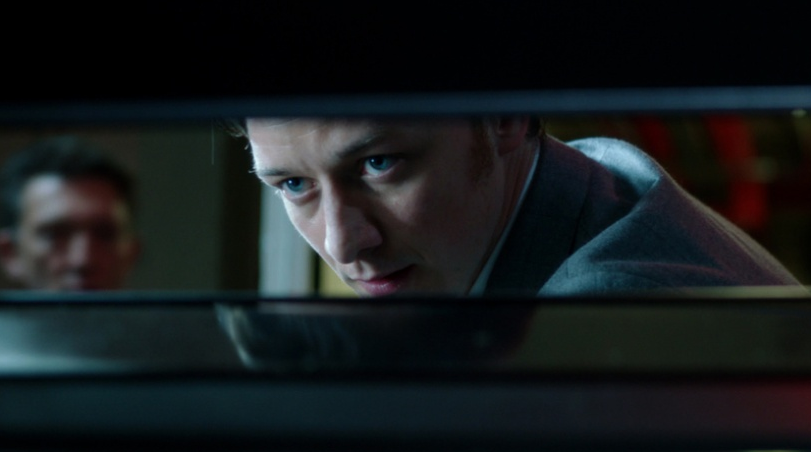
“TRANCE” Review (✫✫✫1/2)

The pocket watch is mightier than the magnum.  

Trance is a fantastic art film, a mesmerizing and fascinating thriller that uses twists, turns, hallucinations, and narrow corridors as its tools to build suspense, and dialogue and performances to form sympathy for its characters.  Its surreal, twisted, strange, nonlinear, and non-conventional, but to dust with conventionality.  This is a great picture.

As the film fades in, we are introduced to Simon Newton (James McAvoy), an art auctioneer who takes us through the ropes of what his job entails.  He tells us of the extensive steps it takes to reserve a painting, the protocols his employers tell him to do when putting a painting up for auction and what steps he must take if a robbery takes place.  Their most valuable item is a painting by Francisco Goya called “Witches In The Air”, and his employers gave him precise instructions on how to preserve the painting if thieves do happen to come into the auction in an attempt to steal it.

Sure enough, thieves break into the auction and attempt to steal the painting.  This troop is lead by one named Franck (Vincent Cassel), and he is determined and headstrong into getting that painting.  Right before Simon puts the painting away, however, Franck cuts him off, a brief struggle happens between them, and Simon is knocked out, with Franck leaving with the stolen painting in tow.

When Simon wakes up, he realizes he lost his memory from the past two weeks.  When he’s finally released from the hospital, Franck pays him an unwelcome visit.  Turns out, all that Franck got on the day of the heist was just the frame of the painting, whereas the real article itself was transported to an alternative location.  Torturing him by peeling back his fingernails, Franck comes to find out Simon truthfully does not remember where he put the painting.  So he tries a different method of extracting information, one that involves psychology and hypnotherapy at the hands of one named Dr. Elizabeth Lamb (Rosario Dawson).  Together, they attempt to probe Simon’s mind, and begin their search for the painting Simon has kept hidden from them.

Here is a film that knows what it wants, a movie that knows its characters, their motivations, its story, and precisely how to tell it.  Director Danny Boyle, who is nearly a master at experimental cinema (if you don’t believe me, look at his hallucination sequences in Slumdog Millionaire or 127 Hours) does something very rare here: he intertwines and meshes characteristics of a narrative film with that of art and experimental cinema, making a truly absorbing, gripping, and fascinating experience.

Let me make something clear here, however: I hate experimental cinema.  Nine times out of ten they don’t make any sense, they seem relevant only to those making them, and they elicit a confused response rather than an emotional one from its audience.  Here though, the result is much different.  Everything is crystal-clear and fluid, the visuals dynamic and expressive, the editing cut together neatly and crisply. It’s like a mind game of cat-and-mouse, except the cat is willing to seek out help and the mouse is more lethal than both cats are lead to believe.

Oh believe me, my attention was unadverted throughout the entire picture.  While I didn’t understand everything immediately in the film, I understood what I needed to in the moment and the plot filled in the rest for me as time went on.  And what did I understand, more than anything else?  That these are sinful characters, decrepit criminals that lie, cheat, and connive their way to success and to financial gain.  Cassel was aggressive and talented as Franck, and while his character was despicable and loathsome at first, a softer side of him was later revealed so that the audience could come to terms with his character.  Dawson is as beautiful and motivated as ever, and while she too was at first a sympathetic figure, she later reveals a darker side to her character that even I didn’t expect.  I’m not even going to go into James McAvoy.  His performance was so specific and so wide-ranged that I was compelled to care for his character while at the same time hating him.

And yes, in case you didn’t pick up on it, the movie is deserving in its R rating.  It is violent, bloody, disturbing, graphic, and it has its vast share of nudity and sexuality, with some of the violence and sex combining in many gruesome scenes.  If this were any other picture, I would take off points for that.  But like Pulp Fiction and Taxi DriverTrance is a film that uses its bleak content as a tool to tell a story and define character, to show an encompassing yet tragic story of three fatally flawed individuals who will torture, manipulate, and kill to get whatever they want.  You have to watch a movie like this long enough to realize the point when it stops being a thriller and starts forming into something greater: when it starts forming into art.

Tagged , , , , , , , , , , , , , , , , , , , , , , , , ,

“AMERICAN PSYCHO” Review (✫)

Sex, murder, and the decrease of the human condition.  

American Psycho is a vile, sickening experience, a gruesome and aching film incapable of human thought, feeling, comfort, or emotion.  This shouldn’t come as too much of a surprise considering the book in which it is based on inspired this same controversy.  Regardless, its achievement cannot be denied: the filmmakers have somehow concocted an experience as brutal, uncomfortable, disturbing, half-lapsed, misogynic, and morally reprehensible as this that they’ve come to completely disconnect with their audience.  I rarely feel this upset about a movie like this.

American Psycho follows the story of Patrick Bateman (Christian Bale), a successful businessman who works in his high-level office by day and parties fiendishly with his friends by night.  On the surface, Bateman looks like a normal upper-class bachelor.  He eats out at expensive restaurants, drinks exquisite martinis, has sex with beautiful women, enjoys swearing gleefully with his friends, and listens to a variety of experimental music.  In appearance, Bateman is the visible representation of the upper class: stoic, upright, eloquent, fashionable, and spoiled.

As the plot progresses, however, we come to understand more about the darker side of Bateman’s personality.  He doesn’t just have sex with beautiful women: he mutilates them.  He tortures them and fantasizes about killing them in horrible ways and playing with their bodies after he’s done dismembering them.  His kitchen pantry contains axes, blades, and tools he uses for his killings.  He draws his victims in a notebook he leaves at work.  A female head sits next to his ice cream in the freezer.  If there wasn’t wine in his alcohol bottles, it would probably be blood.

Ugh.  Just talking about the premise nauseates me.  Why do we need to experience this?  Bateman is a sickening character, a man who would dismember the head of one unfortunate female and chew off the genitals of another.  Why?  For what purpose?  His motivations are never explained in the movie and his reasonings for murdering women are a mystery to us.  Is there a reason for this?  Is there a reason for being so non-inclusive with your audience? Why must everything be shrouded in secrecy?

This is the film’s biggest problem, besides the violence and the sexuality: Patrick Bateman is a deplorable character, difficult to understand and impossible to sympathize with.  You might think its impossible to sympathize with a murderer of women anyway, but it isn’t really.  We’ve ben asked to sympathize with deplorable characters before, including a psychotic war veteran in Taxi Driver to ruthless murderers and drug dealers in Goodfellas.  Sympathy and interest worked with those characters because one character was struggling to find a line of morality and righteousness to follow, and another was hesitant and even regretful over the actions that he’s done.

Bateman doesn’t regret his decisions nor chooses to change them.  He kills instinctively, almost like he’s trying to prove some territorial point to the people around him.  To put it out there in gruesome, violent fashions like this though is just torturous.  Who wants to sit there, eyes on the screen, watching him laughing as a petite blond girl in front of him cries pleading for her life?

But American Psycho isn’t just sickening, repulsive, and pungnent: the film’s logic is half-lapsed, incomplete, and flawed, incomprehensible to the viewer and extremely frustrating to those trying to figure out.

I’ll give you an example.  There’s one scene where’s Bateman is chasing one of his victims through the hallways of a hotel, half naked, screaming manically, and revving his chainsaw like Leatherface from Texas Chainsaw Massacre. Someone explain to me how no one from the hotel hallway heard the ruckus from outside their rooms, or anyone from the two floors above and beneath him?  Here you have Jack Torrence running through the hallways screaming at the top of his lungs with a lawn mower, and nobody even bothers to call the police.  What?  Are the wooden doors sound-proof?  Who knows, maybe they’re afraid of poking their heads out the door so that they won’t get their heads chopped off.

Due to a revelation revealed later on in the plot, one could argue this is a “dream sequence”, or a “vision” Bateman had.  But how is there any way to know?  With Bateman’s maniacal, wretched mind, dreams feels like reality and reality feels like dreams.  How is there any way to read the subtext when you’ve made your narrative so damn hard to figure out?

And this is a movie that is being hailed as a dark comedy.  A comedy for what, exactly?  The film is two graphic hours of bloody, sickening, gruesome violence and pornography.  When, at any point, is it set up to inspire laughs?  In movies like Pulp Fiction and Fight Club we are at least given subtle moments of clever dialogue to clue us in to the humor, and even though stomach-curling things are happening on screen, we are able to suspend that  briefly in order to enjoy the humor.

American Psycho is not subtle, smart, clever, humorous, or any of the related adjectives.  There’s a point director Mary Harron is trying to express through the film, but that point is convoluted, vague and shockingly illiterate.  As a result, what we’re ultimately watching is an idle, pointless, and misconstrued film, and our reward for watching is hours of punishment, nudity, sexual immorality, blood, torture, macabre violence, and sickening indecency.  To be fairly honest, I probably need a second viewing in order to fully understand the picture, but the plain fact is that the movie doesn’t deserve a second viewing.  If I end the film feeling as punished and as mutilated as Bateman’s unfortunate victims, why on earth would I want to subject myself to that again?

At the end of the film, Bateman himself admits that he finds neither closure nor catharsis for his bloody, violent, sexually immoral and murderous journey.  For that matter, neither do we.

Tagged , , , , , , , , , , , , , , , , , , , , ,