Tag Archives: Crime

“ZOOTOPIA” Review (✫✫✫)

And don’t forget the Zoopocalypse.

Zootopia is a movie just about as good as a movie titled Zootopia can be. There’s animals, a cute bunny protagonist (although she doesn’t like to be called “cute”), an underdog story for her to go through, and a colorful city, of which the title derives its name from. Kids will love it, adults not as much. But Zootopia has enough uniqueness to distance itself from the rest of the competition, and make itself stand out in a long line of successful Disney movies.

The plot takes place in an alternate reality where animals have evolved from their primitive, savage states into civilized, anthropomorphic beings, allowing predators and prey to coexist peacefully in the same society. Judy Hopps (Ginnifer Goodwin), a young rabbit who’s wanted to be a police officer ever since she was a kid, dreams of going to Zootopia, the heart of this new co-existing world. But as she soon finds out, Zootopia is not the city of paradise and tolerance that she had hoped. She quickly discovers that the big guys overpower the little ones on almost every block and street, and considering she’s just a wee rabbit, she quickly gets slapped onto parking duty in her district.

Enter Nick Wilde (Jason Bateman), a sniveling fox that is so coy in his craft that he could give Gordon Gecko a run for his money. Wilde becomes a witness to a kidnapping that Hopps is suddenly thrown into investigating. As this unlikely duo burrows deeper and deeper into the investigation, they discover a secret that may impact the future of Zootopia forever.

A question I wondered while watching Zootopia: where are all the humans? The animals have been on the Earth long enough to evolve into a more civilized state. Where did they learn to be civilized from? Did the animals overthrow the human race in an epic revolution? Did the humans become extinct as the animals evolved? I thought of all of these possibilities while Hopps stared in awe at Zootopia, which may or may not have been built on top of piles of human corpses. Of course, these are probably thoughts only I would think of, and a mystery I’ll have to be content with being unsolved, just like with what happened to the humans in Cars.

How do you expect Zootopia to play out? Whatever you’re thinking, the answer is yes, it plays out like that. Like every other animal-loving animated movie out there, Zootopia is filled with cute, cuddly creatures and colors that will liven up a child’s day. Are the beats too familiar for those who are experienced moviegoers? Of course they are, but at least we can still have fun with it.

Let’s run through the cast of characters, shall we? The rabbit is excited, energetic, and optimistic? Check. The fox is sly, slick, and wickedly sarcastic? Check. The Cape Buffalo is big, blunt, and a to-the-point, no-nonsense bovine? Check. Most of the animals you think of will fit their stereotypes, with one notable exception: Benjamin Clawhauser (Nate Torrence), an obese cheetah who works as a police dispatcher and has an obvious obsession for donuts. See the irony here? The fastest animal alive, now being the fattest animal alive. There’s a self-awareness to his character that makes him fun to watch and laugh at. Watching him makes you wish there was as much self-awareness in the entire movie as there is with this one character.

Still though, there are elements to appreciate with this movie. There’s a good reason why kids will enjoy it: it’s because the animation is vivid, detailed, and colorful. Not much of a surprise, considering all of the colorful worlds we witness in Disney movies like Tangled, Frozen, and Wreck-It Ralph. But the other thing I like with this movie is the creativity of its premise, in how vast Zootopia itself is and how different cultures of animals interact with each other.

In the movie, there is a big divide between the animals that are natural predators and prey. Watching this conflict draw out reminded me of the Black Lives Matter movement in today’s world, and the sharp disagreements that sprout in between black communities and the police force. You might find it funny how an animated movie can demonstrate a message of equality, but it pulls it off with immediate relevance while not straying away from its family-friendly tones. There was one moment where an animal shouted at a leopard to “Go back to Africa.” The leopard replies in shock “I’m from Zootopia.” I sadly wondered how many Americans have to repeat a similar conversation on a daily basis.

In its whole scope, Zootopia is a fun movie that is even more fun for the kiddies. I enjoyed it, but I wish it could have escaped from some of its conventions, and even further explored some of the deep ideas that it was already exploring. I guess I’m thinking too much like an adult though and not enough like a kid. Adults already have FOX and CNN. The kids can have Zootopia.

Tagged , , , , , , , , , , , , , , , , , , , , , , , ,

“DEADPOOL” Review (✫✫✫)

Featuring guest writer Wadey Wilson!!!

Hi! Deadpool here, just in time for the release of my own movie! I know this article says that some schmuck named “David” wrote this, but he won’t be joining us today because he’s kind of, well, dead. I’ll be writing in his place because I’m sooo much better at writing than he is! Winky face 😉

Sooooo, what do you need to know about my movie? Well I’m in it, I’m playing Ryan Reynolds, I’m after some douchebag that named himself after dish soap… oh, and there’s women. And nudity. And boobs. Lots and lots of boobs. And blood. Not boobs and blood together, because that would be very unsanitary. But what do I care?! This movie is great!

In your dreams, wise guy.

What the–?! Who are you and what are you doing in between my paragraphs???

I’m the guy you put a spork through his neck while eating a curled bean burrito.

GASP! It– it can’t be! DAVID DUNN???

Yep.

But— but how???

My words exist in my writing, Deadpunk. Even if you kill me, my opinions still exist through them.

Aw, dangit! But your opinion is wrong!

Believe me, Wade, your movie is all sorts of wrong. Did you even wait long enough to hear my opinion before you stabbed me? 

Hell yes, I did! You said you didn’t like my movie!

Wrong. I said I didn’t know if I liked your movie. But while rolling around in my grave, I finally decided that I actually did.  

That means you stabbed me for no reason. 

Killing me. 

Officially preventing me from getting my diploma in the fall. 

… do you take food stamps as an apology?

Idiot.

ARGH! IT’S YOUR OWN FAULT! HOW COULD YOU NOT KNOW IF YOU LIKED MY MOVIE OR NOT?!?!

To be fair, you gave me a good case for why your movie was both entertaining and macabre. On one hand, you’ve rightfully earned your title as “the merc with a mouth”, Wade. You’re funny, witty, self-aware, and you’re not afraid to make fun of yourself and the movies. You’re incredibly in-cheek, and that’s a rarity for superhero movies nowadays. 

Hehehe, well I don’t like to brag, buuuuuuuuut you’re kinda right.

But waitaminute. What didn’t you like about my movie then?

You’re equally as vulgar, violent, and idiotic as you are funny.

LIAR! LIAR LIAR, PANTS ON FIRE! Go ahead, name one example where I was any of those things. I’ll bet you can’t even name ONE.

You masturbated while staring intensely at a stuffed unicorn. 

Do you blame me? That stuffed unicorn was HAWT.

Unfortunately, I’m not sexually attracted to stuffed animals. So I’m just thinking you’re a sick person. 

Okay, okay sourpuss. Any other moments that wriled your panties up in a bunch?

Oh, plenty. You stuffed a hot car lighter into someone’s mouth and told them not to swallow. You made fun of a woman for her blindness and for being addicted to cocaine. You spelled out someone’s name using dead bodies and severed heads and limbs. I can go on and on. The violence, nudity, sex, and language are all the most deplorable elements of the picture, and you should be ashamed for having them in there.

Sorry broseph; I don’t know the definition of “ashamed,” and I also don’t own a dictionary. Just to clarify, you said you liked my movie, correct?

Yes, I did. 

What the ******* **** you ******-******* piece of ****. After all that ********, why the **** do you like my movie?

For one reason, and one reason alone. Every time I thought about your movie, I laughed. I smiled. I laughed again as I recalled moments where you made me grin from ear to ear. Deplorable and revolting as your movie is, it was equally unique and clever, and I would be lying if I said I didn’t have a good time watching it. That probably says more about me than about you, but there you have it. 

… I love you.

Oh God. 

So you, uh, doing anything later?

Get away from me. 

Don’t be scared, baby. I’m gentle.

That’s it, I’m out. I’m going to heaven to ask God’s forgiveness for liking your movie. Don’t worry, I’ll put in a good word for you. You’ll need it. 

Oh! Oh! Say hi for me when you see him! I sent a couple of buddies of mine his way during a runtime of 100 minutes! Or am I thinking of somebody else?

Tagged , , , , , , , , , , , , , , , , , , , , , , , , , , , , , , , , , , , , , , ,

“THE HATEFUL EIGHT” Review (✫✫✫)

Quentin Tarantino sticking up his bloodied middle finger. 

You could not have picked a better title for The Hateful Eight if you had a team of eight Quentin Tarantinos working on the script. It’s simple, straightforward, and to the point: you take away everything you need to know about it, just like Tarantino’s writing. There’s eight killers, they’re all hateful, and they blow each other up in bloody, gory Tarantino-esque fashion. Whether you’d like that sort of thing depends on if you like Tarantino. I do, and I had just as much a blast watching this movie as Tarantino did writing it.

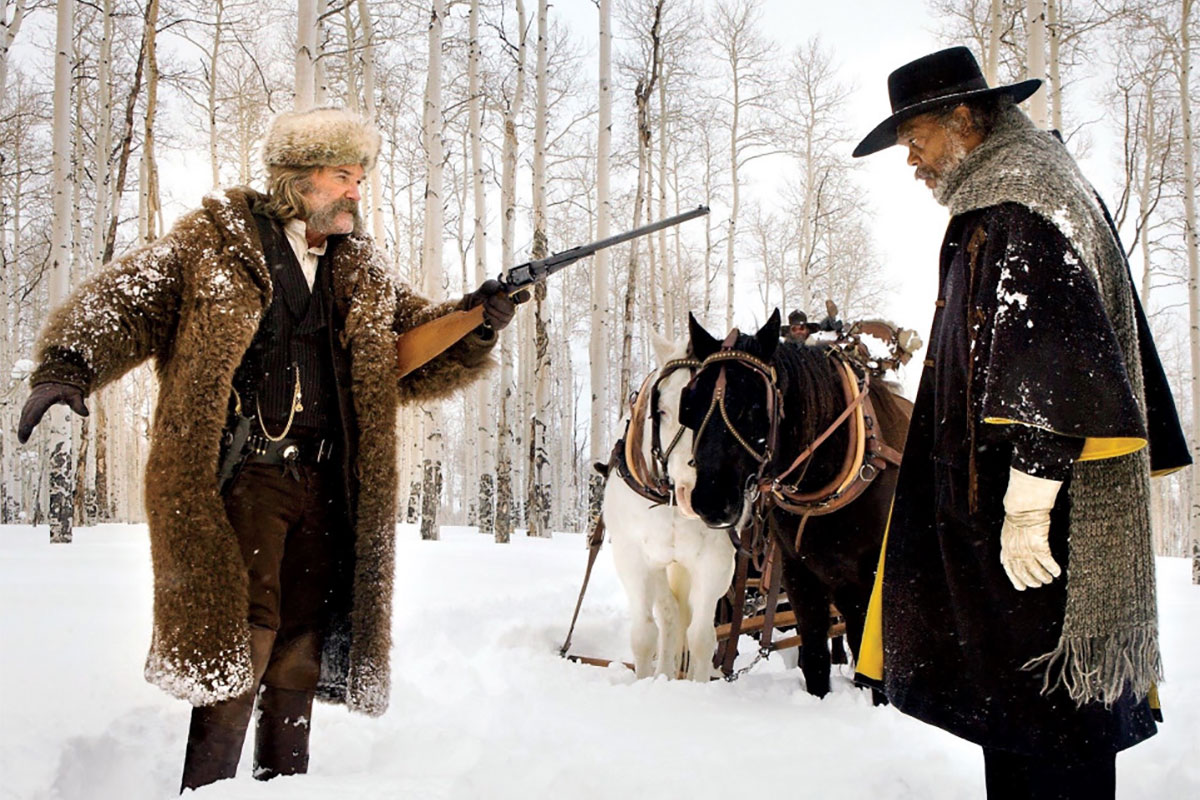
As already mentioned, The Hateful Eight pits eight character’s wits and murderous instincts against each other, all with unique names that accurately reflect their histories and personalities. They include The Bounty Hunter (Samuel L. Jackson), the Hangman (Kurt Russell), the Sheriff (Walton Goggins), the Mexican (Demian Bichir), the Little Man (Tim Roth), the Cow Puncher (Michael Madsen), the Confederate (Bruce Dern), and the Prisoner (Jennifer Jason Leigh), the last of which the plot more or less focuses around. Trapped in a cabin during a harsh winter storm, these eight killers need to keep their wits intact so that they don’t start murdering each other.

This being a Tarantino movie, however, that obviously doesn’t work out very well.

For a lack of a better word, Quentin Tarantino went through hell to get this movie made. First, his script got leaked a few months before he was supposed to start production. Then, he decided to turn his screenplay into a book. When he finally resolved to make it a feature film, he received threats from police officers for participating in a Black Lives Matter protest in New York. Oh, and he had to battle being released in the same month as Star Wars: The Force Awakens. It has not been an easy year for Quentin Tarantino.

With that in mind, I appreciate that Tarantino is still able to make a quality film up to his standards, despite everything he’s been through this year. What is it you love most about Tarantino’s movies? The performances? The dialogue? The characters? The dark humor? The grit? The violence? The shock value? The Hateful Eight has all of that just as much as Inglorious Basterds, Django Unchained, and Pulp Fiction does. To classify it as a western or a comedy or a mystery doesn’t do it justice. Tarantino movies are almost a genre all their own.

That much is how The Hateful Eight is similar to its counterparts. The differences lie in its mystery element, in the characters trying to find the one person slowly, yet violently, killing off everyone else in the cabin. That being confined to eight people makes it difficult to keep this a mystery, as we already know more or less who the “good” guys are, if such a thing can exist in this movie. Regardless, it’s fun to hypothesize and figure the plot out, as there is the added element of mystery that gives The Hateful Eight a sense of intrigue over Tarantino’s other pictures.

As always, the make-it or break-it element comes down to Tarantino’s almost insane obsession with on-screen violence. At times, it gives it that extra shock value that is so ridiculous, you can’t help but laugh about it. At other times, it’s just sick, and it makes you want to throw up the more you think about it. That’s what happened with me and Django Unchained after watching too many nut shots for my own comfort. The Hateful Eight is just as guilty for being violent as Tarantino’s other motion pictures, and while it doesn’t get away with all of its violence (such as the uncomfortable nut shots), it’s still smart enough to survive beyond its onslaught of blood, guts, beatings, bruisings, stabbings, and gore that’s enough to fill up The Shining’s elevator lobby.

Do you like Quentin Tarantino? If the answer is yes, then you will want to see The Hateful Eight. If no, then you definitely don’t want to find yourself alone in this cabin with these eight murderous psychopaths.

Tagged , , , , , , , , , , , , , , , , , , , , , , , , , , , , , , , , , ,

“SPOTLIGHT” Review (✫✫✫✫)

“Shine a light, and let the whole world see.”

In the Boston Globe story on the 1990 Church abuse scandal, the Spotlight team reported that there were over 130 sexual assault victims from just one Catholic priest. In the film Spotlight, we eventually learn that over 80 Boston priests were sexual predators, and were being continuously circulated from parish to parish. If those numbers are consistent, how many victims of sexual assault does that spell out for Boston? My math came down to over 10,000.

I don’t know if that’s accurate because I haven’t dug much further into the Boston Globe’s reporting, but I don’t think that matters. What matters is that Spotlight made me think of those victims. It made me think about the people that you don’t normally think about, the problems that you don’t think exist, and the secrets that you don’t think are being hidden behind prayers and confession booths. Like any great piece of reporting, Spotlight brings importance, urgency, and truth that needs to be known about. If Spotlight isn’t the best film of the year, it is definitely the most important.

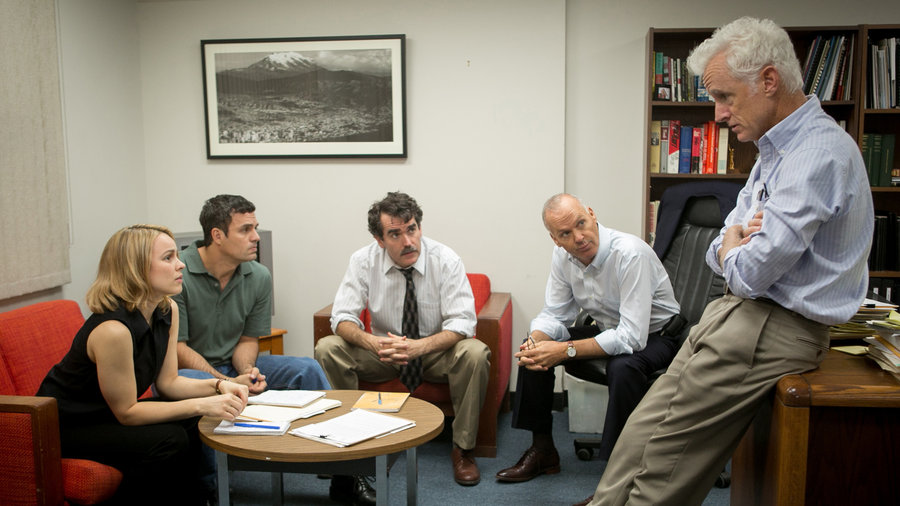
The Spotlight team consists of lead editor Walter Robinson (Michael Keaton) and reporters Matt Carol (Brian d’Arcy James), Sacha Pfeiffer (Rachel McAdams), and Michael Rezendes (Mark Ruffalo). The team is specifically reserved for investigative reporting, previously breaking stories on transit mismanagement and political corruption in Massachusetts. At the time when they were given this assignment, it was not as a follow-up to a news story, but to a column written and published by one of the Globe’s staffers.

At first, no one really thought much of the project. When originally pitched, it had to do with the Catholic church finding out that one priest had sexually assaulted children in six different churches, and did nothing about it. But when the team kept digging, they found out that it was bigger than they anticipated. Much bigger.

While watching Spotlight, I was thrusted upon an early memory of one of my first major news assignments. It was a story called “Seconds Away,” and it was about a university alumna who was just seconds from crossing the finish line before it blew up during the Boston Marathon bombings in 2013. The story wasn’t that she survived. It was that she went back the following year to finish crossing the line that she never did.

While getting ready for our interview, I was excited, nervous, and petrified all at once. This was a woman who had survived a near-death experience. She had faced something few other people have had to face, myself included. I didn’t know how to approach it. Was she comfortable with me talking to her? Would I be insensitive by asking serious questions? Would I be disrespectful by asking what was going through her mind? What would that say of me as a person, by asking her to relive something traumatic that she already went through?

The reporters and editors behind Spotlight face these same questions and concerns of morality every day they step into the office. Yet, they handled this difficult subject in the same way that the movie does: with grace and respect.

The greatest thing that can be said about Spotlight is its transparency: in how its characters charge towards this groundbreaking story and the emotions and conflicts they experience while doing their jobs. Writer-director Tom McCarthy, who was raised Catholic, juggles this behind-the-scenes story with real people’s traumas and emotions in mind. The result is a portrait that is genuine, astounding, mind-blowing, and heartbreaking all at once.

Take the interview scenes as a demonstration of this. During the film’s first scenes, Spotlight reporters sit down with a few sex abuse survivors, their brokenness and vulnerability made evident on the spot. The interesting thing you’ll find in between these intercut scenes is that it’s not Rachel McAdam’s mannerisms we’re noticing. It’s not Mark Ruffalo’s reactions or face of shock we’re noticing. It’s the supporting actors playing these victims, whom I can’t even identify off of the film’s cast list. Every detail of them is absorbing and introspective.

We notice the gay man in a coffee shop as he twiddles his thumbs nervously on his coffee cup. We notice the skinny drug addict sweating, entering the room cautiously, seeing scars up his arms from when he injected himself with heroin. We notice that while their testimonies are overwhelmingly tragic, they talk about it casually and on a whim; like it’s a scar that has already been healed, but will never go away. We listen to their silence as they quietly relive their traumas, the quivering in their voice as they slowly speak, the tears building up in their eyes as they come to once again realize what they are. I find that so compelling, that one of the best things in this film are the actors that I can’t even name.

The rest of the film is like that: finding value in the areas that you can’t exactly point out, but you know they are there. For instance, who’s the main protagonist? You could argue Rezendes, because he has the most visible reaction from working on this story. In reality though, this story is impacting the entire Spotlight team and more. It impacts everyone, in ways that nobody realizes until it walks right up to their doorstep.

This movie takes time and dedication to build up its story and collect the necessary information, just like Spotlight’s reporters do. In doing that, this is undeniably a slow film, but the pace doesn’t matter as much as the payoff. Spotlight deserves to be sought out. It is one of those rare films that not only makes us better viewers, but also better human beings.

Tagged , , , , , , , , , , , , , , , , , , , , , , , , , , , , , , , , , , , , , , ,

“BLACK MASS” Review (✫✫✫)

Fear him. Fear Whitey Bulger.

I would not recommend to any of my friends that they watch Black Mass. It’s not for everyone. In fact, I would argue that it’s not for most. It’s violent, twisted, bleak, convoluted, and has little sense of purpose other than to show us the dark depths of human depravity. In that regard, it is not a worthwhile moviegoing experience. But man, is Johnny Depp’s performance mesmerizing.

In Black Mass, Johnny Depp portrays Jimmy “Whitey” Bulger, a notorious gangster who ruled the south streets of Boston for nearly 30 years. When he was finally captured by the FBI in 2011, he faced a 33-count indictment, including multiple counts of extortion, money laundering, selling drugs, corrupting law enforcement, and committing 19 murders. That number surprises me. After watching the movie, it almost seems low.

How was Bulger able to get away with all of this for almost three decades? Simple. He had help. When his childhood friend John Connolly (Joel Edgerton) was hired by the FBI, Connolly believed he and Bulger could help each other out. As an employed FBI informant, Bulger could provide information to Connolly on rival gangs so the FBI could clean house for Bulger. Meanwhile, Connolly could provide protection for Bulger’s operations as a result of him being an informant. They both end up agreeing to each others terms and Bulger officially enlists himself as an FBI informant.

While watching this movie, I was wondering where I had heard this story before about an FBI informant using the bureau to protect himself from his own criminal operations. Then I remembered Martin Scorsese’s 2006 crime film The Departed, which involved Jack Nicholson’s character also using the FBI to his own purposes. I came to find out that his character was actually largely based around Whitey Bulger’s circumstances. The only difference is that The Departed is somewhat watered down compared to the actual accounts.

Yes, I just wrote that. The Departed is watered down compared to Black Mass. What is the world coming to when Martin Scorsese looks tame?

Black Mass is a sickening, deplorable film, one that outlines one man’s lifetime of crime in disturbing detail. Yet, the film is reasonably sickening because it isn’t actively advocating for Bulger. Indeed, in most of the film, he seems more like the movie’s villain rather than its hero.

So who is the main protagonist then? The movie doesn’t have one. It’s unusual, but it works for this sort of film. This isn’t a story we’re watching, but a report: an account on real-life events that is driven to inform on every detail as accurately as possible. The writers of the original novel, Boston Globe reporters Dick Lehr and Gerard O’Neill, served as consultants on the film, working specifically with director Scott Cooper on what did or didn’t happen based on their experiences.

It is reasonable to say they’re credible sources. Lehr and O’Neill have written numerous books on Boston crime, and Bulger was a key figure in all of their research. Their reporting was thorough and in-depth. They’ve met John Connolly on numerous occasions. Next to the gangsters that have lived alongside Bulger, these two would be the next best accountants on him and his life.

Bringing them on as consultants was wise of Cooper, and his attention to their details brings authenticity to the picture. In one of the most disturbing scenes of the film, Bulger is choking a hooker to death inside of a house. Cooper paused filming this scene because Lehr and O’Neill said one of the gangster that was present in the original events was not present on the set. The fact that Cooper paused filming for such a small detail impresses me. The fact that Bulger wipes his feet, shrugs, and says he’s taking a nap so non-chalantly after killing her disturbs me on how true this is.

Depp is another story altogether. He is completely and utterly eerie as Bulger, perfect in capturing the character’s details and relentless in portraying his acts of violence and cruelty. It’s not just that Depp gives a convincing performance: I literally can’t see any indication that Depp is even in the movie. His being is erased into Bulger’s existence, in his cold, steady stare and his fixed, stoic posture. He’s disturbing in the slurred, snaky voice he speaks in, and how he so casually inflicts pain and death as if he were the Grim Reaper himself. Depp is the highlight of the film, with his portrayal of Bulger evoking memory of Hannibal Lecter from Silence of the Lambs or Jack Torrence from The Shining. His performance isn’t just the best of the year: it’s a challenger for the best of the decade. It’s that momentous and memorable.

If I were reviewing Depp’s performance alone, he would be given four stars, because the truth is his performance is perfect. However, I am not reviewing one actor’s performance. I’m reviewing the movie, and the truth is the movie is sloppy. The camerawork by Masanobu Takayangi is smooth and steady, but everything else in the film is lopsided and rocky. The editing by David Rosenbloom is scattered and choppy. The chronology of events is non-linear and hard to follow. And the screenwriters of the film Jez Butterworth and Mark Mallouk skip an important part of Bulger’s story, which is his upbringing. It doesn’t have to be a flashback either; just simply explaining where the character came from and why he acts the way he does would have sufficed. We’re given clues throughout the movie, but no answers. We are asked to fill in the holes as the movie skips over important questions and just goes to Bulger’s tirades of violence.

Why is the movie called Black Mass? In the 19th Century, a Black Mass was secretly held by a Roman Catholic Church for Satan worship and in mockery of the Christian faith. A Black Mass is a crooked sermon concealing evil intentions. I believe a black mass was made when the FBI enlisted one of history’s most notorious gangsters as an informant. A black mass is also made when we enter the movie theater. The devil’s name is the same in both cases: Whitey Bulger.

Tagged , , , , , , , , , , , , , , , , , , ,

“SPECTRE” Review (✫✫✫)

Back to Bond, baby.

The opening tracking shot in Spectre is masterfully filmed and beautifully consistent, following our subjects smoothly through the chaos of a celebratory crowd like an artist’s hand running down his sculpture. What follows after that is a film less consistent, less smooth, and less artistic, but to hell with being artistic. This is a fun movie.

Following up a few months after Skyfall, Spectre places our hero, James Bond, a.k.a. 007 (Once again portrayed by Daniel Craig) in the middle of a hidden conspiracy of overthrowing the world government and taking over the planet. We can’t go a few decades without Bond dealing with one of those every once in a while, now can’t we?

This time, Bond is after the villainous organization called S.P.E.C.T.R.E., which we’re never told what it stands for in the film (Although in Dr. No, it stood for Special Executive for Counter-intelligence, Terrorism, Revenge and Extortion). At first, Bond doesn’t know exactly what he’s looking for, only having a clue by the deceased M (Judi Dench) to go by. But as he continues to investigate the organization further and further, he finds deeper connections to S.P.E.C.T.R.E. in his enemies from the past, until finally, he finds the deepest connection to S.P.E.C.T.R.E. of all: himself.

What do you think of when you think of James Bond? When I think of Bond, I think of a movie icon who is the penultimate vision of the masculine fantasy. He’s physically astute and sexually appealing. He’s smooth, suave, and has a way with words that is both comforting and edgy. He drinks a lot, but he can hold his liquor. He can fire a gun better than any marksman, throw a punch better than most fighters. He dresses up in nice suits and bow ties, although he does a great job at mucking them up on missions. When I think of Bond, I think of a character that women secretly desire and men not-so-secretly idolize. If he were any more larger than life, he would be a superhero.

Spectre continues the trend of Bond being a stylish action hero, and it continues the trend well. I mentioned in my lead that the film isn’t very artistic. That’s because it doesn’t need to be. After the impressive tracking shot at the beginning, Bond gets into a firefight, dodges a falling building, chases a suspect through the streets, gets into a fist fight, then highjacks a helicopter after it flips over on its axis in the air. And it’s not even the first 15 minutes.

This is something I’m impressed by in a lot of Bond movies, which is the action sequences. Minus the mediocrity of Quantum of Solace, the most recent Bond films have always found new ways to make old conventions interesting. For instance, how many times have you seen Bond take a sip of a martini? How many times have we seen him charm a young woman into the bedroom? How many times have we seen him get into chase, fighting, and action sequences involving all sorts of weaponry and vehicular manslaughter? You think we’d get sick of it by now, and yet, the series has lasted past 24 films. The series is doing something right.

I think part of it is because of how well Craig inherits the role of of James Bond. Sean Connery is always going to be regarded as the most significant Bond actor, because he was the first to take on the role and the one to exemplify most of Bond’s characteristics. Yet, Craig is nearly equal in iconic status because he too portrays Bond with multiple layers, and he does all of those layers well. He’s charming and sincere when he needs to be, manipulative and deceptive when otherwise.

Most impressive to me is that, even in the action sequences, the biggest thing I notice is Craig’s mannerisms. Not the explosions. Not the gunfire. Not the people he’s punching in the face. I’m noticing Craig. Why? Because I’m buying him as a character, not as an actor. I see the anger in his face when someone hits him and he’s getting ready to hit back. I see the cold calculation in his eyes as he’s deciding which targets to shoot first. I’m noticing the surprise on his face as his eyes widen, the panic that sets in when he’s discovered, and the fear piercing through his body when someone he loves is in danger. It’s hard to notice someone’s performance in the middle of an action sequence. Craig makes it seem like a cakewalk.

Of course, director Sam Mendes is also credited for the style of the film as well, with the action and the incredible set pieces making up for most of the excitement of the film. Yet, I’m a little disappointed that, after making one of the most definitive Bond films ever in Skyfall, Mendes reverted to a few conventions of the franchise that worked against it.

Take the characters as a primary example. Who do we have here? A secretive baddie hiding in the shadows, a big, burly baddie that walks and fights like a tank, a figure from Bond’s past that ushers him a profound warning, and the Bond girl, who is as beautiful and striking as ever. Their actors deliver just what is expected of them and what has been delivered before. The secretive baddie hides in the shadows, the big, burly baddie beats up Bond before he is killed, the figure from his past dies, and the girl hooks up with Bond. Not very original, now is it?

And this isn’t a criticism so much as it is a notice. Casino Royale and Skyfall were significant entries to the series because they saw Bond not as an action hero, but as a human being, dealing with his own hurts and pains by taking it out on the mission and his enemies. Here, Bond goes back to hero mode while we just tag along for the ride. That’s not necessarily a bad thing, but when you’re used to seeing one thing, it’s a little bit of a let down to see the franchise take a step back on itself.

In the end, Spectre is like Bond’s rebuilt Ashton Martin after it blew up in Skyfall: It may have the same frame, but it doesn’t have the same ride.

Tagged , , , , , , , , , , , , , , , , , , , , , , , , , , , , ,

“SICARIO” Review (✫✫✫✫)

Your time has come, hombre.

A bleak, haunting scent looms over the frames of Sicario: like decaying bodies that have laid in a drug dealer’s basement for a few days. It’s permanent and disturbing, and remains with you long after you’ve left the theater. In the opening slide, it is explained to us that Sicario is Spanish for hitman. I don’t know what disturbs me more in the movie: who the Sicario is, or who are the people that he’s hunting.

As the movie begins, we watch as a SWAT team is gearing up to raid a house in Chandler, Arizona. The neighborhood is relatively quiet. It’s serene. Calm. Normal. You would never have expected that the cartel was living in the midst of this slight, unsuspecting town.

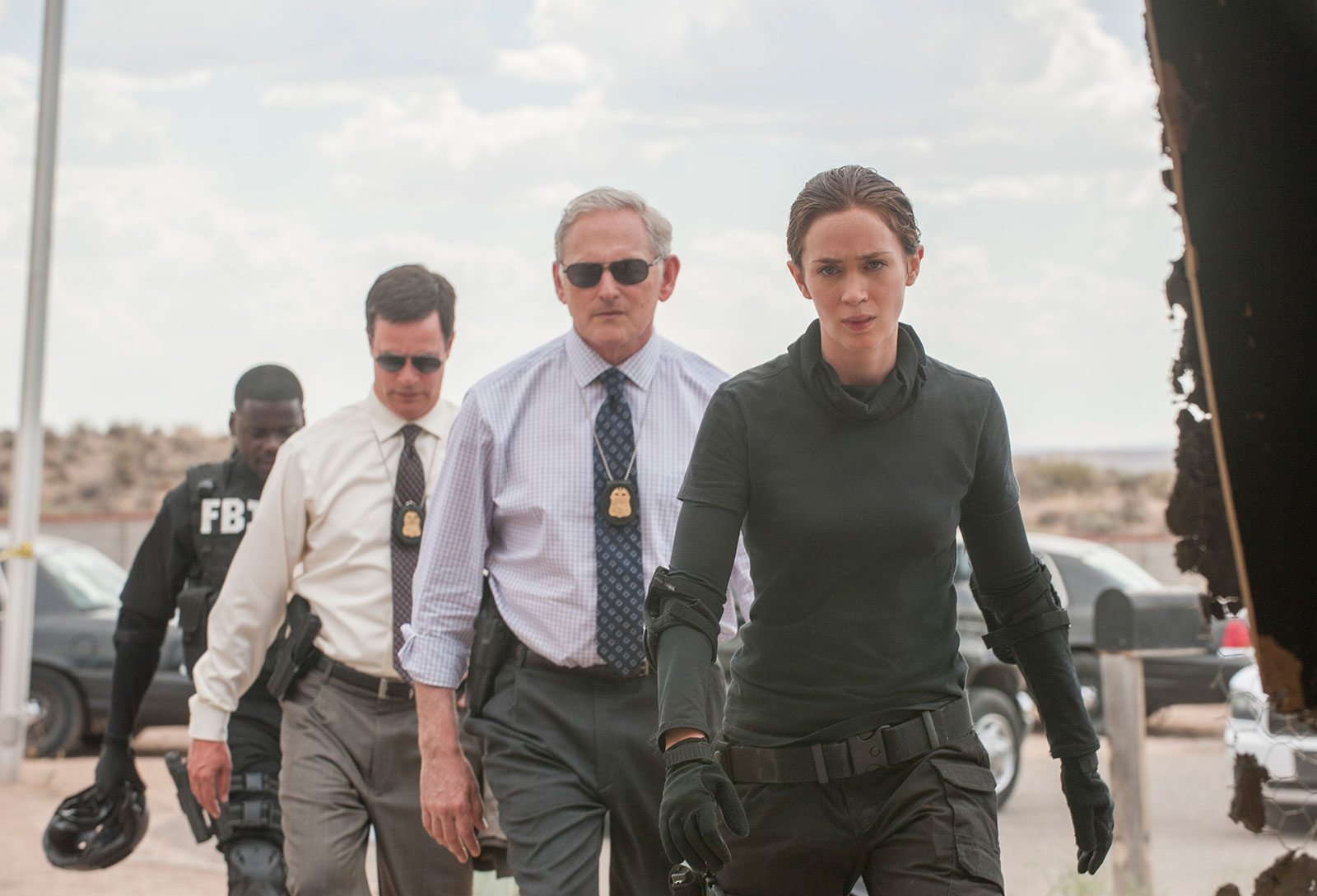
FBI agent Kate Mercer (Emily Blunt) is one of the members on this team. After breaking into the house and engaging in a brief firefight, Mercer discovers the horrible fate of what the tenants did to a group of people they were holding hostage. As the team investigates the property, they go into the backyard and are killed after a bomb blows up from inside the shed. We don’t know how experienced an officer Mercer is, but after the raid, she’s obviously shaken and disturbed by what she saw. This mission has served as sort of a wake up call for her.

Despite her emotions, her superiors were so impressed by her performance that they recommend her for a special op with Matt Graver (Josh Brolin), a CIA officer tasked with finding Manuel Diaz (Bernardo P. Saracino), the cartel boss responsible for the drug plant in Arizona. Matt is offering Kate a chance to get back at the man who killed many of her men. Eager for a chance at payback, she accepts the offer.

When the film begins, I thought the movie was aiming to be a pro-imigration film, pausing and drawing out focus on the many darker sides of illegal immigration near the beginning of the film. This was interesting, I thought, because its rare for liberal Hollywood to go against the grain. As the film went on, however, I realized that the movie doesn’t have a stance on illegal immigration. It shows both sides of the issue, and how each side of the system is manipulating the other in this never-ending cycle of deceit and violence.

Meanwhile, innocents are getting dragged into this never-ending conflict like ants to an extermination. In one of the most pivotal scenes of the film, a kid is playing football in Mexico until he, along with his classmates and their parents, hear screams and gunshots a few blocks away from them. It’s something most of us can’t even imagine in rural America. It’s something children face every day in modern Mexico.

This is the greatest strength of the film, in that it functions in realism, not politics. It’s not interested in taking sides on the issue, because how would that lend to the story? What we have here is a morally-charged drama about characters trying to do the right thing in a world where “the right thing” doesn’t exist. Kate believes a line exists to maintain integrity and order. Matt believes a line exists for integrity and order, and can be manipulated to maintain that idea as such.

There’s one character I haven’t mentioned yet, and his name is Alejandro (Benicio Del Toro). He doesn’t believe a line even exists. Whatever ideas of order and chaos other people have doesn’t matter to him. In his eyes, they’re all one and the same.

Del Toro’s character fascinates me. In many ways, he is the heart of the film. He’s elusive. Mysterious. Unforgiving. Empathetic. Dangerous. He’s helping Matt and Kate, but we sense he’s not here for their end purposes as much as he is for his own. He’s manipulative, yet sympathetic, extending kindness to Kate as if she’s just a little kid suddenly thrown into a grown-up’s world. The third act of the film focuses more on him than it does Kate, and it should. What we’re seeing here is not a progression of character, but a progression of events. The climax itself provides one of the most exciting and unnerving thrills I’ve seen this year: yes, even more so than The Martian and Mad Max. That’s because the stakes are set up masterfully well, and by the end of the film, we understand the characters and the quiet motives that compel them.

This is a nearly perfect film in which all of the elements form together into an excellent scope of filmmaking. The actors are brilliant and could catch your attention just by reading their lines. Director Dennis Villeneuve evokes a sense of hopelessness and desperation from its setting. The cinematography by Roger Deakins captures this aesthetic perfectly and with great focus to detail, while the editor Joe Walker knows how to cut in between angles and shots to help construct coherent ideas in the viewer’s minds. In short, my only complaint is that the film is violent and disturbing. But then again, it’s supposed to be violent and disturbing. What service would that do the viewer if you hid from them the truth?

In one of my favorite scenes from the film, Alejandro tells Kate that there is no book for her to go by anymore. That it’s only a world full of wolves now. I believe him when he says that, and I think Kate ends up believing him as well. The question, then, is this: who are the sheep, and who are the wolves?

Tagged , , , , , , , , , , , , , , , , , , ,

“STRAIGHT OUTTA COMPTON” Review (✫✫✫✫)

The biography of the boyz in the hood. 

Perception is reality.

That’s a motto my newsroom lives and dies by. That’s also a truth that the boys from Straight Outta Compton live and die by. The only difference between us is that we experience it figuratively: they experience it literally.

We witness this early in Straight Outta Compton; as early as the first scene, in fact. Eric Wright, a.k.a. Eazy E (Jason Mitchell) confronts his cousins, who hasn’t paid him yet for the dope that he sold them a few weeks ago. Suddenly, like an Earthquake striking a town, the police ram into the house and start raiding it, arresting any African-American they can find in there. E slips out of the window and onto the roof just in time. He’s survived. For now.

We switch to a less tense scene. Andre Young, a.k.a. Dr. Dre (Corey Hawkins) is sitting on his bedroom floor, listening to classic funk and R&B records on his record player. Dre isn’t like the others in the streets. He doesn’t want to sling dope or be in a gang. He just wants to produce beats and music: a mozart to his suburbs.

His mother Verna (Lisa Renee Pitts), however, isn’t so enthused about his career path. He has a family and a daughter to care for, and he isn’t going to do it sitting on the floor listening to a record player, DJ’ing for a club at night. Dre, however, has his mind set. His future doesn’t lie in cleaning toilets and taking fast food orders. It lies in a DJ mixer and a pair of headphones. Dre knows what he needs to do.

Meanwhile, on the other side of Compton, O’Shea Jackson, a.k.a. Ice Cube (played by his own son, O’Shea Jackson Jr.) is sitting on a bus waiting to go to school. He sees the white kids in another school yard, all dressed in nice clothes, all with newly-bought school supplies and slick cars. Meanwhile, Cube sits in his creaky bus seat, looking at his clothes he probably wore yesterday, and his worn pencil and notepad, which is the only school supplies he has.

He takes his pencil and notepad and starts writing.

These three men, alongside Lorenzo Patterson, a.k.a. MC Ren (Aldis Hodge) and Antoine Carraby, a.k.a. DJ Yella (Neil Brown Jr.) make up the notorious hip-hop group N.W.A. The last two words stand for “With Attitude.” You can imagine what the letter “N” stands for.

Here is a film that, by any standards, is morally despicable. I go on and on in some of my reviews how movies are either incredibly violent, shamelessly sexual, or blatantly vulgar. This movie is all of those things and more. F-words fly out of their mouths like bullets in an uzi. Nude and scantily-clad women flock to these rappers in herds. In some scenes, they engage in sexual intercourse with many attendants watching, all with drugs and alcohol present. Police and gang violence is also present in the film, with crips, bloods, and officers shoving, punching, shooting, assaulting, and harassing each other in very violent, confrontational fashions.

Do not be fooled. This is not an easy film to watch, and if you don’t have a strong moral compass, you will get lost in the violent, sexual, promiscuous, profane, and blatantly explicit content you will find in this motion picture. If you hate hip-hop, you will hate Straight Outta Compton.

That being said, Straight Outta Compton is one of the most compelling films I’ve seen so far this year. The movie is more than the problems it poses. In fact, I’m happy that the film shows the content that it does in the film. It shows the destructive lifestyle these people experience, both on and off the streets, and they confront very real issues that hits them hard at home and at heart. The most significant issue that the movie covers is, of course, police violence. In one of my favorite scenes from the film, one of the police officers that was harassing these young men was not white, but black. My jaw dropped as he continued to berate these men as they were walking away: “Listen to your master!” he said, referring to their white manager.

What I love most about this movie, though, is that it isn’t biased. It isn’t pro-police or anti-police or pro-gangs or anti-gangs. It shows the ugliness of every side of Compton, whether it exists on a badge or on a bandana. Police cruelty is an obvious focus of the film, because it’s a recurring theme in hip-hop and rap culture. I was pleasantly surprised, though, to find at how much the film delved into hood culture and how damaging it is to these young men’s lives. The biggest instances of cruelty came from record producer Suge Knight, portrayed here by R. Marcus Taylor, whose business tactics include physical intimidation, humiliation, fear, confrontation, and violence. If the movie is anything to go by on how the real events transpired, Suge is a monster. He is painted as nothing less than the Godfather of suffering in this movie.

The parallels this movie draws on is ingenious, and director F. Gary Gray is exemplary in realizing the African-American struggle in a poverty-stricken neighborhood and in their aspiration to escape from it. Jackson does very well in portraying his father, and demonstrates the same snarl and attitude with such accuracy that it made me laugh at how similar he looked to his father. Hawkins is passionate and driven in portraying Dre, and while he physically looks smaller than the real-life Dr. Dre, his performance and his versatility in emotion more than makes up for lacking in physical similarities.

The greatest performance, however, comes from Jason Mitchell. In hindsight, he is the character with the most problems. He’s egotistical, he objectifies women, he betrays his friends, he resorts to violence, and he flourishes in the most destructive lifestyle as he bathes himself in a plethora of drugs, alcohol, and sex. In comparison to his N.W.A. companions, he is the most flawed character. But with his flaws comes his emotions to those flaws, his own moments of self-reflection that makes him think back at his decisions, his career, and the life that he’s trapped in. E goes through many emotions in this film, from fear, to anger, to happiness, to sadness, to heartbreak, and Mitchell portrays all of those emotions perfectly. If he doesn’t deserve the Academy Award for best supporting actor, he definitely deserves a nomination.

But at the heart of this movie is the struggle, the struggle that these five young men go through together, apart, individually, and inseparably. Their struggle being not having enough money. Their struggle being having too much money. Their struggle of not having a place in the world, and their struggle of what to do after establishing their place in the world. Like hip-hop, this movie will stir some major controversy for its content and for what messages it sends to its younger viewers. But it’s important to understand that this movie doesn’t set out to prove who is right and wrong. This movie sets out to show a reality. This movie sets out to show their reality.

Tagged , , , , , , , , , , , , , , , , , , , , , , , , , , , , , , , , , ,

“MISSION IMPOSSIBLE: ROGUE NATION” Review (✫✫1/2)

More like a city, or a gated community.

I’m really starting to get sick of these action movies. I know, I know, how do I get sick of action? Well, have you ever seen a television episode over, and over, and over again to the point where it frustrated you just to look at it? That’s where I’m at with these action movies that are getting recycled summer after summer after summer.

I was really hoping Mission Impossible: Rogue Nation wasn’t going to be another recycled action pic. Truthfully, I wasn’t expecting it. The film is at a 93% from critics on RottenTomatoes, while users rate it at a 91%. Metacritic users rate it an 8 out of 10. Cinemascore polls it at an A-. Everyone around me seems to be fervently enjoying the action romp that is Mission Impossible. Everyone, that is, except me.

So what happened? Simply put, I think audiences were expecting something different from me. I’ve seen four of these movies now before watching Mission Impossible: Rogue Nation, and with each one, I got something different. The first Mission Impossible pitted a younger Ethan Hunt against two opposing spy agencies, along with the gravity of seeing his entire team get killed on a deadly mission. The third Mission Impossible found Hunt breaking out of retirement to rescue his wife, who was held captive at the hands of a cruel terrorist threat. The fourth Mission Impossible found Ethan dealing with his wife’s death after the events of MI3. We won’t count Mission Impossible II, because that’s not a real Mission Impossible movie.

With Mission Impossible: Rogue Nation, Ethan Hunt (once again, portrayed by Tom Cruise) is pitted against both his own government and yet another secret spy agency named the Syndicate, comprised of insurgent IMF agents labeled as either missing or dead. That’s it. He has no personal investment in the story, no driving emotional force that focuses on him and him only. At one point in the movie, one of his closest friends gets kidnapped by the syndicate and he starts freaking out about it. Right. How many times did someone get kidnapped in your other movies, Ethan?

His supporting characters includes most of his crew from the fourth Mission Impossible. Ving Rhames is back as Vincent, returning once again to help Ethan Hunt since their first mission in the original Mission Impossible. The comedic relief Benji is once again portrayed by self-employed funny man Simon Pegg. Jeremy Renner returns as William Brandt, acting as Ethan’s voice of reason against all of his crazy ideas of stunts. Considering Cruise does all of his own stunts, I think Renner needs to be his voice of reason off-screen as well.

The first thing you need to know about Mission Impossible: Rogue Nation is that the visuals do not disappoint. The one thing every movie in the series is most known for is its spectacle, and Rogue Nation keeps the tradition going strong. In one fight scene early in the film, Ethan was fighting a swarm of syndicate agents while handcuffed at both his wrists and ankles. In another, he’s quietly struggling against a sniper on top of a German opera production while the performance is still going on. My favorite is probably when he has to hold his breath under water for six minutes in what is essentially an underwater hard drive as he switches out two data disks. It’s important to note, Cruise actually trained with a diving specialist in order to hold his breath under water for three minutes. The sequence we see in the film was actually shot in one take with no edits.

The stunts we see in the film are impressive to say the least. The danger with a fifth entry, however, is that I’ve been impressed four times already. Whatever stunts are to come, I’m already expecting. And since I’ve seen these crazy stunts in four movies now, the effect is dulled before I even see it.

For instance, the big stunt people were excited for in this movie specifically was a sequence where Cruise is holding on outside of an airplane while it is taking off. Impressive as it was, it was the very first scene in the movie. Since I’ve already seen the trailer, I know Cruise survives this sequence, otherwise why would we even have a movie? How am I supposed to feel tension and excitement in a scene where I already know what’s going to happen?

The cast is appropriate, but ineffective. They serve the same roles they’ve done from other movies and that’s about it. How is Tom Cruise as Ethan Hunt? The same he’s been for four movies now. How is Jeremy Renner? About as good as he was in Ghost Protocol, except now he’s less interesting because he doesn’t have the investment and guilt he had in Ghost Protocol. Pegg is the same. Rhames is the same. The only characters that are different are the new characters, which includes its baddie played by Sean Harris and its discount Bond girl played by Rebecca Ferguson. Again, what do these characters have to offer that we haven’t seen before? The late Phillip Seymour-Hoffman did a better job manipulating and pushing Ethan past his limits in the J.J. Abrams-directed Mission Impossible III than Harris did in this movie. And Ferguson? Did she not see Emmanuelle Béart in her brilliantly deceptive performance in the original Mission Impossible?

I caught myself saying one thing over and over again during the film: “I’ve seen this before.” For a movie series that’s lasted past five films, that’s not a good thing. Funny, this movie is written and directed by Christopher McQuarrie, who is responsible for writing The Usual Suspects and Edge of Tomorrow and directing Jack Reacher, all films with their own unique interest and personality. Now he has made Mission Impossible: Rogue Nation, and like Ethan’s assigned missions, his movie blew up in my face after it gave me what it was supposed to.

Tagged , , , , , , , , , , , , , , , , , , , , , , , , , , , , , , , , , , , , , , ,

“MISSION IMPOSSIBLE: GHOST PROTOCOL” Review (✫✫✫1/2)

Pray for Tom Cruise’s sanity.

There is something seriously wrong with Tom Cruise if he is not pissing his pants while scaling up the world’s tallest building in Dubai. In Mission Impossible: Ghost Protocol, he shows he’s more daring by stumping a feat that he matched in MI2 where he free-climbed up a canyon wearing nothing but a safety harness. This time, he’s climbing up the Burj Khalifa building in Dubai, which happens to be the world’s tallest building at a whopping 829 meters. That’s the equivalent of three Eiffel towers.

What is wrong with him?

This feat, among others, demonstrates that Mission Impossible: Ghost Protocol is by far one of the most visually spectacular of all the Mission Impossible movies. It’s also one of the more entertaining ones as well. Like the other Mission Impossible movies, there is never a dull moment, and never a thrill wasted. There is appeal in every scene of every shot, whether it is a ridiculous chase/action sequence, a precise line of exposition, a humorous exchange of dialogue between characters, or Cruise pulling off yet another stupidly insane stunt that would probably kill anyone else. Mission Impossible: Ghost Protocol is the definition of great moviemaking.

Mission Impossible: Ghost Protocol takes place a few years after the events of the third Mission Impossible. Ethan Hunt (Tom Cruise), who was previously happily married to his wife, Julie (Michelle Monoghan), is now incarcerated and in a federal prison in Moscow, Russia. What he’s doing there, we have no idea. Not until later in the movie.

He is broken out of prison with the help of two IMF agents: agents Carter (Paula Patton) and Benji (Simon Pegg), who you would remember as the dorky, but funny, computer geek we saw in Mission Impossible III. They are ordered to break Hunt out of prison for one reason: assistance on an upcoming mission where they have to break into the Kremlin to discover the identity of “Cobalt”, a global criminal who intends to start an international nuclear war in order to issue a new era of peace. His idea is similar to Ozymandias’ in the 2009 film Watchmen: before humanity can be saved, there first needs to be something to save them from. That is, at least, what “Cobalt” believes.

Here is a film where the visual spectacle and design of the film overwhelms the story that is being told. In the two previous Mission Impossible movies, that was a weakness. Here though, I applaud it for its ambition in visual spectacle and for its audacity to impress the audience in sheer spirit and style alone. Besides the climbing of the Burf Khalifa sequence, I can name many other sequences that really impressed me, such as the prison break scene in Moscow, the breaking into the Kremlin, a chase scene between Ethan and “Cobalt” in Dubai, and a final spectacular fight sequence that takes place in a car lot in India. I was so impressed by all of these sequences that I went back to the theater to watch it again just for those scenes alone.

Don’t think for a second, however, that just because the story is secondary to the action, it doesn’t mean it cannot hold up on its own. One thing I was initially worried about with this movie was how it would handle being a sequel to Mission Impossible III, which I thought was a fine way to end the franchise on a happy note. How they tie that movie into this one is brilliant, and there are many moments where we can pick up what happened to Ethan and Julie in between the events of MI3 and Ghost Protocol. This is where the film’s emotional appeal comes from. Ethan is trying to recover from what happened with him and Julie in the past, and as husbands and lovers, we can sympathize with Ethan and his problems. It isn’t tear-wrenching, but it doesn’t need to be. It gets a response from its viewers, and it doesn’t need an explosion and a falling building to get it. As a movie that is action-focused, it impresses me that the movie focuses on all the areas that it needs to: not just the ones that will bring it the biggest bucks.

Cruise, of course, is as slick, cool, and crazy as he always is, and comes back to this movie with the same charm and charisma that made him an icon in the original “Mission Impossible” movies. Paula Patton, who is most known in supporting roles like “Déjà Vu”, “Precious” and recently “Jumping The Broom” plays here yet another supporting role who is just as effective in other movies as she is here. She is smart, ambitious, and incredibly passionate, who puts in everything she can into every shot. And, if I may say so, she looks damn good while doing it.

Two actors who I felt had great presence in the film: Benji, played by Simon Pegg, and a new character named Brandt, played by Jeremy Renner from The Hurt Locker. I loved both of them in this movie. If Cruise and Patton provided the action-packed, exciting moments in the movie, these two provided the comedic relief. I can remember countless lines of dialogue from them both that made me and everyone else in the theater laugh. One especially funny scene was basically a re-enactment of the iconic dangling scene from the first Mission Impossible movie. Was it exciting, suspenseful, and nerve-wracking? Yes, but Benj’s oblivious comments combined with Brandt’s agitated responses culminated for a very funny moment that started off very unnerving and heart-pounding. Few films have the capacity to be able to switch from one tone to another; this film does it with surprising efficiency.

Perhaps the most surprising thing about this film is that this is the director’s first live-action film. Director Brad Bird is famous for animated critical successes such as The Iron Giant, The Incredibles, and Ratatouille, but no live-action films prior to Mission Impossible. How was he able to make this and make it look so amazing? Mission Impossible: Ghost Protocol is visually spectacular, sharply humorous, and relentlessly spirited and invigorating. It may not be the best Mission Impossible, but it is definitely the best sequel.

Tagged , , , , , , , , , , , , , , , , , , , , , , , , , , , , ,