Tag Archives: Comedy

“AMERICAN PSYCHO” Review (✫)

Sex, murder, and the decrease of the human condition.  

American Psycho is a vile, sickening experience, a gruesome and aching film incapable of human thought, feeling, comfort, or emotion.  This shouldn’t come as too much of a surprise considering the book in which it is based on inspired this same controversy.  Regardless, its achievement cannot be denied: the filmmakers have somehow concocted an experience as brutal, uncomfortable, disturbing, half-lapsed, misogynic, and morally reprehensible as this that they’ve come to completely disconnect with their audience.  I rarely feel this upset about a movie like this.

American Psycho follows the story of Patrick Bateman (Christian Bale), a successful businessman who works in his high-level office by day and parties fiendishly with his friends by night.  On the surface, Bateman looks like a normal upper-class bachelor.  He eats out at expensive restaurants, drinks exquisite martinis, has sex with beautiful women, enjoys swearing gleefully with his friends, and listens to a variety of experimental music.  In appearance, Bateman is the visible representation of the upper class: stoic, upright, eloquent, fashionable, and spoiled.

As the plot progresses, however, we come to understand more about the darker side of Bateman’s personality.  He doesn’t just have sex with beautiful women: he mutilates them.  He tortures them and fantasizes about killing them in horrible ways and playing with their bodies after he’s done dismembering them.  His kitchen pantry contains axes, blades, and tools he uses for his killings.  He draws his victims in a notebook he leaves at work.  A female head sits next to his ice cream in the freezer.  If there wasn’t wine in his alcohol bottles, it would probably be blood.

Ugh.  Just talking about the premise nauseates me.  Why do we need to experience this?  Bateman is a sickening character, a man who would dismember the head of one unfortunate female and chew off the genitals of another.  Why?  For what purpose?  His motivations are never explained in the movie and his reasonings for murdering women are a mystery to us.  Is there a reason for this?  Is there a reason for being so non-inclusive with your audience? Why must everything be shrouded in secrecy?

This is the film’s biggest problem, besides the violence and the sexuality: Patrick Bateman is a deplorable character, difficult to understand and impossible to sympathize with.  You might think its impossible to sympathize with a murderer of women anyway, but it isn’t really.  We’ve ben asked to sympathize with deplorable characters before, including a psychotic war veteran in Taxi Driver to ruthless murderers and drug dealers in Goodfellas.  Sympathy and interest worked with those characters because one character was struggling to find a line of morality and righteousness to follow, and another was hesitant and even regretful over the actions that he’s done.

Bateman doesn’t regret his decisions nor chooses to change them.  He kills instinctively, almost like he’s trying to prove some territorial point to the people around him.  To put it out there in gruesome, violent fashions like this though is just torturous.  Who wants to sit there, eyes on the screen, watching him laughing as a petite blond girl in front of him cries pleading for her life?

But American Psycho isn’t just sickening, repulsive, and pungnent: the film’s logic is half-lapsed, incomplete, and flawed, incomprehensible to the viewer and extremely frustrating to those trying to figure out.

I’ll give you an example.  There’s one scene where’s Bateman is chasing one of his victims through the hallways of a hotel, half naked, screaming manically, and revving his chainsaw like Leatherface from Texas Chainsaw Massacre. Someone explain to me how no one from the hotel hallway heard the ruckus from outside their rooms, or anyone from the two floors above and beneath him?  Here you have Jack Torrence running through the hallways screaming at the top of his lungs with a lawn mower, and nobody even bothers to call the police.  What?  Are the wooden doors sound-proof?  Who knows, maybe they’re afraid of poking their heads out the door so that they won’t get their heads chopped off.

Due to a revelation revealed later on in the plot, one could argue this is a “dream sequence”, or a “vision” Bateman had.  But how is there any way to know?  With Bateman’s maniacal, wretched mind, dreams feels like reality and reality feels like dreams.  How is there any way to read the subtext when you’ve made your narrative so damn hard to figure out?

And this is a movie that is being hailed as a dark comedy.  A comedy for what, exactly?  The film is two graphic hours of bloody, sickening, gruesome violence and pornography.  When, at any point, is it set up to inspire laughs?  In movies like Pulp Fiction and Fight Club we are at least given subtle moments of clever dialogue to clue us in to the humor, and even though stomach-curling things are happening on screen, we are able to suspend that  briefly in order to enjoy the humor.

American Psycho is not subtle, smart, clever, humorous, or any of the related adjectives.  There’s a point director Mary Harron is trying to express through the film, but that point is convoluted, vague and shockingly illiterate.  As a result, what we’re ultimately watching is an idle, pointless, and misconstrued film, and our reward for watching is hours of punishment, nudity, sexual immorality, blood, torture, macabre violence, and sickening indecency.  To be fairly honest, I probably need a second viewing in order to fully understand the picture, but the plain fact is that the movie doesn’t deserve a second viewing.  If I end the film feeling as punished and as mutilated as Bateman’s unfortunate victims, why on earth would I want to subject myself to that again?

At the end of the film, Bateman himself admits that he finds neither closure nor catharsis for his bloody, violent, sexually immoral and murderous journey.  For that matter, neither do we.

Tagged , , , , , , , , , , , , , , , , , , , , ,

“MONSTERS UNIVERSITY” Review (✫✫✫)

Class is now in session.  Please open your fright books to page 237. 

Boy, will this bring back memories for you when you’re seventy.  Monsters University does a rare thing with its premise that Pixar does with all of their movies: it incorporates real-world ideas and principles and relates them to the simplistic joys of a kids movie.  Pixar isn’t alien to this concept: with WALL-E, you witness the effects of industrialism, with Up and Toy Story 3, the truth of loss and growing up.  With Monsters University, we are given yet another truth, a truth about changing dreams and the pursuit of a higher education.  It’s not as potent as Monsters Inc., but that’s another issue.

Taking place years before the events of Monsters Inc.Monsters University opens on a young Mike Wazowski (Billy Crystal), a punky little eyeball who dreams of growing up to be a scarer for Monsters Incorporated.  His gateway into that dream lies in Monsters University, a college mostly known for its Scaring Program.  This college is intimidating, a buidling filled with dark curtains, creaky floors, and echoed hallways, the perfect place for Scare students.  I’d hate to see what the Art Department looks like on this campus.

So Mike Wazoswki immerses himself in his studies and in his bookwork, determined to be the best scarer at the University.  There’s only one obstacle in his way: James P. Sullivan (John Goodman), a cocky, overly-confident jock who thinks getting through college is about a big name and a big roar, which is about the only two things he’s got.  In their first semester at Monsters University, Sully is showing Mike up in every single scare opportunity, and Mike shows Sully up on every test and oral exam.  Monsters University chronicles their adventures together, from their chance introduction, to their rivalrous exchanges between each other, and finally, the unlikely friendship that forms in between them.

Here is a movie that features the typical staples of a Pixar film: a good concept with a well-written plot, all forming together with fluid animation and wonderful voice-acting.  Directed and co-written by Dan Scalon (The other two writers being Robert Baird and original Monsters Inc. writer Daniel Geirson), Monsters University is a story that combines clever, witty humor with that of a conventional, enjoyable story, even if it is at times a tad predictable.  It’s easy to appreciate the humor in the film: even the names of Monster fraternities are enough to utter a chuckle.  Admit it: how can you not smile when hearing the names “Roar-Omega-Roar”, or “Oozma Kappa”?

This is the kind of cleverness in Monsters University: the kind that takes real-world truths and facts and parodies them in a children’s cartoon.  I’ve always appreciated this about Pixar: they’ve always made their work smarter and more profound than other animated films, therefore allowing adults to enjoy their films just as much as the kiddies do.  Whenever you see a slug-like monster rushing at slug-like speed trying to get to class, or seeing a brush0like monster put paint in his hair and go “Ker-Splat!” on a canvas, the cleverness and the humor cannot help but shine through the brightly-colored and textured animation in this film.  Here, the monsters come in all shape, sizes, and breeds in University, and they plop, bang, clang, sneak, slither, and scare in all forms chaos and hilarity on the screen.  Crystal and Goodman, of course, need no comment about the liveliness of their roles.  You only need to see the first Monsters movie to understand how perfect they are in their voice acting.

The important thing to remember here is that Monsters University is not Monsters Inc., and I mean that sincerely as a compliment.  There is no doubt bits and pieces of Inc. that we can piece together in University; it’s charisma is intact, its wit and cleverness in-diminishable, and it cares just as much for its characters as Inc. does.

What its missing, then, is not intelligence or technical efficiency: what its missing is heart.  Or at least, as much as Monsters Inc. has.  To illustrate my point, I bring up a pivotal scene from the original Monsters movie: remember the scene where Sully had to say goodbye to Boo?  Do you remember the scene where he frightened her?  Do you remember Sully playing with her in her room, telling her in his deep baritone voice “Kitty has to go”?  Do you remember that when her door was torn to shreds, he kept one little piece as his reminder of Boo?  And do you remember Mike piecing the door back together, turning it on, and letting Sully open it to find a little girl whispering “Kitty” on the other side?  Do you remember the emotion?  The heartbreak? The happiness?

That “Aww” moment in Monsters Inc. is nowhere to be found in University.  I’m not saying there isn’t emotion in there: there are plenty of deep and convincing moments of well-made drama between characters, and they are done well enough for us to be compelled to care for them.  I’m saying the emotion isn’t done as well, or as effectively, as it was in Inc. to the point where I felt a deeper connection to the characters, almost as if I was in the room saying goodbye to my best imaginary friend.  Someone might think I’m being unfair by comparing this prequel to the original, but that’s the game Pixar is playing here.  Didn’t they know people would automatically look to the original when trying to decide which one is their favorite?

But I digress.  Monsters University is fun, intelligent, and dare I say it, relevant entertainment.  The animation is as stellar as always, it makes its characters compelling, it sets them up properly in line for their inevitable trip to Inc., and it makes a funny connection in between the audience and their own college years.  I strongly recommend you sign up to join the student body at Monsters University.  Just make sure you stay away from the Art Department.

Tagged , , , , , , , , , , , , , ,

“THIS MEANS WAR” Review (✫1/2)

Spy vs Spy in the most imbecilic way possible.

I hate formula movies.  I hate em, I hate em, I hate em.  They are predictable, repetitive, and annoying in nature, deafening and forgettable by default.  It doesn’t matter what genre its from: if it follows the formula, premise, or plot-line of another film, it is automatically doomed for failure.  You’ve never heard of Mac and Me because it isn’t E.T., and you don’t remember The Mummy because it isn’t Indiana Jones.  Why on earth, then, would we remember this when we already have movies like Rush Hour, Lethal Weapon, and Men In Black?

This Means War is one of those movies that follows its formula so strictly, it treats its premise like its their only chance of survival.  Imagine the movie like the sinking Titanic, and the small plank of wood (the formula) is the actor’s only hope of survival.  Director McG should have actually seen Titanic though: the plank of wood didn’t have the strength to support its two leads.  What makes McG think that here it would support three?

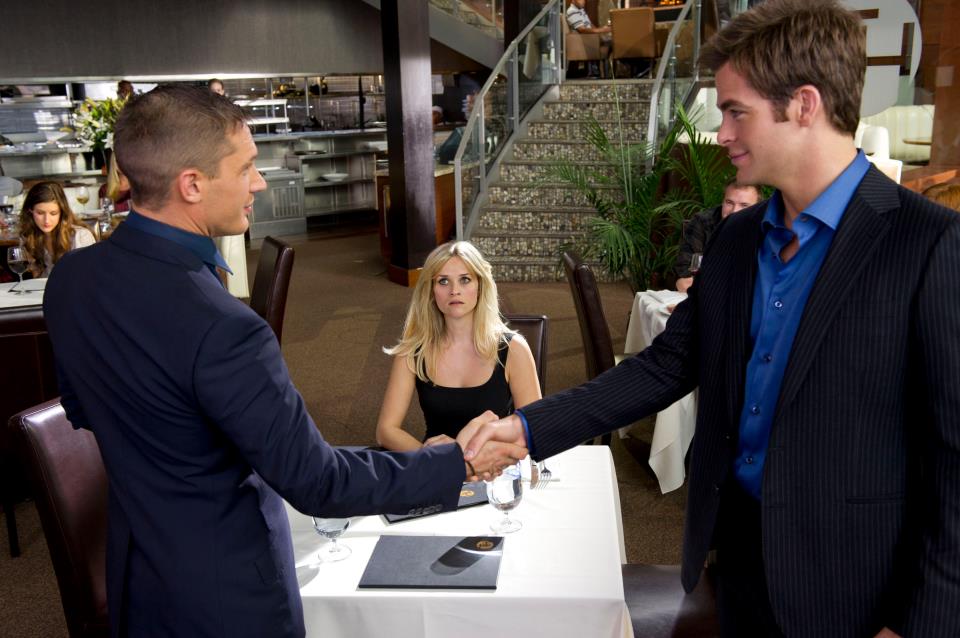
This Means War follows the story of two CIA agents: partners, allies, goody-goody beer buddies.  FDR (Chris Pine) is an active womanizer who is always on the lookout for new jailbait.  Tuck (Tom Hardy) is his less-lucky friend who is divorced, has a son, and struggles to even find a date.  Lauren (Reese Witherspoon) is a bold, intelligent, and beautiful product-testing agent who struggles to find love.  Oh boy.

These are our characters: one of them a pleasure-seeking playboy and the other two romantically hopeless until they discover online dating.  And when Tuck arranges for a date online with the beautiful, yet oblivious, Lauren, their date leads to another coincidence encounter that could only happen in a movie: FDR, who just happened to be looking for a video in the rental store when he ran into Lauren.  From there, you can predict what the movie is: a spy-romantic-action-“comedy” about two expert CIA agents fighting over the same girl.

Har har har, hee hee hee.  How original.  Hasn’t this been done before?  How many times have we seen movies, television shows, novels, and even comic books about competing love interests?  I’m all for the buddy-cop-turns-rivalrous-romance gag, but the material in the story must be funny and/or clever in order for it to back up its lack of originality.

Expect none of that humor, wit, or emotion in this movie.  This Means War is mind-numbing, a sterile, unfunny, and idiotic film that tries to win us over with confidence and charisma, but instead rubs us off with immaturity and annoyance.  There’s no reason to care for these characters.  The emotion is artificial.  All of the jokes are unfunny, and they dilute to topics as silly and insignificant as alcohol in a baby’s bottle, or sex jokes involving Cheetos.  No, that was not a typo.  Think of how many jokes you can make about a small, orange, stubby-shaped object.  I’ll bet Chester was happy to hear about the product placement, though.

The greatest hinderance of this movie is its writing, where every single line of dialogue carries over its insincerity and its dependency on its paper-thin premise.  The dialogue is so shockingly dumbfounded that I wanted to rub my fingernails on the chalkboard owned to whoever taught these screenwriters how to write.  The smartest lines of dialogue in the film include something like “What do you do when you don’t know what to do?” or “You have the intelligence of a fifteen year old boy!”.  Well, at least we’re on the same page here.

The only redeeming factor of this movie is the cast, who at times deliver their lines with whimsicality and good humor.  Even then though, their roles are wasted.  Their characters are so stupid, half-witted, and immature that they could only be artificial.  Take, for instance, Reese Witherspoon’s character.  How is it that a woman like her gets all of these advances and radical emotional changes from both of these guys, yet she continues to remain so clueless and oblivious like she’s out on a first date?  Explosions go off and these guys go kung-fu on each other and you still think they’re just travel agents?  Sorry, I’m not buying that.

Do I really need to elaborate any more here?  I’ve already said why This Means War is terrible, and I hope my point is made.  The chemistry is flat, plastic, and unbelievable, the dialogue, even more so.  The plot is stock, unoriginal, and lifeless.  The visual effects are so bad, you can see the CG on a car when it goes flying from an explosion.  The villains, especially, are extremely lackluster and uninspired.  What is more stock, for instance, than a Russian baddie trying to get revenge at two secret agents who killed his brother?

This, from the same guy who gave us We Are Marshall.  What happened to McG?  He was so great with that film, filling it with so much life and emotion.  Terminator Salvation, preposterous as it may be, was also darkly atmospheric and marginally entertaining.  Now, he’s here scraping the bottom of the barrel with This Means War, giving us no sanctuary from conventionalism, but instead, wooden planks to float on it.  Let it sink, McG.  Please.  Let it sink.

Tagged , , , , , , , , , , , , , , , , , , ,