Tag Archives: Comedy

“THE AMAZING SPIDER-MAN” Review (✫✫✫1/2)

♪Does whatever a spider can♪

If I were to have a reboot of one of my favorite superhero films made just ten years ago, The Amazing Spider-man would be that reboot. What can I say about the film that will accurately do it justice? That it is exciting, suspenseful and displays visual effects that leaves the old one in the dust? That the writing is just as acute and skilled as the direction is? That Andrew Garfield has perfect chemistry with Emma Stone? No. Instead, I will describe the film by simply using just one word: amazing.

When Peter Parker was a young, bright-minded child, he lived in the content and warmth of his parents home. When his house was broken into, his father’s office searched through in every crook and cranny, his father Richard (Campbell Scott) quickly packs a suitcase, drives Peter to his Uncle Ben (Martin Sheen) and Aunt May’s (Sally Field) house, and tells Peter him and his mother will be gone for a while. A few days later, the plane that Peter’s parents were on was reported to have crashed. They didn’t make it out.

Twelve years later, Peter (Now played by Andrew Garfield), now in his teen years, is in high school, gets picked on by the local bullies every now and then, and has a crush on this pretty blonde-haired genius named Gwen Stacy (Emma Stone). While in the basement one day helping his Uncle unclog the water pipe, Peter makes an interesting discovery: his father’s briefcase, filled with notes, theories, and algorithms Peter has never seen before. While looking and studying the notes his father left behind, Peter realizes everything points to one scientific company in particular: Oscorp.

From there, Peter snoops around, goes into a lab he wasn’t supposed to go into, a radioactive spider bites him, and well… you probably already know where it goes from there.

If we look at the story, it is on repeat from the first Spider-man. But the repeat isn’t what we care about. The Amazing Spider-man is done with a new style, energy, and enthusiasm to it than the original one was. Funny, I didn’t expect this movie to be as energetic as it is. This film is directed by Mark Webb, who to date, his only directing experience being music videos and the 2009 romantic-comedy 500 Days of Summer. Quite a difference in genres, I know, but Webb handles the transition well. He makes Spider-man as he sees it, as a young man coming out of puberty using his powers for playful, mischievous reasons rather than the heroic acts of courage and responsibility that most heroes are known for. This Spider-man is more jokey and sarcastic than the original one, spitting witty one-liners while arresting a criminal or web swinging past bystanders.

He fuels the action scenes, inspires laughs, and is the source for original entertainment. If Tobey Maguire is the more emotional Spider-man, this Spider-man is the more sporadic and amusing one.

Andrew Garfield does a great job in portraying this Spider-man in a totally different dynamic. His character is definitely different, retorting to puns, jokes, and one-liners that would only result with awkward silences if Tobey Maguire tried to pull off the same thing. Garfield, however, is more talented than a one-dimensional joker. Like any great actor, his character portrays a flurry of emotions, and he portrays all of these emotions well. We can tell exactly when he is troubled or concerned, when he is angered and enraged, when he is happy and content, or when he is saddened and alone. Peter experiences many tragedies in this movie, and Garfield does a good job expressing the emotions for all of them. Emma Stone, equally, is incredible in this movie, providing the film’s beautiful, smart heroine. Together, their chemistry is irreplaceable, and forms a romance that rivals that of the chemistry Maguire and Dunst made in the original Spider-man movies.

Here is, regardless of pre-conceived opinions, a great movie. It is a blockbuster that does a great job balancing in between spectacular action, heartfelt emotion, and genuine humor, all combining into a reboot that makes it not only fun, but unique in its own right.

From a technical perspective, this film has no flaws. It, however, is not about what it did wrong; its a matter of who did it better.

The biggest weakness with The Amazing Spider-man is its release date. This is ten years after the first movie came out, and five years after its most recent one. Why did it need a reboot? It cannot help but bring up the comparison game when you watch this movie. And what happens when you compare things? You recognize which one did things better, and which one did things weaker. In comparison to the old one, The Amazing Spider-man cannot help but look inferior.

But how, exactly? The flaw exists in the writing, dear reader. There are just simply not enough moments in the film that are as emotionally real or relevant as there was in the first two Spider-man movies. Take, for example, the scene in the original Spider-man where Peter’s Uncle Ben dies because Peter did nothing to stop a criminal that ran past him. In the original film, this was a tragic, painful, and heartbroken realization for Peter that it was not the burglar who killed Uncle Ben, but Peter’s inaction and lack of doing the right thing. Here, it’s just on repeat as something that Peter needs to go through in order to become Spider-man. Peter, however, never acknowledges his responsibility in the matter, and neither does he ever even confront the criminal. How, then, does the issue ever become resolved? Answer: it does not. At the end of the film, everything is resolved except for that one specific conflict.

That’s the film’s only real weakness. I don’t want to go on about this weakness, though, because I’d be beating the bush. The main point: The Amazing Spider-man is still utterly fantastic. It is action-packed, suspenseful, energetic, relentless, exciting, humorous, and highly, highly entertaining. The production is all-around strong, the cast is even stronger, and the story is as driven and purposeful as it has ever been, despite a few moments of misplaced emotion. This is a reboot to one of my favorite superhero films of all time, and the surprise is I wouldn’t mind seeing a sequel to it in the slightest.

Tagged , , , , , , , , , , , , , , , , , , , , , , , , , , , , , ,

“HER” Review (✫✫1/2)

What on earth did I just watch?

How do you fall in love with a computer program? Throughout the entire runtime of Her, that’s the only thought that was peaking through my mind. I wasn’t thinking about Joaquin Phoenix’s deliberate performance. I wasn’t thinking about how sweet and serene Scarlett Johansson’s voice sounded. I didn’t think about how clever the story was or how passionate Spike Jonze’s direction was. The only thing I was thinking about was how hard it must be to maintain a relationship with a piece of machinery. Can you imagine how awkward those morning encounters must be?

Taking place in the not-too-distant future, Her follows the story of Theodore Twombly (Joaquin Phoenix), an introvert and manic depressive who writes love letters for a living and has recently gone through a divorce with his wife Catherine (Rooney Mara). Theodore is not in the most stable mindset as the movie begins, and as an effort to feel less lonely, he purchases an artificial intelligence who names herself “Samantha” (Scarlett Johanson) to help him with his everyday needs. What goes from there is a grand journey of self-discovery, identity and romance as these two gradually come closer with each other and eventually fall in love.

For those of you who have seen the movie, does that paragraph just about do it justice? I could go deeper into the plot synopsis, but why would I? From just those three sentences, half of you have already decided whether you would like the movie or not. There are, no doubt, some introspective and provocative thinkers out there who will find joy and enchantment with this story, while other viewers will watch it and ask themselves what on earth they just watched.

For me, I went in an open book. I knew that the movie had an opportunity to woo me, that it was a strange and outlandish idea to begin with, but that the idea doesn’t matter as long as it was handled and carried out well. How did the movie do with that?

Eh. I’d rather watch 1 Night In Paris. 

Like its central idea, Her is a strange movie, a surreal and against-the-grain picture that challenges a lot of misconceptions about love and relationships. While I like that and think it has a lot of great ideas to offer its viewers, I find them so hard to focus on while we’re watching Joaquin Phoenix having sex with a machine.

Yes, there are sex scenes in the movie, although I hesitate to even call them that. There are two that we actually see, but from their conversations we actually infer that there were plenty more.

The first one isn’t really a sex scene, but more or less a copycat of phone sex with Scarlett Johansson’s voice (which I’ll admit, didn’t bother me that much at all). The second one, however, was out of this world weird, with Samantha hiring a surrogate (prostitute) for Theodore to have pretend sex with. They’re trying to justify it by saying that she isn’t a prostitute and that she’s just trying to be a part of their experience, but that argument is null and void. She’s provided sexual services in exchange for something else. She’s a prostitute.

Don’t get me wrong: there are many emotional moments that the movie handled surprisingly well, and there’s an undeniable sweetness and sentiment to the story that can’t help but be noticed. Despite her being a machine, Samantha has a surprising amount of layers to her, being an in-depth and interesting character and love interest in her own right, while the human characters contribute the more grounded relationships that make more sense than that of Samantha’s (Including a recently-divorced Rooney Mara and Amy Adams, who offer very interesting parallels to Twombly’s exotic love story).

Joaquin Phoenix, however, is the flesh and blood of the film. His performance is nothing less than exemplary, playing this shy introvert so convincingly that its hard to imagine that he at one point portrayed Johnny Cash. His character reminds me of many of cinema’s most memorable introverts, ranging from the autistic-yet-brilliant Raymond Babbit in Rain Man to the hyper-obsessive and socially distant Mark Zuckerberg in The Social Network, or the paranoid John Forbes Nash Jr. in A Beautiful Mind. All of those movies focused on characters that struggled romantically and socially, and how much they struggled with their identity and being themselves. I love it when movies reach into characters that deep and personally, and if the film focused more on Twobly’s personality rather than that of his love and attraction to his operating system, the movie could have ended up being way more successful.

I can’t help but keep thinking about how small Her’s audience will be. In this day and age, art films are getting harder and harder to advertise and appeal to mainstream moviegoing audiences, and this movie is definitely no exception. I know the film’s premise doesn’t matter as much as how well that premise is handled, but there are some movies that just can’t get away from their bizarre ideas. Case in point: did anyone really expect Quentin Dupieux’s Rubber to be a good movie?

I stress this again: the main character is in love with a computer program. If you can buy that and get over that to enjoy the movie, good for you. But there are no doubt others who will not enjoy this picture, and I can’t help but think that they will be a more sane person because of it.

Tagged , , , , , , , , , , , , , , , , ,

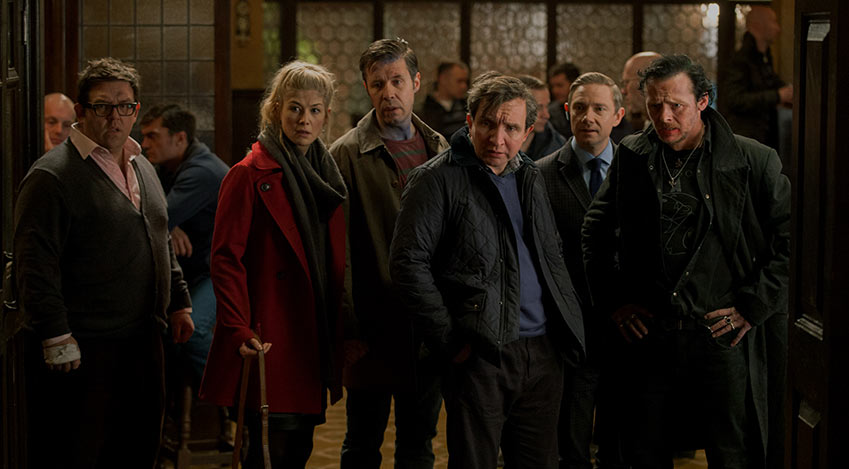
“THE WORLD’S END” Review (✫✫✫)

These poor dims have had too much to drink.

We’ve all known that kid somewhere in our high school years. Yes, you know who I’m talking about. That kid. That kid as in, the troublemaker. The smart talker. The womanizer. The drinker. The guy who turns heads and raises eyebrows, the guy whose only concerned with having a good time and not much else. They act on impulse, spontaneity, paying no second thoughts to doubt or common sense. They don’t think about their future or what they’re going to do after high school. They don’t live in the future. They live in the moment.

That same trouble-making, lady-loving, drink-guzzling, bad-mouthed rebel is known in this movie as Gary King (Simon Pegg), a poor old sap in rehab who misses the old days and just wants them back again. In order to do this, he reaches out to his old british friends from high school to go and complete “The Golden Mile”, a long pub crawl of twelve different pubs in his old town of Newhaven, where the crawl ends at the most popular pub of all, appropriately called “The Worlds End.”

His friends are now all estranged successful businessmen, but they all lack the energy and perhaps foolhardy excitement that Gary loves to constantly express. Perhaps the best of his friends, however, is one Andy Knighly (Nick Frost), a once-cheerful young fellow, now an old, depressed office worker trying to win back the affections of his wife and children. The last thing he needs is to go on this trip with Gary, but if there’s one thing Andy knows, its that you don’t say no to the King.

They go to their hometown where they started the Golden Mile, and they notice a lot of things have changed since they were last there. Why? Well, that’s because alien robots have taken the town over.

……WHAT?!?!?!? No, dear reader, I am not drunk. Alien robots took over Newhaven, and Gary King discovers this by knocking one’s head off after he slid on his own urine in the bathroom. When he recoups with his friends later on at the bar, they decide that they need to keep going on their route so as not to raise suspicion, and later quietly slip out of town. Sounds pretty simple, right? Not when you have four drunk guys traveling along a total fool. Good luck with that, fellas.

Co-written and directed by Edgar Wright, The World’s End is the birth child of an unofficial trilogy of Pegg, Wright, and Frost’s previous work together, including Shaun Of The Dead and Hot Fuzz. For those who’ve seen those previous movies and are expecting a pompous, outlandish experience just like those pictures, you’re not far off. The World’s End is, by every definition, a ridiculous, ludicrous, and far-out experience, a preposterous and purposefully silly picture to the point where it surpasses being stupid and starts being funny. It’s like those older television skits by Monty Python: they undeniably immature and stupid by nature, but there’s an inherent wit and silliness to them that can’t help but make them so much fun.

Case in point: Simon Pegg and Nick Frost’s chemistry. In the past, their character’s relationship involved a budding romance in a cheesy “You’ve Got A Friend In Me” type of ordeal. Here, the relationship is more strained, almost like Frost is a babysitter and its his turn to supervise little baby Simon so he doesn’t eat sand from the playground. Their characters are hilarious because they’re polar opposites: because Pegg plays the ambitious, over-the-top party boy while Frost is the more conserved, more easily frustrated business man.  Remember the chemistry between John Candy and Steve Martin in Planes, Trains, and Automobiles, where the frustrated business guy (Martin) keeps having to monitor the guy (Candy) who is oblivious, foolish and hopeless? Same case here, although the roles are more or less switched between the two actors.

And then the robots. Oh my God, are they hilarious. In Shaun Of The Dead we had zombies, and in Hot Fuzz we had crooked cops. Now, we have supernatural alien robots, although they hilariously keep insisting that they are not robots because they have sentiment and free will. Anyhow, the funniest thing is how the group reacts to them, tearing off their body parts, whacking themselves with their arms, legs, and anything else they can pull off of their bodies. It’s like someone combined the Lego minifigures with Whack-A-Mole and then decided to throw blue kool-aid somewhere into the mix. Just trust me, it gets messy.

I’m overanalyzing this. The question I should be answering is this: did it make me laugh? The answer: Yes it did, consistently and abundantly, and what’s even more important is that it had something more to offer than simply entertainment. It had a deeper message to tell its audience, and instead of celebrating foolishness and drunkenness, it decided to touch upon a deeper subject involving friendship and true happiness.

I won’t spoil the segment for you, because for me it was the best scene out of the whole movie. I will say this though: most movies, including Project X, 21 And Over, and the dreaded Hangover series take alcoholism and play it out like its fun, like a big party with no consequences or repercussions to the people involved with them. This movie had the opportunity to play it out in that same fashion, but it chose a different direction. It decided to take alcoholism and show it in a more realistic light, maybe even a tragic one. This sequence genuinely touched me, as well as the conversation two characters shared about their life and what exactly they mean to each other. It did more than entertained me: it genuinely surprised me.

As far as comedy and drama goes, I can name a number of films this year that have both made me laugh harder and feel more, among them including the explicit Don Jon, the tamer Monsters University and the other horror-comedy Warm Bodies. Should I take off points, however, if the movie doesn’t match up to the standard of other pictures? The point is that this is a good movie. It had more to offer than just pointless swearing and debauchery: the movie is funny, touching, and original, and there’s a lot of moral truth to it, aside from all of the alien robots mucking everything up.

Tagged , , , , , , , , , , , , , , , , , , , , , , , , , , ,

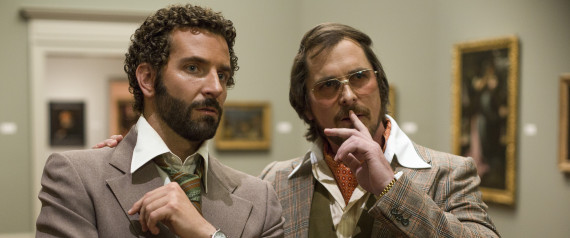
“AMERICAN HUSTLE” Review (✫✫✫)

FBI trying to hustle politicians by hustling con artists.

“We’re always conning other people,” says a slurred, yet sure voice in the background. “It’s in our nature. We even con ourselves.” These words are coming from the mouth that belongs to Irving Rosenfeld (Christian Bale), a con artist who quickly learned what it meant to grow up and survive in a harsh economy. Irving is the sort of guy you wouldn’t want to interact with out in public. He is grossly out of shape, he smells of old hairspray and cologne, his crafty eyes hide behind a dark pair of shades, and his diet consists of nothing but beer, fast food and cigars. From an outward appearance, Irving doesn’t really make a good impression. But man, can that guy talk a good game.

After rushing through Irving’s very brief childhood, we are quickly introduced to Sydney Prosser (Amy Adams), a woman in her mid-thirties whose beauty is both ageless and captivating. Despite his nauseating physical appearance, Sydney almost instantly falls in love with Irving, and Irving falls in love with her too. So much so that he discloses his illegal business with her, asking her to become a part of him scamming other people out of their hard-earned cash and checks.

That’s all I’m going to get into as far as the plot synopsis goes. Believe me, I haven’t even gotten to the surface of it. There’s an FBI agent trying to catch them named Richie DiMaso (Bradley Cooper), there’s a New Jersey mayor played by Jeremy Renner somewhere in the mix, Irving has a son and a wife he’s committed to named Rosalyn (Jennifer Lawrence). There’s even a mobster somewhere in this movie where an actor makes a cameo appearance, but I won’t spoil the surprise by revealing who it is (hint hint: He’s got some bad ideas in his head).

Point being: this is a smart movie. It’s funny, original, intelligent, and thoughtful, an observant portrait that looks at the moral and financial struggles of these characters and what impact their actions have on the people in their lives. Part of this, no doubt, is because of the cast’s mastery at delivery. Part of it is also because its writer-director is equally as funny, original, intelligent, and thoughtful as the story is. David O’Russell, who was nominated for best directing and writing Oscars for the past few years now (For Silver Linings Playbook last year and The Fighter in 2010), returns yet again with the same wit, charm, and complexion that made his previous films both unique and entertaining.

The dialogue is authentic, almost like it pops off of the pages of the screenplay just as much as it does in the movie. How though? This is, after all, a work of fiction, right? Wrong. The plot is just is like Irving’s deceptions: they’re only half fake. The movie is based on the real-life ASCAM sting operations of the late 1970’s, in which the FBI arrested over 31 individuals of congress and 7 were convicted of bribery and conspiracy. That sort of realism translates brilliantly to the screen, and makes the conversations characters share feel so personal. Make no mistake, fellow reader: this is, in every definition, a heist picture, because everyone is all after something and are willing to manipulate everyone in order to get to it first.

The cast is unforgettable. So much so that I can’t even pick a favorite among them. Bale is as talented as ever in this movie, a brilliant and dedicated method actor who has immersed himself so much into a role that its hard to imagine that at one point he was Patrick Bateman or Bruce Wayne. Lawrence and Adams are excellent female leads, and are great at expressing how conflicted Irving feels towards the both of them as lovers. Renner is great as the New Jersey mayor, a loving and kind-hearted man, father, and husband who just wants the best for everybody, but ends up making the wrong decisions in trying to do so. If I had to pick a favorite, it would probably be Bradley Cooper, only because he is so passionate and wacky that he could have been redone as a cartoon character. Like I said though, I can’t pick one. This cast is so talented and skilled in their roles that to pick one performance over another would be considered a sin. They are just as responsible for bringing this story to life as David O’Russell is.

This movie has all of the elements of being Oscar-worthy material: a great story, dialogue, characters, direction, and a great cast that fills these figures with vibrant energy and personality. The only real problem with this movie is the setup, and that’s unfortunate because that’s one of the most important parts of any movie.

Let me provide an example: when I first watched Goodfellas, what absorbed me into that picture was the first 15 minutes, a little italian boy learning about the mafia as a child, and the first narration we hear being “Ever since I can remember, I’ve always wanted to be a gangster.” Another one? In the opening scene of There Will Be Blood, we see a touching yet tragic portrait of a man seeing one of his workers die in an oil deposit, leaving behind an infant who can’t even speak, and Daniel Plainview deciding, against his better judgement, to adopt him as his own. Do I even need to mention Up?

All of those pictures started off with a bang because they gave us a perspective into the character’s history before getting into the meat of the story. Not that there needs to be a “How-to” guide for making opening sequences, but American Hustle literally flashes Irving’s childhood for about a minute before throwing us into the plot. I’m all for “show-don’t-tell” stories where they’re all situational, strictly limited to being set in their own present (Such as The King’s Speech or Black Hawk Down), but this one felt too much like being thrown into cold water when you can’t even swim.

Despite my views, I know critics already have their opinions established on this movie. They’re going to say its a masterpiece. That it is masterfully written and acted (which it is) and that it is going going to be nominated for multiple Academy Awards (which it will be as well). What critics won’t realize is the movie itself might be a con, making people believe that it is better than it actually is.

Well, if it is a scam, and David O’Russell is the con artist, then all I’m going to say is that he did a damn good job at it.

Post-script: For you irresponsible parents that are considering taking your teenagers to see this movie, don’t. The MPAA rated this movie R for “pervasive language, some sexual content and brief violence.” The violence is very brief and honestly not a large problem. The sexual content, however, is profuse because of Irving’s two sexual partners, and the movie has no shame for showing us any of it. I noticed over 100 F-words.

Tagged , , , , , , , , , , , , , , , , , , , , , , , , , , ,

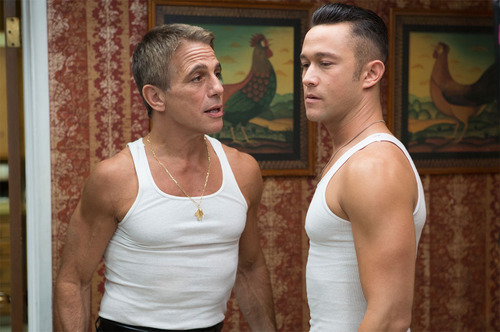
“DON JON” Review (✫✫✫)

Oh, Donnie boy…

 “There’s only a few things I really care about in life,” a rich, deep boston voice says as we look at him staring  at his bright laptop screen shirtless in a dark room. “My body, my pad, my ride, my family, my church, my boys, my girls, and my porn.”

That last one doesn’t really belong there, but whatever, its in there.  The man we are looking at is Joe Martello (Joseph Gordon-Levitt), a thick, cut, and strongly appealing young man who has a slick, black haircut and a grin on his face that looks like he just finished up business in the bedroom.  His friends call him “The Don” because he’s able to score “dimes” on the weekends, which is another way of saying “That woman is a ten!”

One night in the bar, Donnie meets the best dime he’s ever seen: Barbara Sugarman (Scarlett Johansson), a beautiful blonde bombshell that turns heads and raises attention everywhere she goes.  To Donnie, this is simply another case of trying to score a hot night, but Barbara isn’t that easy.  She wants something more meaningful than just a one-night stand: she wants an affectionate, fairytale relationship, the cheesy kind you see in those unbearable romantic comedies starring Anne Hathaway and Channing Tatum.

So Donnie takes a deep breath and waits it out, hoping for her to come around eventually and give him the chance to slip under the covers with her.  The more time he spends with her, however, the more his addiction to pornography gets in the way and stops him from having a more meaningful relationship.  Now conflicted between his feelings between Barbara and his dependency on pornography, Donnie needs to figure out which is more important to him before she leaves him and all he has left is his laptop and his internet wifi.

Before I continue, let me issue a short disclaimer.  If you do not like R rated movies, do not watch this movie.  If you don’t like looking at nudity, do not watch this movie.  If you don’t like swearing, do not watch this movie.  And if you don’t like movies about sex, DEFINITELY do not watch this movie.  This is a picture stuffed to the mouthful with sex, nudity, T&A, F-words, censored and uncensored pornography to the point where I believe it deserved, and should have been rated, NC-17.

The only reason I issue this warning is because I know my readers, and the majority of my readers do not appreciate sexually explicit films that make jokes about the male/female anatomy and what goes on inside the bedroom.  Their views are warranted, and in many ways I share many of those same views with my readers.  I, however, am not as close-minded to this idea if it means not enjoying Don Jon, and believe me, that is a very hard thing to do.

That’s probably the worst word I could have used to describe this picture just now, but nevermind.  Don Jon is good.  Very good.  How good?  So good that it made me, a conservative reviewer who hates excessive nudity, enjoy it very, very much.  Trust me, I am not easy to please.  If you don’t believe me, you will when I tell you I rated The Hangover as the worst picture of 2009.

I find it interesting how effective Gordon-Levitt is here as a filmmaker.  His writing is fresh, fun, and original, exercising dialogue that is both clever and witty while at the same time being deeply meaningful and expressive.  The cast is equally brilliant, as their charismatic portrayals breathe life into these characters in ways that not even an animated rendition could do.

What I find more interesting, however, is how Gordon-Levitt handles this film as a director, using space and situations in his film to define Jon’s character and to show what sort of emotional state he’s in.

For instance, look at how he shows Jon’s everyday routine.  When Jon wakes up in the morning, he cleans his room the best way a bachelor knows how, he drives to Church, he goes to confession, he eats lunch with his family, he works out at the gym, he goes to a club to meet some beautiful lady, and then he ends his nights watching a skimpy porn video.

Got it?  Okay, now look at the variations of this same routine shown throughout the film.  At first its just the same thing over and over again, but later as Jon’s character changes, so does how he behaves during his routines.  When he’s depressed, his room get messy.  When he’s excited, he sings to Marky Mark in the car.  When he’s optimistic, he exercises with other people when he goes to the gym.  But what remains consistent in all of these sequences is him going to confessional and confessing his sins to the Catholic Priest he’s never met, hoping one day to have a clean slate in the eyes of the father.

I don’t think this movie is about a man struggling with his addiction to pornography.  I think this movie is about a man struggling between his lusts and sexual desires and the guilt he silently feels he needs to be redeemed from.  Think about it for a second.  Why else would he go to Church so frequently despite his promiscuous lifestyle?  He’s a grown man, he knows he doesn’t have to go to church if he doesn’t want to.  So why does he go so frequently even though his lifestyle isn’t congruent to that of a catholic?  There’s a deepness developing silently to Don Jon that can only be barely noticed, and if you don’t look out for it, it will slip you past you.

There’s obviously the negative element of watch a movie about pornography, and I would be the first to agree with you.  Even though the pornography is at times censored, its still there, and we can’t help but visualize everything because we’re seeing a rendition of it on the screen.

Still, since we’re talking about pornography, let me retaliate with another film that is also about addiction: a 2011 film titled Shame, starring Michael Fassbender and directed by Steve McQueen.  Like Don Jon, Shame is about a man who holds an unsatiated lust for porn and sex, and his life sinks into a swamp of sadness and depression because of his unsatiated hunger.  Unlike Don Jon, however, Shame is downtrodden, depressing, sickening, despicable, ugly, demeaning, and has no redeeming qualities whatsoever, outside of the acting and the composition.

Don Jon is different.  Unlike Shame, it is upbeat, energetic and joyous, and even though there are dramatic moments in the movie, there is never a moment that feels ugly, sickening, or unclean.  Don Jon is a stylish, articulate, and simply brilliant dramedy.  It is not only a film filled with clever dialogue and solid character development: it actually has a good, wholesome message to take away from the story, something to make you appreciate the small things in life that you never really notice.  I know some people are going to look at this movie from a first glance and ask “Why would I want to watch a feature-length pornography?”  Believe me, fellow reader, if this film can even be categorized as a pornography, its probably the best of its kind.

On a closing note, please don’t tell my mother.

Tagged , , , , , , , , , , , , , , , , , , , , , , ,

“MY NEIGHBOR TOTORO” Review (✫✫✫✫)

My name isn’t Totoro, kids.  It’s Hayao Miyazaki. 

Now this is what we’re supposed to get when we go in to see an animation picture.  My Neighbor Totoro is everything you expect it to be, and equally as much everything you don’t expect it to be.  This is definitely a kids movie, intended to fulfill the needs of the most innocent and simple-minded of younger viewers.  But this is a rare treasure for adults too, a film that is equally fulfilling and emotionally appealing to older audiences as it is upbeat and joyous for the younger ones.

Taking place in 1950’s Japan, My Neighbor Totoro follows the story of two young sisters named Satsuki and Mei (English dub by Dakota and Elle Fanning), who are moving into their new home with their father Tatsuo (Tim Daly) in order to be closer to their mother in the hospital, Yasuko (Lea Salonga).  Their mother has been sick with an unknown disease for quite some time, and it really concerns the girls because they can’t even get her home for a visit.  Most affected is Satsuki, because her father is always busy, Mei is painstakingly afraid that her mother will leave them, and Satsuki is forced to be the strong one during this time of hardship.

Deep in the forest though, the girls encounter strange beasts of wonder and splendor.  There are these small, darkly black fuzz balls called soot spirits, who hibernate from one dark spot to another.  There are two bunny-like creatures, one white young one who can phase through objects like a ghost, and an older blue one who carries a knapsack of acorns with her everywhere.  Most fascinating though, is a giant, loud, gray beast called Totoro (Frank Welker), a gentle-hearted forest spirit who loves nothing more but to sleep and play on his flute in the silence of the night.  The girls are at first afraid of Totoro’s large, intimidating appearance, but through his gentle, kind-hearted spirit, learn to appreciate him and become friends with Totoro and the forest creatures.

Written and directed by Hayao Miyazaki, My Neighbor Totoro is a rare animated film where the characters are as vibrant and colorful as the beautiful animation that is being expressed on screen.  You really just need to see these little girls in action: they’re one of the most energetic, emotional, endearing, and inspiring little characters I’ve ever seen.  I knew from the first moment I saw them that I would like them: they are these little oddballs of energy, two cute girls who are literally exploding with energy and enthusiasm as they run across the front lawn, or explore the mysteries of their upstairs attic.

The best moments, however, come from when the little girls encounter Totoro.  Looking from a straightforward perspective at Totoro, its a case of what you see is what you get.  He’s a big, fluffy creature who loves to eat, dance, fly, talk (and by talk, I mean roar loudly), and more than anything else, sleep.  If this were any other animated film, I would say the character was another interpretation of Garfield.

I, however, think Totoro is required for more fervent analysis.  I can’t help but look at Totoro like an emotional recompense for the girls, almost like an imaginary friend to distract them from the pain they experience everyday through their sick mother.  Kids with only one parent will know what I’m talking about: when the one you love is in pain or worse, they want everything in the world to distract them from the reality of what they are experiencing.  Its simply too painful for them to take in all at once.  They need something to distract them, to divert them from reality, and so the younger ones try to focus on something fictional that will put their mind at ease, like an imaginary friend for them to talk with.

Totoro reminds me of that imaginary friend.  Unlike an imaginary friend, however, Totoro is real, and this is proven through the interactions he has with the girls.  He is not just a simple-minded, unintelligent forest animal.  He is considerate towards the girls.  He cares for them.  He expresses real and genuine affection for the girls, and he shows this by dancing with them in the middle of the night, growing trees with them in their backyard, or by letting them ride his Cat Bus in cases of emergency.  Even though Totoro is fictional, he’s the most real thing in the movie, taking the girls story filled with hardship and tragedy and filling it with energy, enthusiasm, and life that cannot be faked in a movie.

Every single fiber of me wants to look at this movie and say it is a perfect film, but something stops me.  What is it?  It certainly isn’t the characters, the animation, the story, or the emotion being expressed on screen.  What is it then, if its none of the above?

Of course, I think.  Accessibility.  The weakness with this film, much like the stark foreign language films and the ancient black-and-white silent films, is that it strictly appeals to a certain audience.  You know what I’m talking about: what is the typical american viewer going to see, a boisterous and explosive action movie with big name actors starring in it, or some independent animated film made by some guy whose name they can’t even pronounce?  The weakness here is this: people who don’t like anime won’t like it, and probably shouldn’t see it, because this film mainly appeals to that same audience and culture through its story and through its execution.  Because of that, Totoro will lose some viewers in its audience.

But even then, is that the fault of the filmmaker for not conforming to their tastes, or the audiences for not being open about it?  Regardless of what you think, My Neighbor Totoro is a magical little film, an uplifting and wonderful fantasy that taps into the inner child in all of us, and in many ways reflects the behavior of children: animate, lifelike, endearing, sincere, and visually expressive.  It’s a movie whose characters are so precious and lifelike that a live-action portrayal couldn’t have been as real as this.  It’s a film that allows us to believe in miracles, even if we don’t necessarily believe in them.  And at the heart of it all is Totoro, a warm, fluffy forest spirit that only loves children more than he does sleeping on his favorite moss bed.

Tagged , , , , , , , , , , , , , , , , , , , ,

“PITCH PERFECT” Review (✫✫)

Special appearance from the cast of “Glee”!  

Pitch Perfect is a predictable, formulaic film, a movie enveloped in its conventions, forcing in cliche characters, and bolstered only by its joyous music, which cannot help but seem misplaced in a movie like this.  It’s the sort of movie that doesn’t deserve the word “perfect” in its title.  I’d offer an alternative title, something shorter and more subtle such as simply Pitch, but I’ll advise against that for the fear of people mispronouncing it.

The story begins on a young and rebellious Beca Mitchell (Anna Kendrick), an aspiring DJ who dreams to one day become as popular as Skrillex or David Guetta (80’s kids, look them up on wikipedia).  Her father however, who just happens to be a professor at Barden University, encourages her to become more immersed in her education and to get more involved on campus.  Beca hates school and hates socializing even more, but will put up with it because her father will help her out with her DJ career if things don’t pan out at school like he wants them to.

She gets a job as an intern at a radio station, and ends up joining the Bellas, a group of diversified female singers who all compete at an acappella competition at the end of the year.  These girls are Aubrey (Anna Camp), the snotty, stuck-up leader of the Bellas, Chloe (Brittney Snow), the more civil and more approachable Bella out of the group, and Fat Amy (Rebel Wilson), a woman who is determined to throw herself out there despite her weight and her unattractive appearance.  Just so you know, I’m not calling her “Fat Amy” on purpose.  That is the specific name she instructed the Bellas to call her when they mistakingly called her “Amy”.  I’ll bet her mother is proud of that, hearing her daughter wanting to be called Fat.

The Bellas were disqualified from the last competition because Aubrey vomited all over the front row of the audience last year (believe me, that wasn’t a pretty sight to see).  Aubrey, as a result, is even more strict about protocol, behavior, and song selection than before, and so now she functions as a sort of an acappella Hitler to these poor college girls who are just trying to find their place at this university.

Let me say something here: there is something seriously wrong with your picture if your best comedy comes from a girl called Fat Amy and the worst involves girls swimming in pools of vomit.  That’s not figurative, by the way, that is a literal reoccurring joke in the picture.  This is perhaps the biggest problem with the picture over everything else: the comedy is not funny.  It is not original, clever, precise, or even remotely well-written.  It is unbelievable, insincere, forced, and extremely ham-fisted.

Why do I say this?  Because not a single laugh was genuine.  Nothing was funny.  The jokes all involve typical cliches or moronic conventions, things you can find easily on a television network like ABC or Nickelodeon.  What other examples do I need to give, besides the vomit jokes?  How about awkward parents, preachy life lessons, bad singing, rapping, stereotypes, hazing and topics about sex?  I’ll thought I was watching a musical here, not an episode of “Kids In The Hall”.  

Oh yes, this film is not funny, but even worse are its characters, who are so unbelievable and overly-dramatized that they can only be in a movie.  These girls are an annoying, rambunctious sort, a group of absent-minded drama queens who worry only about what tradition they uphold or which boys they are sleeping with.  I know they’re meant to be seen as overly-expressive college archetypes, but for Pete’s sake, at least try to be more creative.  “High School Musical” had more interesting characters than this.

Anna Camp is both spoiled and paranoid, a woman who is an over-exaggerated negative picture of sorority girls.  Snow is meager, idle, and useless, there only to inspire Beca to join the Bellas, but not much else since she’s so passive when confronting Aubrey.  Kendrick is good as Beca, but not really that compelling, and even when she first appears on screen we get a sense that the script is going to force us through some deep, meaningful character romance even though it isn’t really that deep or meaningful.  The most compelling and talented actress here is Rebel Wilson as Fat Amy, who is so spirited and so enthusiastic in her role that she ends up more appealing than any of the other sorority brats in this movie.  Her attitude and her humor was uplifting and energetic, and I wouldn’t be surprised if she served as a sort of inspiration for overweight girls everywhere.  Dare I say I was turned on by her energy?  No, but she was close.  Really close.

Ultimately, Pitch Perfect is a flat, typical experience.  It provides nothing we haven‘t seen before and its immature handling only reveals more of its desperate copycat nature.  Why, then, am I giving it two stars when it’s story clearly deserves one?  That is because of the music.  If the movie accomplishes nothing else (and it doesn’t), it has the most beautiful covers and acappellas I’ve ever heard, even better than what most of what the TV show “Glee” produces.  There was one great moment where Kendrick even does an original acappella with only her voice, hands, and a plastic cup to use at her instruments.  That does not happen by insincere chance, fellow readers.  That is genuine, passionate talent, one that is evidenced in every beautiful note in these acappellas (although I don’t understand how a woman is capable of singing in baritone.  That’s another issue though).

Oh boy, am I going to get roasted for this.  What, I wonder, do people find so entertaining about this movie?  Look, I don’t expect a perfect film.  I don’t go into these things expecting to dislike them from the outset.  All I ask is that you have good singing, a solid story, and appealing characters for me to appreciate.  Here, the singing is incredible, but the dialogue is flat, the story is predictable, and the characters are more annoying and high-strung than the Kardashians.  Pitch please.

Tagged , , , , , , , , , , , , , , , , , , , , , , , , ,

“NOW YOU SEE ME” Review (✫✫✫)

And now you don’t.  

We open on a black screen, similar to how a magician opens up his show behind the secrecy of a red curtain.  A deck of cards can be heard flipping through the background with the presence of a calm, cool, and serene voice to accompany them.  “Pick a card”, he says.  “Any card”.  But before his volunteer can pick a card, he is quick to remind her “But look closely.  Because the closer you look, the less you will actually see”.

The words of a true magician, and the fact that he flipped this deck and actually picked the card I choose impressed me even more.  This character is named Atlas, who is played by Jesse Eisenberg, and he is a street magician on such a skill level to where he can make skyscrapers light up in the night.  As he impresses a crowd of ongoing viewers, one stands in the audience with a hood over his head quietly observing Atlas.  We can’t see his face and we don’t know who he is, but he carries a card in his pocket, and leaves it for Mr. Atlas at the end of the performance.

Atlas isn’t the only magician to receive special treatment: three other magicians have also been observed by this strange visitor and have been left cards for each of them.  There is the mentalist Meritt McKinney (Woody Harrelson), the pickpocket Jack Wilder (Dave Franco), and the escape artist Henly Reeves (Isla Fisher).  All four of these talented magicians have been recruited by a secret cult called “The Eye” to carry out a secret mission for them.  One year later, they come together in their first show as “The Four Horsemen”: and during their show, they rob a bank all the way in Paris while still performing in Las Vegas.

The FBI are called in to investigate, and they bring in Agent Dylan Rhodes (Mark Ruffalo) to arrest and interrogate the four horsemen.  Pressing as he is, the horsemen are equally as clever and deceptive.  Henly is spinning chairs, McKinney keeps reading his mind, and Atlas ends the interrogation by taking off his handcuffs and snapping them onto Rhodes.  The rest of the film shows Rhodes chasing the four horsemen, trying to figure out their plot, and to stop them before they succeed.

This film is all about style over substance, a movie that is more concerned with tricks and showcase over character depth and dimension.  Do I care about dimension, however, if the film is more than fun enough to take it over?  The success of movies do not just come from how deep or complex they are.  They also come from how well-made the picture is, how sharply the cut is edited, and how cleverly the narrative is structured.

And boy, if Now You See Me is anything, its definitely clever.  Directed by Lois Letterier (Transporter 2, The Incredible Hulk) and written by screenwriters Ed Solomon (Men In Black) and Boaz Yakin (Remember The Titans), Now You See Me is a movie driven to the brim with its cleverness, its wit, deceit, and effervescent charm in its characters, in what they do, and how they do it.  In many ways, this movie reminds me of caper films such as Oceans Eleven and The Italian Job: its a movie where characters cleverly trick and deceive their pursuers and expose them to their traps and their decisive plans.  They don’t use muscle, brawn, or big guys with guns to get what they want: they use their wits, their brains, and their thievingly cunning plans to accomplish their goals in the plot.

Of course, these plans weren’t inherently inspired by the four horsemen in themselves: someone from the shadows has helped them with this plan, and is always monitoring these horsemen from shadows of secrecy.  Tonally, the film achieves what it desires, and throughout the conniving plot we’re always wondering a key mystery: who is the fifth horseman?  Why did he enlist in the help of these four?  Who could it possibly be?  Is it one of the FBI or Interpol, pretending to be on one side while coyly playing for the other?  Or is it another mystery card player, one who has hidden behind a long-aged myth and has hidden himself from all cards in the field?

This isn’t just a caper film: it is a complex and fascinating mystery, and the cast of characters is all the rogues gallery in this police questioning.   Mark Ruffallo does well as Dylan Rhodes, and in small moments of intimate revealings he shows a man who was once a boy who will always hate those in higher power oppressing the helpless underdogs.  Michael Caine and Morgan Freeman make great cameos, and each play a role we don’t normally see from them, Caine being an antagonistic money monger and Freeman being an observant expose’ of schemes.  Eisenberg, as always, is a knockout in anything he does.  Here his character combines both the social awkward and invertedness of The Social Network, and the coy, cool, sleek confidence of Brad Pitt from Oceans Eleven.  Don’t ask me how he does it, okay?  He just does.

And this is a film that has been bombasted by critics.  For what?  A few quotes I pulled from Rottentomatoes:  “Overcooked, overcomplicated and underinteresting, this heist caper turns into a mess”, one critic said. “Complicated nonsense”, and “…a flimsy plot whose logic disappears faster than a rabbit in a hat”.

There is some truth here.  Yes, the film is overcomplicated.  Yes, it is elaborate and sometimes distracting.  Yes the characters are one-note and thinly written.  And yes, the twist ending is dangerous enough to make the entire narrative collapse on itself, let alone offering the threat of plot holes.

In other words, I’ll admit I don’t understand everything by the end of the picture.  And that’s precisely the point.  There isn’t any fun with a trick that has been exposed: the fun comes in with those trying to figure it out.

Tagged , , , , , , , , , , , , , , , , , , , , , , , ,

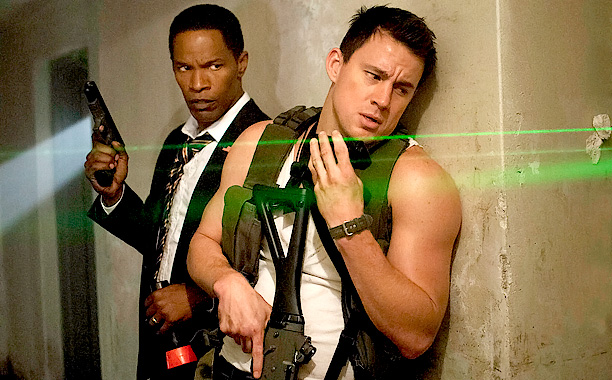
“WHITE HOUSE DOWN” Review (✫✫1/2)

You’d be crazy running for a second term, Mr. President.  

Now here’s a movie that would give President Obama a heart attack.  White House Down, much like a film released earlier this film called Olympus Has Fallen are both about the same thing.  The white house is under attack by a group of professional terrorists, the president is in danger, and our brawn yet brave hero must step in to save him.  All you need is a ripped shirt, a clean-shaven face, and a lot of guns on this guy (not just automatic) and you’re all set.

Unfortunately, that’s all the information I can give you.  This movie is so thinly written that that’s the deepest I can go without giving any spoilers.  The only other information I can provide that could give you any clue on to what this movie is like is that the brawn, brutish hero is played by Channing Tatum,  the president is played by Jamie Foxx, and Tatum owns a daughter portrayed by the sweet and talented Joey King.

I’m going to get this out of the way: Channing Tatum should never play the lead in any movie ever.  He cannot act.  There is no sincerity in his voice, no fluid movement of his body, no expression on his face to show he’s feeling anything except for when he’s shooting at something.  The fullest his acting capability reaches in the movie is the eyedrops you see in his cornea when he’s “crying” for his daughter. I’m not even kidding.  His acting is so terrible, the only use Tatum is in the movie is to provide meat for the female viewers in the audience.

(And I will admit my jealousy here: I will never look as good as Channing Tatum does.  I don’t think its possible for any man to).

Where was I again?  Ah yes, Tatum’s acting.  As always he is a stiff, awkward, and uncomfortable actor, a perfect reason why he should never be the lead character in a movie.  Admittedly though, the dialogue isn’t helping him much.  His best lines in the movie involve something like: “You have to go out there and be President”, or “If this guy keeps making those sounds, I’m going to start looking at him.”

If the above description makes this movie sound appealing to you, you should see it.  White House Down is a big case of what-you-see-is-what-you-get: a movie filled to the brim with excessive action, big explosions, cheesy dialogue, and mediocre acting, with the minor exception of Jamie Foxx, who has the most patriotic and humorous dialogue out of any other character in the movie.  In one scene, he’s reciting the history of America so beautifully to his secretary of defense over the phone that one could mistaken him as a Lincoln who underwent skin surgery.  In another scene, he’s following Tatum up an elevator shaft to evade capture when this exchange happens between them:

Foxx: What you do, I do.

(Channing Tatum ninja moves across elevator).

Foxx: I ain’t doing that.

Foxx’s character was the most appealing, the most intelligent, and the most charismatic character out of the entire movie.  Everyone other character was overly charismatic and grossly unrealistic.  One radical baddie is so stereotypical and so overpumped with tattoos, facial hair, ego, and steroids that I expected him to rip off his skin and reveal that he’s the Terminator.  A tour guide portrayed by Nicholas Wright is more worried about fine china and precious artifacts than he is about his own life and well being.  Tatum’s daughter, however, is probably the most frustrating.  She comes off as annoying, careless, and extremely absent-minded in this film.  You might say this is because she’s a child, but tell me something: how realistic is it that a teenage girl like this is smart enough to run her own youtube channel and know more about the white house than the tour guide, and yet, she doesn’t know when to stay in the bathroom or to leave a building when its going to blow up?

I remember an argument I had with a friend of mine in my first year of college.  He was an experienced videographer who understood more about the film industry than any of the professors did in that department.  We were arguing about the differences between film and art, and he told me a direct yet simple statement:

“Film is not an art” he argued.  “Film is a business.”

While I desperately want to prove him wrong through films such as Inception, Life Of Pi and Beasts Of The Southern Wild, it is movies like White House Down that remind me that the industry does in fact exist and operate like a business intended for profit.  At least Roland Emmerich didn’t release this film in 3-D: that wouldn’t have helped my side of the argument one bit.

Tagged , , , , , , , , , , , , , , , , , , , , ,

“THE LAST STAND” Review (✫✫)

Stuff blowin’ up real good in Redneck City. 

The Last Stand is an actioneer’s action movie, a film so overstuffed with explosions, gunshots, profanity and testosterone that it might have been more appropriate as a video game rather than a movie. I had a friend of mine describe the movie as being “The guyest guy guy movie you’re ever going to see”. That much is true. Whether its the best one, or even a good one, is up to you.

Sheriff Ray Owens (Arnold Schwarzeneggar) has been the sheriff of Summertown for many years now after having quit his profession of being a cop in Los Angeles.  Summertown is a quiet place, a small town where crimes range from the Mayor parking his car in a fire lane to deputies firing at slabs of meat during lunch time.  In a small, quiet town such as this, Ray finds little excitement in his day to day routines and he is perfectly fine with that.

But one day, he receives unwelcome news from the FBI: a nation-wide criminal named Gabriel Cortez (Eduardo Noriega) escaped from the FBI’s hands and is fast on his way to the Mexican border, where he will be out of the FBI’s reach.  The only thing blocking his path: Summertown, which also sits on the United States border to Mexico.  Owens now has to rise up to the challenge to defend his home.  To defend its citizens.  This is the last stand.

This is Arnold’s first lead role after his 10 year hiatus as California’s governor.  Before that hiatus, Arnold was a standout in a slew of memorable action roles, including (but not limited to) Predator, Total Recall, True Lies, Last Action Hero, and my personal favorite, The Terminator and its sequel.  All of those movies are memorable, exciting, suspenseful, and sport great blockbuster entertainment.

Now look at The Last Stand.  This movie cannot help but look shoddy compared to those titles because of its plot, its only inconsistently funny and exciting, and whats worse, it depends on the forumula of repetitive action.  Wonderful.  We certainly don’t get enough of those, now do we?

Let’s take a deeper look at Arnold real quick.  The man has had a great career.  Before going into office, he was asked to be in these tense, highly riveting action roles, and he was damn good in all of them.  Now, he’s been dilluted to just standing tall and read lines as everyone else turns to him asking what to do when a drug cartel is ready to tear through his town.  Guys, come on.  This is the 42nd governor of California, not Angus MacGyver.

The rest of the characters aren’t really that helpful or compelling.  Zach Gilford portrays Officer Jerry, a guy who wants to see more action than he does but then gets his nose broke by the recoil of a gun.  Luis Guzman plays as a chubby mexican officer, and he’s so stereotypical he might as well have been portrayed by Anthony Anderson.  Rodrigo Santoro and Jaimie Alexander share a forced romantic conflict in the middle of all the bullets and gunfire, and while they’re coincidentally dodging all of the bullets amist their kissing, all I could think to myself was “Hey kids!  Find a shower!”

The worst miscalculation, however, is in the film’s villains: Eduardo Noriega as Gabriel Cortez and Rodrigo Santoro as his goatee, ponytail lackey.   Noriega is worthless as the main villain, and is just stuck to driving a car recklessly for more than two-thirds of the movie until the last 20 minutes where the climax calls for a chase scene.  But even worse is his lackey, who seems completely lacking basic motivation of reasoning behind his actions.

Take a look at the only three things he does in the movie: kill a farmer, build a bridge over to Mexico, and strike a raid across Arnold’s town.  Explain to me A) Why he killed the farmer and clued the detectives into his plan, considering the construction of the bridge was nowhere near the farmland, B) How the bridge to Mexico only took around 24 hours to complete, C) Why waste resources building a bridge when he can just bring in a helicopter for the escape, and D) What is the relevance for attacking the town when it means nothing toward Cortez’s escape?  His actions seem senseless, almost like his decisions are delegated by the script just for the sake of action sequences and explosions.  Why must an action film like this seem so mindless, so pointless in its structure and so artificial in its writing?

The film’s most entertaining character is a man named Lewis Dinkam, portrayed by Jackass star Johnny Knoxville.  Highlight, embolden, and underline Jackass.  This guy is the opitimy of stupid, most of it portrayed humorously so.  This guy is an absolute psycho, shooting off pistols and machine guns named “Betty” and “Nazi Killer” with his pajamas on and tearing off electric polls by climbing them and chainsawing the electric wire.  Is he the smartest character in the bunch?  No, but he is the funniest, although I don’t understand why he’s wearing a woolly hat in the middle of the summer.

Ultimately, I’m at a loss with The Last Stand.  There’s no doubt entertainment value here, but it is severrely misguided, almost like a misfired Colt.  Half of the film is used to just set up its premise with predictable scripting and bad acting, while the other half is used for repetitive and monotonous action, gunshots, and F-bombs.

“But David”, one fellow viewer pointed to me, “That’s entertainment!  People need entertainment because real life sucks!”  This is true that people need entertainment, and The Last Stand will satisfy some viewers.  For others however, they will be left yearning for a better story, more original action, and a more worthwhile experience.  In the meantime, what you see is what you get: if its action you want, boy oh boy, it action what you’re going to get.

Tagged , , , , , , , , , , , , , , , , , ,