
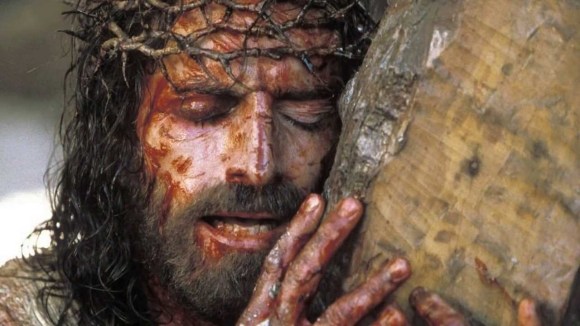
A passion we’ll never be able to understand.
We open on a dark, haunting shot, a man standing alone in the vineyard weeping and praying desperately. Tears are streaming down his face. Blood is sweating from his brow. He begs in thick Hebrew dialect, begging to his heavenly father for another path if there is one. He knows what is coming. He knows what he has to do, and he’s afraid of everything that is about to happen.
A figure hides in the shadows, tempting him like he always has. He tells him he does not need to suffer if he does not want to. He does not need to be harmed. He does not need to die for the crimes committed by others. The man continues to weep, conflicted by his commitment to his father and the temptations from the evil one.
I’ve known this man ever since I was a young boy growing up in a Baptist Church. I’ve never met him face to face, yet I know him just like millions of other people do. Later when he exits the garden, a group of soldiers come to take him away before one of his followers slices one of the soldiers’ ear off in retaliation. The man rebukes his friend, miraculously heals the soldier’s ear, and allows the other soldiers to take him away. The evil one continues to watch closely while the rest of the man’s followers flee into the night.
This man, of course, is Jesus Christ of Nazareth, portrayed here by Jim Caviezel. He is the son of Mary the virgin, leader and friend to his faithful disciples, and the central figure behind the Christian faith. His story has been told and retold numerous times already, his sacrifice praised in churches all around the world. Yet, his story has never been told like this before. Not in the way that it is told in The Passion of the Christ.
In this epic drama directed by Mel Gibson, Jesus’ final hours is depicted in brutal, unrelenting detail as it covers the entirety of Jesus’ emotional and physical abuse leading up to his crucifixion. Whether you’re a believer or not, you more than likely already know the story from a historical perspective. A man claimed to be the son of God and was beaten, tortured, and sentenced to die on the cross because of his prophecies. Then on the third day after his passing, he mysteriously vanished from his tomb.
This much is consistent knowledge among atheists and believers alike. What isn’t covered enough is the full details surrounding Jesus’ suffering. I remember when I was in Sunday school and how much our instructors cleaned up their telling of Jesus’ crucifixion to us. I’m sure it was because we were all children and the instructors didn’t want to disturb us, but regardless we were only given a brief outline of the crucifixion without covering much of the specific details surrounding Jesus’ anguish. Since we grew up with this sanitized picture in our minds, we imagine the whole affair as clean-cut and are somehow able to brush through the messy parts of Jesus’ death.
Gibson, however, doesn’t allow us to shy away from the violence. Pulling from the New Testament Gospels including Matthew, Mark, Luke, and John, Gibson confronts Jesus’ suffering headfirst, demonstrating all of the brutalities that Jesus went through at the hands of those who persecuted him. Among the cruelties that Jesus experienced included being arrested, beaten, kicked, spat on, flogged viciously, stabbed rose thorns into his head, forced him to pick up a 300 pound wooden cross, travel through the blistering heat while carrying it on his back, whip him when he falls behind, dehydrate him, strip him, and humiliate him in public before nailing him to the cross and waiting for him to die a slow, agonizing death. I know some pastors who preach about the crucifixion as if it were some deeply spiritual, dignified affair. Believe me when I say there was nothing dignified about it. It was an ugly, violent, torturous, exhausting, and disturbing experience that Jesus went through, all because the Jewish high priests felt this man wasn’t the son of God.
The Passion of the Christ is a deeply moving film. Powerful, spiritual, and profoundly mesmerizing, this picture is commanding of our attention and doesn’t lose it until after it fades out from its final shot. That’s because Gibson focuses on telling Jesus’ story as a filmmaker and not as a follower. In most Faith-based movies, the big mistake most filmmakers make is glossing over the complexities of real life to stick to its shiny-clean moralistic agenda, forgetting that oftentimes believers and non-believers both face the same struggles. This is one of my biggest pet peeves when a film skips material just to take the high road when it comes to content and development. Can you imagine how jarring it might be to see Jesus’ crucifixion adapted as brutally as it is here, then flip into a upbeat, flowery musical such as Jesus Christ: Superstar?
And yet, Gibson doesn’t forget that Jesus was a man before he was any of the other things that society has labeled him. In both cultural and religious groups, Jesus is referred to under multiple pseudonyms. Messiah. Savior. Redeemer. Son of God. If you are a person belonging to the faith, then of course you see him as all of these things and more.
But who was Jesus before any of these titles were attached to him? Quite simply, Jesus was a man. He had a family, friends, a great many people who cared about him and loved him, and he cared about and loved each of them a great deal in return. And yet, even as a man, he possessed a grace and strength to his character that is all too rare in today’s world. In the moments where he was tortured, victimized, and sentenced to a bloody death, you would understandably assume that most others in his position would curse and lash out at the people who were hurting him. Yet, while being mutilated, abused, and laughed at, Jesus cried to the heavens and shouted out “Father forgive them, for they know not what they do.”
I’m trying to write this review from the perspective of a non-believer. As a Christian, I’ve always been familiar with Jesus’ story and why he felt the need to sacrifice himself for the people he loved. In the same way that Martin Luther King Jr. and Mahatmas Gandhi died for the causes they believed in, so too did Jesus die for the cause that he believed in. Yet, their causes were for mortal and earthly movements. Jesus’ cause was for something much bigger, something that is not understandable to most people. So why should non-believers take the time to watch The Passion?
For me, I would watch it just to get an understanding of the man who lived and died. Like Schindler’s List, Braveheart, and Born on the Fourth of July, The Passion of the Christ evokes a deep understanding of the emotional impact for the character and what his actions meant to the people around him. This was a man who really lived and died for the people he held a deep compassion for. Even if you don’t believe in his mission or his identity as the messiah, can’t you at least feel sympathy for this man’s sacrifice and his willingness to die for the people he loved?
I will leave it to you to decide your own conclusions based on what this film shows you. I will say that even if I were not a Christian or a believer, I would still be moved by Jesus’ story and the sacrifices he made for his people. He knew in his heart what would come from this. He knew he would extend this gift to everyone and many would still choose to not accept it. So why would he still willingly sacrifice himself and allow himself to suffer, knowing where everything will lead in the long run? As much as we’re tempted to read too deeply into his intentions, I think the answer is relatively simple: love. He died because he loved us, even though he has every reason to hate us for our persecution of him. That’s a love many of us will never be able to understand. Or perhaps, maybe a more appropriate word would be passion.

 DAVID DUNN