Tag Archives: Blockbuster

“DAREDEVIL” Review (✫✫✫)

What is the man without fear afraid of?  

We open on a still, quiet shot, a haunting frame of a rat walking over a pool of blood dripping in front of a church.  As we pan up the window frame, with quick flashbacks cutting in and out as the music crescendos, we reach the top, helicopter spotlights shining on a wounded man in a devil costume grasping onto the holy cross.  This is easily the film’s master shot, and its influence quite possibly lasts throughout the rest of the film, even if nothing else ever comes to live up with this establishing shot.

The man we are looking at is Daredevil, and unless you read the comics, you would never have guessed that he’s blind. Growing up as a young boy in Hell’s Kitchen, Matthew Murdock (Ben Affleck) was the son of former boxer Jack “The Devil” Murdock (David Keith), nicknamed for his brutal fighting style towards his opponents. One day while skating past a construction site, Matt got in the way of a truck carrying barrels of radioactive chemicals when a bar suddenly punctures the metal, spilling the lethal chemical into young Matt’s eyes.

He lost his vision, but what he gained changed him forever. When he woke up in a hospital bed the next day, all of his senses were enhanced to superhuman levels. He could feel the fabrics of his eye bandages without even touching them. He could smell the aroma of bleach permeating off of the tiles in the hallway outside of his room. He could hear the sound of construction work, the cars beeping and the heartbeats of other human beings from miles away. But most impressively, his sense of sound gave him a “radar sense”, allowing him to form images of the people and things that he saw in front of him. He wasn’t just a boy any longer: he became a living sonar.

After witnessing the death of his father (I guess “hearing” his death if you want to get technical), Matt vows to never be afraid of the things he can’t see. To find the killer and bring him to justice. To seek justice, one way or another. To become Daredevil.

Here is a film that has an irresistible sense of style, a movie that takes us through its lavish stunts, choreography, and fight sequences and makes them exhilarating to sit through. It is really exciting, seeing these characters pulling off these crazy, mind-blowing leaps and bounds over buildings, in bars, and on rooftops as they fight each other with lightning-quick movements, attacks and reflexes. It’s even more fascinating seeing it from Daredevil’s perspective, watching bullets fly past him while he slides on railing, flips over tables, and knocks criminals out with his staff and nunchuks. Most would probably view these scenes as silly or preposterous, with characters flying from building to building as if they were in The Matrix. My response? I don’t really care. The fight scenes are choreographed and filmed in a very specific way to where its enjoyable, almost as if the laws of physics don’t matter in a movie like this. You more or less watch it for the joy of seeing the sensational effects rather than criticizing how preposterous and unrealistic it looks.

Oh yes, the action is excellent. Compared to the action, the performances are… inconsistent. Not bad, mind you, just inconsistent, and not all of it is entirely the actors fault. Affleck at least does a good job to keep us interested in between the sensational fight scenes, and even offers some very nice emotional moments where his character experiences both fear and vulnerability. Michael Clarke Duncan, most known as the pure-hearted and innocent miracle-maker in The Green Mile plays here the antonym of that role, a kingpin so foul and villanous that its shocking to see him make the transition. The highlight performance is in breakout actor Collin Ferrel as a hitman named Bullseye, and his presence on the screen is infectious. He is terrifying, his motions, speech and mannerisms forming this character who is so set on making his jobs perfect that he will kill anyone that makes him do something as simple as missing. He is mortifying, and definitely not the kind of guy you want to sit next to on a plane. The only actress I didn’t care much for in this movie was Jennifer Garner, who played a love interest of Matt’s named Elektra, but we’ll get a more into that in a bit.

For simple entertainment, the movie is acceptable. The fight scenes are great, the actors are fitting in their roles and the story advances in a form of pulpy comic book violence, the kind you expect to see when you open a Frank Miller comic and see two superhuman acrobats fighting all over the page.

The problems don’t start at the fight scenes or in its cast: they start at the hands of writer-director Mark Steven Johnson, and that’s a problem because those are two areas that should be the strongest in any film. Johnson, who directed the critically-favorable Simon Birch before this obviously has his “rookie” cap on because the film is so lopsided. It’s so freakingly inconsistent, so much so to the point where I can name an equal number of scenes that I liked side-by-side with the scenes that I disliked.

Do I really need to write out a list? The script switches from serious to silly. So does the acting. The tone can’t decide whether it wants to be dark and dreary or smirking and tongue-in-cheek. I mentioned early in this review that we were introduced with a dark, mesmerizing shot that hooked our attention to the screen. Would you take this movie just as seriously, however, if I told you that there was scene later in the movie where blind lawyer Matt Murdock was kung-fu-fighting against Elektra at a children’s park in broad daylight in public? Probably not, no.

Look, in the eyes of a critic (and I’m not talking about myself), this movie failed. The tone is off-beat, the acting is off-kilter, the scripting is inconsistent, and on that note, so are the visuals. And yet here I stand, giving this movie a marginal positive rating.  Why?  Because I liked it, that’s why. Because I sat down, looked at the movie, compared the good side-by-side with the bad, and ultimately, the good won me over.

I know that won’t be the same case for other viewers, and others are likely to hate the movie for its silliness, for its half-completed visuals, for its inconsistent scripting, filming, editing, and even acting. That’s fine. Different movies appeal to different tastes, and Daredevil won’t appeal to all of them. In the genre of superhero movies, there are many obviously superior to this one,  including the recently-released Spider-man and X-men movies.  If we are going to admit what it is worse than, however, let’s not be forget that Batman and Robin and Howard The Duck also exists. No, that last one was not a typo.
Tagged , , , , , , , , , , , , , , , , , , , , , , , , , ,

“RUSH” Review (✫✫✫✫)

Don’t think.  Don’t pause.  Just drive.  

I couldn’t have thought of a better title for the movie Rush, because that’s exactly what it is: an unstoppable and uncontrollable rush of energy, excitement, and gravitas, a movie that starts on a high note and simply refuses to let up all the way through.  I hear a lot of complaints that there are biographical movies that are more concerned with cashing in on people’s legacies rather than making an authentic account of a person’s true story, such as Jobs or The Iron Lady.  Here is a break from all of that, a refreshing and ideal account of two racers who live every moment of their life trying to figure out how to beat the other guy, while understanding that their symbiotic relationship is what made them both great racers in the first place.

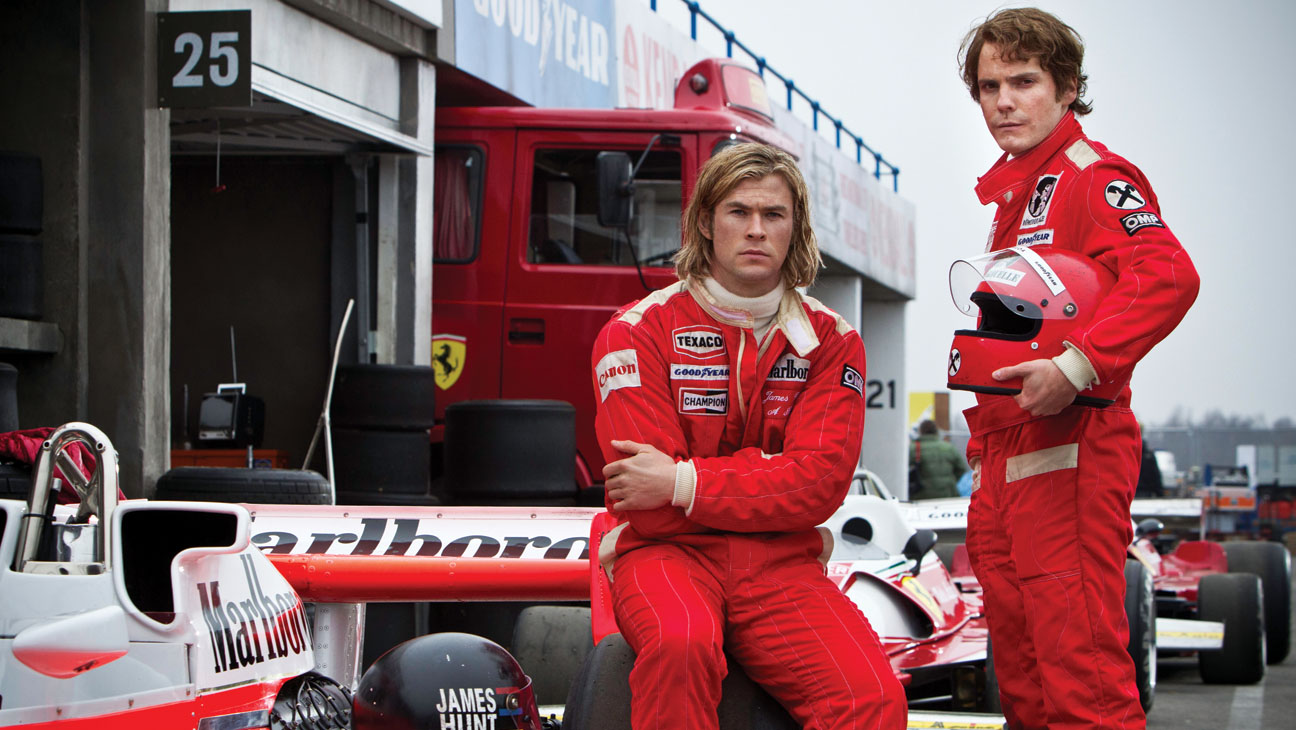
Focusing on the 1976 Formula One Grand Prix season, Rush follows the story of two different racers, both with polar opposite personalities and complexions.  James Hunt (Chris Hemsworth) is a hard-headed racer who races with passion instead of brains, and a playboy who drinks a lot, smokes a lot, and sleeps with beautiful women, a lot.  Nicki Lauda (Daniel Bruhl) is a intelligent, smart, and crafty german who is just as focused and analytical as he is rude and ignorant. The film chronicles the contempt they feel for each other and the mutual respect that makes them strive to be better than the other man.

Before you go and see this picture, I encourage you to go online and google the names “James Hunt” and “Nicki Lauda” and look at their images.  Got it?  Okay, now that you’ve done that, go and watch the movie.

If you actually took the time to open up another tab and look at the images, you will be just as shocked as I was.  Comparing the sight of Lauda and Hunt with that of Bruhl and Hemsworth isn’t comparing them at all: they look exactly like the same characters, from the red jackets around their back to the color and hairstyles that we see on their heads.

I love it when movies do this: when movies are so accurate to the real-life figures that they copy their appearance so accurately, it is nearly impossible to differentiate from them.  We’ve seen this from The Fighter in 2009, and recently from Daniel Day-Lewis in Lincoln.

Here is yet another example of a movie that is compelled by truth and driven by accuracy, pun intended.  Rush is exhilarating.  Exciting.  Edgy.  Anticipative.  Emotional.  True.  Everything about this movie is a heart-pounding, sweat-pouring adventure, and what’s truly impressive is not that the movie makes us feel this way: its the fact that it really happened, and that really director Ron Howard is just documenting it rather than retelling it.

One of the highlights in the film are easily its lead actors.  Not only do Hemsworth and Bruhl look exactly like the people they are portraying: they act like them too, with their rivalry and their edginess apparent in every fraction of a scene.  Sometimes their clashes are funny, like the dialogue bits between Mark Zuckerberg and Eduardo Saverin in The Social Network, while at other times its strikingly serious like the James Braddock/Max Baer rivalry in Cinderella Man.  Whatever the situations, these actors do well at remaining in tense situations and they never, ever break their character.  Hemsworth is energetic, lively, and egotistical as Hunt, a man whose only loves are beautiful women and racing.  Bruhl is equally as egotistical, but he’s got a sly smartness about him you can’t help but appreciate.  There’s one great scene where Hunt calls Lauda a rat and he responds by saying “You think I’m hurt that you call me a rat, Hunt?  Rats are ugly, but they are smart.  Intelligent.  I am proud of that.”

The film doesn’t slow down at their performances, however, and filmmaker Ron Howard (Apollo 13, A Beautiful Mind) and screenwriter Peter Morgan (The Queen, Frost/Nixon) are quick to follow up on the pace of these two fine actors.  The guys who made Fast And Furious could take a hint or two from this movie. Morgan and Howard not only succeed in making the movie exciting and suspenseful through key moments in races, press conferences and private, vulnerable moments when these racers are all by their lonesomes: they’ve managed to make it gripping and relevant, a grounded drama thats equal parts and insightful into these two men’s lives that we feel like we’re witnessing their story upfront in the pit, not viewing it from far away on the sidelines.

Oh, I could go on all day praising this film and how all the elements culminate into a near masterpiece.  The soundtrack by Hans Zimmer is tense, unsettling, and noble, defining these men’s relationship just as well as the movie does.  The editing is tight, crisp, and clean at the hands of collaborators Daniel Hanley and Mike Hill.  For Pete’s sake, even the cinematography by Anthony Mantle was so good at capturing emotions and details so intimate, Howard would probably have missed some of them if Mantle wasn’t there to point them out.

Bottom line: Rush is entirely, unforgettably awesome.  It’s a strong and powerful tale about two passionate racers who knew what they were after and were willing to sacrifice whatever they could to go after it.  We see why they want to beat each other.  We understand who they are and why they are racing.  We know what makes them tick and we want to see them make it through every pulsating moment of the film in order to accomplish their dreams.  Trust me, you’re going to want to sit in on this race.  Oh, and bring your seatbelt.  You’re going to need it.

Tagged , , , , , , , , , , , , , , , , , , , , , , , , , , , , , , , , , , , ,

“THE BOURNE LEGACY” Review (✫1/2)

This movie has the wrong title.

The Bourne Legacy is a misconstrued mess, an absolute miscalculation and train wreck of a film that it has no business being made into a movie in the first place.  I hated this idea months before this was released, and I hate it even more now after having seen it.  Who, in their right minds, thought it was a good idea to make a Bourne movie without Jason Bourne???  That was my biggest concern going into the movie.  Believe me though, fellow moviegoers: that is the least of your worries.

Taking place shortly after the events of The Bourne Ultimatum, The Bourne Legacy shows the repercussions of Bourne’s actions, how it affects Treadstone, and what marks it leaves on the people involved.  Erik Byer (Edward Norton) is a government official who was directly involved with the affairs of Treadstone during its days of operation.  Shortly after Jason Bourne escapes their custody, however, Byer believes that all of the agents now are a potential threat to the government, and is convinced that he needs to shut the project down in order to protect themselves.  By “shut the project down”, I really mean kill all of the agents in the field.

One of these agents is Aaron Cross (Jeremy Renner), an experienced field agent who is carrying out a mission in Alaska for Treadstone when the order was released.  While taking refuge in a wooden cabin with another fellow agent out in Alaska, they are suddenly attacked by robot jets, and Cross barely escapes with his life intact.  Surviving only because of the medication he is on (Treadstone agents are required to take two pills, a blue one for physical boosting, and a green one for mental boosting), Cross looked into his stash to realize that he only has a couple days worth of medication left.  Now low on food, supplies, and ammunition, Cross must now find a way to get back to America and survive against Treadstone long enough to find a way to counterattack their onslaught.

Let me start with the most obvious flaw here: Tony Gilroy.  Looking at his filmography, you would think he would be the best man for the job here.  He was credited as co-writer for the three previous Bourne movies, he wrote and directed the Oscar-winning drama-thriller Michael Clayton as well as the 2008 caper film Duplicity.  I enjoyed all of those movies, and thinking that this one would be the same, made the mistake of thinking that it would be just as good.

Trust me, this couldn’t be any more of a dissapointment.  Everything wrong with this movie has everything to do with Gilroy’s script and direction, which couldn’t be more forced, erratic, confusing, and half-lapsed than this.

The problems start with the premise: a Jason Bourne movie without Jason Bourne is a bad enough idea.  But let’s take a step back here and try to be open with this.  Let’s just say, for facetious effort, that Aaron Cross’ story is just as fascinating and compelling as Bourne’s is.  What are the conflicts?  In his first three movies, Jason Bourne’s struggle was against his morality, identity, and the confronting of his past.  What is Cross’ magnificent, epic struggle?  Survival by trying to find a green pill.  If this movie dwelved any more into the conflict than it did, I would have said Cross was a junkie.

“Funny”, I think.  “I don’t remember these pills being used in the original trilogy”.  Correction: I vaguely remember them.  In a brief flashback sequence in The Bourne Ultimatum, I remember Jason Bourne taking a blue and green pill during his initiation into Treadstone (this memory is hazy though).  Bourne obviously didn’t need to take the pills further because his body adapted to the drugs.  Here, Cross is dependent on the drugs like a junkie is on cocaine, and if he doesn’t get his daily dose of the green pill, he’ll apparently revert to the level of intelligence of Forest Gump, according to him.

Okay, that’s fine.  Jason Bourne isn’t in the movie, check.  Super pills gives Cross super powers, check.  I would be able to buy the premise and its characters if A) it were handled well, or B) it was anywhere near as smart, interesting, or even remotely readable as it was to The Bourne Identity.  Here, instead of intelligence we get confusion, instead of cleverness we get forced easter eggs to earlier movies, and instead of interest we get on-the-nose, ham-fisted writing.  The editing in this film is choppy, leaping all over the place, jumping from one timeline to another, one flashback to the next, and it becomes so repetitive and convoluted throughout the picture that by halfway through I stopped caring about it.

Oh, I don’t deny Jeremy Renner is a knockout in this role.  Neither do I deny the talents of Rachel Weisz, Edward Norton, and especially not Joan Allen or Albert Finney.  All of the performances are great, but the story is a complete wreck, and Gilroy clearly has no idea how to handle his premise or the cast he’s been given for this.  What more proof do you need, besides this convoluted script, an uninteresting story, and a tedious chase sequence at the end with a sharply abrupt cliffhanger?

This is exactly the reason why I hate sequels.  When done well, like the original Bourne trilogy, they are compelling, brilliant expansions furthering the story set up by the first one.  When done like this however, they are nothing but forced, awkward, nonsensical garbage.

Again, I ask this: why did this movie have to get made?  The Bourne Legacy is exactly what you expect it to be, a Bourne movie without Jason Bourne, equally without the compelling character drama or real conflict in it. And now they’re talking about a possible sequel to this mess.  Only if Jason comes back and kills Aaron Cross.  That’s the only way they can redeem themselves at this point.

Tagged , , , , , , , , , , , , , , , , , , , , , , , ,

“NOW YOU SEE ME” Review (✫✫✫)

And now you don’t.  

We open on a black screen, similar to how a magician opens up his show behind the secrecy of a red curtain.  A deck of cards can be heard flipping through the background with the presence of a calm, cool, and serene voice to accompany them.  “Pick a card”, he says.  “Any card”.  But before his volunteer can pick a card, he is quick to remind her “But look closely.  Because the closer you look, the less you will actually see”.

The words of a true magician, and the fact that he flipped this deck and actually picked the card I choose impressed me even more.  This character is named Atlas, who is played by Jesse Eisenberg, and he is a street magician on such a skill level to where he can make skyscrapers light up in the night.  As he impresses a crowd of ongoing viewers, one stands in the audience with a hood over his head quietly observing Atlas.  We can’t see his face and we don’t know who he is, but he carries a card in his pocket, and leaves it for Mr. Atlas at the end of the performance.

Atlas isn’t the only magician to receive special treatment: three other magicians have also been observed by this strange visitor and have been left cards for each of them.  There is the mentalist Meritt McKinney (Woody Harrelson), the pickpocket Jack Wilder (Dave Franco), and the escape artist Henly Reeves (Isla Fisher).  All four of these talented magicians have been recruited by a secret cult called “The Eye” to carry out a secret mission for them.  One year later, they come together in their first show as “The Four Horsemen”: and during their show, they rob a bank all the way in Paris while still performing in Las Vegas.

The FBI are called in to investigate, and they bring in Agent Dylan Rhodes (Mark Ruffalo) to arrest and interrogate the four horsemen.  Pressing as he is, the horsemen are equally as clever and deceptive.  Henly is spinning chairs, McKinney keeps reading his mind, and Atlas ends the interrogation by taking off his handcuffs and snapping them onto Rhodes.  The rest of the film shows Rhodes chasing the four horsemen, trying to figure out their plot, and to stop them before they succeed.

This film is all about style over substance, a movie that is more concerned with tricks and showcase over character depth and dimension.  Do I care about dimension, however, if the film is more than fun enough to take it over?  The success of movies do not just come from how deep or complex they are.  They also come from how well-made the picture is, how sharply the cut is edited, and how cleverly the narrative is structured.

And boy, if Now You See Me is anything, its definitely clever.  Directed by Lois Letterier (Transporter 2, The Incredible Hulk) and written by screenwriters Ed Solomon (Men In Black) and Boaz Yakin (Remember The Titans), Now You See Me is a movie driven to the brim with its cleverness, its wit, deceit, and effervescent charm in its characters, in what they do, and how they do it.  In many ways, this movie reminds me of caper films such as Oceans Eleven and The Italian Job: its a movie where characters cleverly trick and deceive their pursuers and expose them to their traps and their decisive plans.  They don’t use muscle, brawn, or big guys with guns to get what they want: they use their wits, their brains, and their thievingly cunning plans to accomplish their goals in the plot.

Of course, these plans weren’t inherently inspired by the four horsemen in themselves: someone from the shadows has helped them with this plan, and is always monitoring these horsemen from shadows of secrecy.  Tonally, the film achieves what it desires, and throughout the conniving plot we’re always wondering a key mystery: who is the fifth horseman?  Why did he enlist in the help of these four?  Who could it possibly be?  Is it one of the FBI or Interpol, pretending to be on one side while coyly playing for the other?  Or is it another mystery card player, one who has hidden behind a long-aged myth and has hidden himself from all cards in the field?

This isn’t just a caper film: it is a complex and fascinating mystery, and the cast of characters is all the rogues gallery in this police questioning.   Mark Ruffallo does well as Dylan Rhodes, and in small moments of intimate revealings he shows a man who was once a boy who will always hate those in higher power oppressing the helpless underdogs.  Michael Caine and Morgan Freeman make great cameos, and each play a role we don’t normally see from them, Caine being an antagonistic money monger and Freeman being an observant expose’ of schemes.  Eisenberg, as always, is a knockout in anything he does.  Here his character combines both the social awkward and invertedness of The Social Network, and the coy, cool, sleek confidence of Brad Pitt from Oceans Eleven.  Don’t ask me how he does it, okay?  He just does.

And this is a film that has been bombasted by critics.  For what?  A few quotes I pulled from Rottentomatoes:  “Overcooked, overcomplicated and underinteresting, this heist caper turns into a mess”, one critic said. “Complicated nonsense”, and “…a flimsy plot whose logic disappears faster than a rabbit in a hat”.

There is some truth here.  Yes, the film is overcomplicated.  Yes, it is elaborate and sometimes distracting.  Yes the characters are one-note and thinly written.  And yes, the twist ending is dangerous enough to make the entire narrative collapse on itself, let alone offering the threat of plot holes.

In other words, I’ll admit I don’t understand everything by the end of the picture.  And that’s precisely the point.  There isn’t any fun with a trick that has been exposed: the fun comes in with those trying to figure it out.

Tagged , , , , , , , , , , , , , , , , , , , , , , , ,

“WHITE HOUSE DOWN” Review (✫✫1/2)

You’d be crazy running for a second term, Mr. President.  

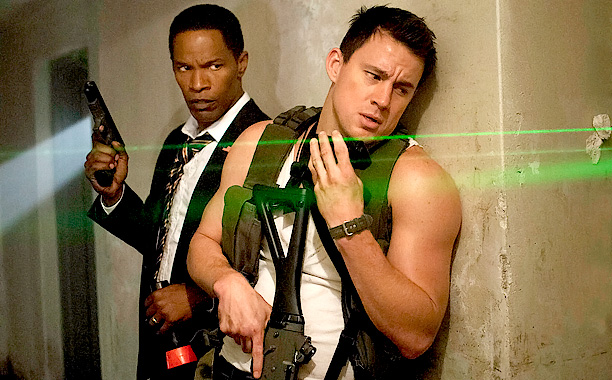
Now here’s a movie that would give President Obama a heart attack.  White House Down, much like a film released earlier this film called Olympus Has Fallen are both about the same thing.  The white house is under attack by a group of professional terrorists, the president is in danger, and our brawn yet brave hero must step in to save him.  All you need is a ripped shirt, a clean-shaven face, and a lot of guns on this guy (not just automatic) and you’re all set.

Unfortunately, that’s all the information I can give you.  This movie is so thinly written that that’s the deepest I can go without giving any spoilers.  The only other information I can provide that could give you any clue on to what this movie is like is that the brawn, brutish hero is played by Channing Tatum,  the president is played by Jamie Foxx, and Tatum owns a daughter portrayed by the sweet and talented Joey King.

I’m going to get this out of the way: Channing Tatum should never play the lead in any movie ever.  He cannot act.  There is no sincerity in his voice, no fluid movement of his body, no expression on his face to show he’s feeling anything except for when he’s shooting at something.  The fullest his acting capability reaches in the movie is the eyedrops you see in his cornea when he’s “crying” for his daughter. I’m not even kidding.  His acting is so terrible, the only use Tatum is in the movie is to provide meat for the female viewers in the audience.

(And I will admit my jealousy here: I will never look as good as Channing Tatum does.  I don’t think its possible for any man to).

Where was I again?  Ah yes, Tatum’s acting.  As always he is a stiff, awkward, and uncomfortable actor, a perfect reason why he should never be the lead character in a movie.  Admittedly though, the dialogue isn’t helping him much.  His best lines in the movie involve something like: “You have to go out there and be President”, or “If this guy keeps making those sounds, I’m going to start looking at him.”

If the above description makes this movie sound appealing to you, you should see it.  White House Down is a big case of what-you-see-is-what-you-get: a movie filled to the brim with excessive action, big explosions, cheesy dialogue, and mediocre acting, with the minor exception of Jamie Foxx, who has the most patriotic and humorous dialogue out of any other character in the movie.  In one scene, he’s reciting the history of America so beautifully to his secretary of defense over the phone that one could mistaken him as a Lincoln who underwent skin surgery.  In another scene, he’s following Tatum up an elevator shaft to evade capture when this exchange happens between them:

Foxx: What you do, I do.

(Channing Tatum ninja moves across elevator).

Foxx: I ain’t doing that.

Foxx’s character was the most appealing, the most intelligent, and the most charismatic character out of the entire movie.  Everyone other character was overly charismatic and grossly unrealistic.  One radical baddie is so stereotypical and so overpumped with tattoos, facial hair, ego, and steroids that I expected him to rip off his skin and reveal that he’s the Terminator.  A tour guide portrayed by Nicholas Wright is more worried about fine china and precious artifacts than he is about his own life and well being.  Tatum’s daughter, however, is probably the most frustrating.  She comes off as annoying, careless, and extremely absent-minded in this film.  You might say this is because she’s a child, but tell me something: how realistic is it that a teenage girl like this is smart enough to run her own youtube channel and know more about the white house than the tour guide, and yet, she doesn’t know when to stay in the bathroom or to leave a building when its going to blow up?

I remember an argument I had with a friend of mine in my first year of college.  He was an experienced videographer who understood more about the film industry than any of the professors did in that department.  We were arguing about the differences between film and art, and he told me a direct yet simple statement:

“Film is not an art” he argued.  “Film is a business.”

While I desperately want to prove him wrong through films such as Inception, Life Of Pi and Beasts Of The Southern Wild, it is movies like White House Down that remind me that the industry does in fact exist and operate like a business intended for profit.  At least Roland Emmerich didn’t release this film in 3-D: that wouldn’t have helped my side of the argument one bit.

Tagged , , , , , , , , , , , , , , , , , , , , ,

“SNOW WHITE AND THE HUNTSMAN” Review (✫✫✫)

And thank you, Thor, for keeping up appearances.

Take a deep breath and say it with me: Snow White And The Huntsman.  Doesn’t sound very promising, does it?  Like most fantasy films, Snow White And The Huntsman seemed set up for failure.  It’s centered around a very popular character portrayed by Bella Swan, the film is based around a fairy tale known universally in every person’s mind, and it seemed tempted to fall for a formula and let down its audience.  Believe me, that was the movie I was expecting when I went into the theater.  The movie, however, is much better than the title suggests.

Based on the famous original fairy tale by brothers Grimm, Snow White And The Huntsmanfollows the story of Snow White (Kirsten Stewart), a kind and beautiful princess of the land Tabor who would one day inherit the kingdom and the throne from her father King Magnus (Noah Huntley).  Before she was born, the narrator tells us that her mother pricked her fingers on a rose outside of her castle, with three drops of blood staining the snow.  Her mother told herself that she wanted a daughter as white as the snow, lips as red as the blood, and a spirit as strong and defiant as the rose she prickled.

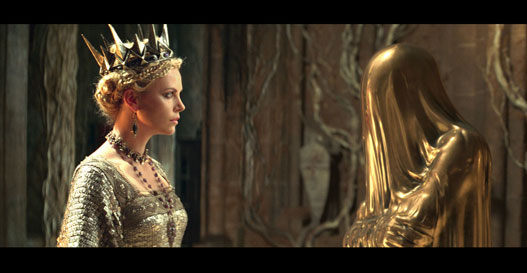
This opening sequence was both fascinating and revealing, a deeper introspect into Snow White’s history that I don’t believe has been visited before.  Her mother eventually died giving birth to Snow White, and so King Magnus marries a strikingly beautiful woman named Ravenna (Charlize Theron), whom he rescued from a dark army made out of glass soldiers that tried to invade his kingdom.  Magnus is so stricken by Ravenna’s beauty, in fact, that she becomes his queen in less than two days.

You already know where this is going, don’t you?  Ravenna is, in fact, the dark and conniving witch leader of the dark army.  After killing Magnus in his bed, she takes Snow White, forces her into the upstairs dungeon, and seizes power over the kingdom as the newly appointed Queen of Tabor.

Years past, and the kingdom of Tabor falls into desolation and poverty.  Snow White has now become of age to become the new queen of Tabor, and has been blessed with the gift of kindness that will ultimately dethrone Ravenna from the throne.  Snow White eventually escapes from the dungeon, flees from Ravenna, and escapes into the dark forest, a place where people slowly lose their sanity and, in time, their life.

Raevenna cannot go to this place to kill Snow White, so she hires somebody who can: a huntsman by the name of Eric (Chris Hemsworth), a man who lost his wife to death’s hand long ago.  Nothing could convince this angry, tired old drunk to take this job willingly, but he takes the job nonetheless in the hopes of that the evil witch can revive his dead wife with her dark powers.  And so the adventures of Snow White and the Huntsman begin.

The biggest thing Snow White And The Huntsman has going for it is two things: its visuals and its handling of the premise, in that exact order.  Rubert Sanders, who is making his director debut through this picture, is very smart and very careful with his visuals, using very precise and expertly-detailed CGI in things like the Magic Mirror or in the dark army made out of glass.  But it isn’t just the visuals that makes the picture what it is: Sanders is smart enough to make the visuals mean something, and just like the camera he’s using to record the picture, the visuals are a tool he uses to tell a story and to instill some deeper meaning in the audience.

Take, for example, how Sanders uses the color of white in the picture.  The color itself only appears three times in the picture: once where Snow White rides and abandons a white horse on the beach, another time where she encounters and caresses a magnificent and beautiful white stag, and the last one being where she dies and is resurrected while being in a white funeral dress.  Go back and look at the pictures again and try to look at it through a more symbolic scope.  I promise you, if you see the picture as I do, you will see a princess abandoning her kingdom, returning to her kingdom, and finally, becoming the queen and leader that the kingdom deserves.

To find such complexion in a picture as this was both shocking and surprising, and the cast delivers just as much as the visuals do. Charlize Theron was menacing, evil, and conniving as the dark witch, and gives a stellar performance that would have had the animated version relieving in her pants.  Stewart, shockingly, is very grounded in her take as Snow White, and embodies everything her mother says she has: strength, beauty, courage, kindness, and heart, and this especially shows in the last half hour of the picture.  Hemsworth was equally as emotional and convincing as the huntsman named Eric, although there are a few brief moments where he breaks character and acts more like Thor from The Avengers.

There was another Snow White movie released earlier this year called Mirror Mirror, and it starred the lovely Lily Collins and Julia Roberts in roles opposite Stewart and Theron.  That movie was too silly and immature for its own good.  Here, we have the opposite problem: this film is dreary, dark, sullen, and bleak, a movie that for the first half of its runtime, fills us with dread, angst,  and sorrow.  Starkly different tone from the whimsical, uplifting veins of the original Disney classic don’t you think?  Whatever happened to Doc, Grumpy, Happy, Sleepy, Bashful, Sneezy, and Dopey?

Still, its a good movie.  When there is color in the picture, it reaches out to you in striking detail, the cast is extremely strong, and the visuals and the camera angles combine to make a very provocative picture and a very sharp visual experience.  All you need left is Mjolnir and the rest of the Avengers, and you’ll be all set.

Tagged , , , , , , , , , , , , , , , , , , , , , ,

“THE LAST STAND” Review (✫✫)

Stuff blowin’ up real good in Redneck City. 

The Last Stand is an actioneer’s action movie, a film so overstuffed with explosions, gunshots, profanity and testosterone that it might have been more appropriate as a video game rather than a movie. I had a friend of mine describe the movie as being “The guyest guy guy movie you’re ever going to see”. That much is true. Whether its the best one, or even a good one, is up to you.

Sheriff Ray Owens (Arnold Schwarzeneggar) has been the sheriff of Summertown for many years now after having quit his profession of being a cop in Los Angeles.  Summertown is a quiet place, a small town where crimes range from the Mayor parking his car in a fire lane to deputies firing at slabs of meat during lunch time.  In a small, quiet town such as this, Ray finds little excitement in his day to day routines and he is perfectly fine with that.

But one day, he receives unwelcome news from the FBI: a nation-wide criminal named Gabriel Cortez (Eduardo Noriega) escaped from the FBI’s hands and is fast on his way to the Mexican border, where he will be out of the FBI’s reach.  The only thing blocking his path: Summertown, which also sits on the United States border to Mexico.  Owens now has to rise up to the challenge to defend his home.  To defend its citizens.  This is the last stand.

This is Arnold’s first lead role after his 10 year hiatus as California’s governor.  Before that hiatus, Arnold was a standout in a slew of memorable action roles, including (but not limited to) Predator, Total Recall, True Lies, Last Action Hero, and my personal favorite, The Terminator and its sequel.  All of those movies are memorable, exciting, suspenseful, and sport great blockbuster entertainment.

Now look at The Last Stand.  This movie cannot help but look shoddy compared to those titles because of its plot, its only inconsistently funny and exciting, and whats worse, it depends on the forumula of repetitive action.  Wonderful.  We certainly don’t get enough of those, now do we?

Let’s take a deeper look at Arnold real quick.  The man has had a great career.  Before going into office, he was asked to be in these tense, highly riveting action roles, and he was damn good in all of them.  Now, he’s been dilluted to just standing tall and read lines as everyone else turns to him asking what to do when a drug cartel is ready to tear through his town.  Guys, come on.  This is the 42nd governor of California, not Angus MacGyver.

The rest of the characters aren’t really that helpful or compelling.  Zach Gilford portrays Officer Jerry, a guy who wants to see more action than he does but then gets his nose broke by the recoil of a gun.  Luis Guzman plays as a chubby mexican officer, and he’s so stereotypical he might as well have been portrayed by Anthony Anderson.  Rodrigo Santoro and Jaimie Alexander share a forced romantic conflict in the middle of all the bullets and gunfire, and while they’re coincidentally dodging all of the bullets amist their kissing, all I could think to myself was “Hey kids!  Find a shower!”

The worst miscalculation, however, is in the film’s villains: Eduardo Noriega as Gabriel Cortez and Rodrigo Santoro as his goatee, ponytail lackey.   Noriega is worthless as the main villain, and is just stuck to driving a car recklessly for more than two-thirds of the movie until the last 20 minutes where the climax calls for a chase scene.  But even worse is his lackey, who seems completely lacking basic motivation of reasoning behind his actions.

Take a look at the only three things he does in the movie: kill a farmer, build a bridge over to Mexico, and strike a raid across Arnold’s town.  Explain to me A) Why he killed the farmer and clued the detectives into his plan, considering the construction of the bridge was nowhere near the farmland, B) How the bridge to Mexico only took around 24 hours to complete, C) Why waste resources building a bridge when he can just bring in a helicopter for the escape, and D) What is the relevance for attacking the town when it means nothing toward Cortez’s escape?  His actions seem senseless, almost like his decisions are delegated by the script just for the sake of action sequences and explosions.  Why must an action film like this seem so mindless, so pointless in its structure and so artificial in its writing?

The film’s most entertaining character is a man named Lewis Dinkam, portrayed by Jackass star Johnny Knoxville.  Highlight, embolden, and underline Jackass.  This guy is the opitimy of stupid, most of it portrayed humorously so.  This guy is an absolute psycho, shooting off pistols and machine guns named “Betty” and “Nazi Killer” with his pajamas on and tearing off electric polls by climbing them and chainsawing the electric wire.  Is he the smartest character in the bunch?  No, but he is the funniest, although I don’t understand why he’s wearing a woolly hat in the middle of the summer.

Ultimately, I’m at a loss with The Last Stand.  There’s no doubt entertainment value here, but it is severrely misguided, almost like a misfired Colt.  Half of the film is used to just set up its premise with predictable scripting and bad acting, while the other half is used for repetitive and monotonous action, gunshots, and F-bombs.

“But David”, one fellow viewer pointed to me, “That’s entertainment!  People need entertainment because real life sucks!”  This is true that people need entertainment, and The Last Stand will satisfy some viewers.  For others however, they will be left yearning for a better story, more original action, and a more worthwhile experience.  In the meantime, what you see is what you get: if its action you want, boy oh boy, it action what you’re going to get.

Tagged , , , , , , , , , , , , , , , , , ,

“MAN OF STEEL” Review (✫✫✫✫)

Look!  Up in the sky!  Its a bird!  It’s a plane!  It’s the man of steel!

Now this is what I’m talking about.  Man Of Steel is in a special place as a reboot, a carefully calculated yet ambitious and affectionate movie giving a new energy and enthusiasm to a cherished American icon.  The last thing I wanted Man Of Steel to become was a remake of the original Superman movies, or even worse, a PG-13 version of Watchmen.  We have none of that here.  It isn’t coy, formulaic, or insincere: it’s a rare rebooted superhero remake that affectionately, genuinely works.

In case you haven’t picked up on it by now, Man Of Steel is a retelling of the story of Superman.  Clark Kent (Henry Cavill) is a young inhabitant of Smallville, Kansas who deals with a specific problem that other teengers his age doesn’t deal with: he has metahuman powers the likes of which cannot be from planet earth.  And young Clark isn’t from planet Earth either: but he doesn’t know that.  Not yet.

You see, Clark’s real name is Kal-El, and he comes from the planet Krypton, a planet that died due to its own selfishness and greed.  Scientist Jor-el (Russel Crowe), who is the father of Kal-El, knew of Krypton’s future demise, and planned ahead for it.  He embedded the code of Krypton’s DNA within his newborn son, Kal-El, and sent him to a faraway planet where he not be harmed from Krypton’s destruction: Planet Earth.

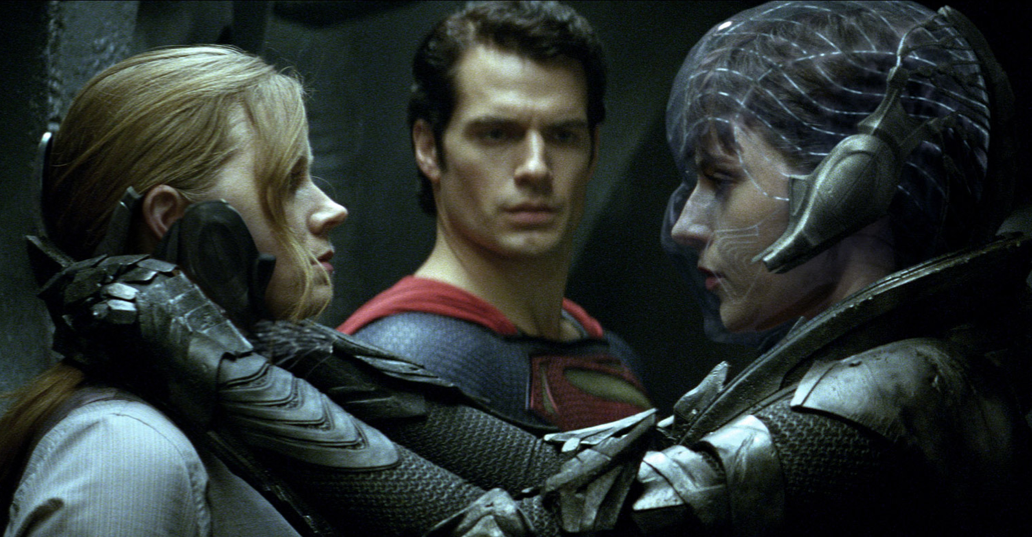
Unfortunately, his former ally and friend General Zod (Michael Shannon) is hellbent on preserving his species and building a new Krypton on planet Earth.  For this he needs Clark and his DNA to fuel his machine so that they can form a rebirthed Krypton upon the ashes of Earth’s surface.  Clark, fully knowing where he came from and the extent of his abilities, decides to defend the earth from Zod’s evil scheme and to become the symbol of hope for all of mankind to follow.

Fully aware of the dangers that came with a reboot for Superman, one of my initial worries for the film was that there would be too much action and not enough character investment to go with it.  That is the typical danger with superhero movies, after all: filmmakers are typically more interested in the action and visual effects than they are in emotion or in investment for their characters.

That is not what we have here.  Director Zack Snyder (300, Watchmen) and screenwriter David S. Goyer (Dark City, The Dark Knight Trilogy) make here a wonderful marriage of something rare: great scripting with great action, and great directing.  What makes this movie so appealing is not the fact that it is an action movie: we’ve seen hundreds of movies before where action is just stacked on top of action, with no real cause or motivation to be concerned with any of it.

Man Of Steel is not that.  It is a rare thing: a movie in which the action is just as fleshed out as the character’s emotions are.  Whenever Clark isn’t flying, breaking the sound barrier, or punching some guy’s light’s out, the movie interjects a flashback of Clark’s childhood: we get a glimpse to a more personal portrait of Clark as a child and what it was like growing up struggling with these superhuman powers.  Perhaps in another movie it would be all fun and jokey, but here it is taken as seriously as the death of Bruce’s parents from the Batman series.  I was reminded of the last line Peter spoke during his ending monologue of the original Spider-man: “This power is my gift: my curse”.

The action, however, is utterly spectacular.  In the original Superman movies, Clark was resorted to lifting up school buses and stopping nuclear missiles as his highest challenges.  Not here.  Here the stakes are much higher, and we can tell that because of the level of destruction in this movie.  When Superman trades blows with another Kryptonian, destruction is sure to follow.  Crushed cars and overturned trains are a constant during these fight scenes.  Crumbling buildings and falling debris is to be expected.  There was even one terrifying moment where the Kryptonians used a gravity machine to tear apart the Earth’s infrastructure.  Did I mention the crumbling buildings?  Watching this level of destruction made me feel sorry for the mayor of Metropolis.  I’d hate to see the repair bill.

And lastly, I must pay respect to Henry Cavill and Michael Shannon.  Here, they are the perfect embodiment of themselves: good, or evil, human or Kryptonian. They don’t fight in an area of black-and-white: they fight in many shades of gray, because while we don’t want Clark to lose his home on planet Earth, we also understand and sympathize with Zod’s reasonings because he too lost his home.  There’s a very human reason why these men are fighting, and there’s no simplicity in their conflict: only complexion and brutal reality.

Before you ask me, no this does not replace the original “Superman” movies, and no, Cavill is not an adequate replacement for Christopher Reeve himself.  That is besides the point.  Man Of Steel did to the Superman franchise what The Amazing Spider-man did for Spider-man: it breathed a new life and conception to it, ensuring that when its all said and done, the Superman legacy will live on, and it will not die away because the actor of the former icon has passed through time.  Snyder has accomplished quite a feat here: he has paid tribute and honor to Reeve and the filmmakers of the original Superman by offering this exciting, emotional, and action-packed thrill ride that gives a new birth to the flying caped crusader.

PS: Admittedly, I saw this film in IMAX 3-D.  See it in IMAX, but don’t waste your money on the 3-D.  A fantastic movie doesn’t deserve a dim picture anyway.

Tagged , , , , , , , , , , , , , , , , , ,

“STAR TREK INTO DARKNESS” Review (✫✫✫1/2)

A.k.a, the wrath of John Harrison. 

Star Trek Into Darkness is a sequel of excellent caliber, a science-fiction movie that not only lives up to the expectations set beforehand by its fans, but in many ways, surpasses them by making a much more efficient, fluent, exciting, and overall, more well-made film.  The movie is everything a science-fiction epic should be and more: it is exciting, suspenseful, entertaining, visually spectacular, and surprisingly emotional.  Were we expecting this?  I think we were not.  

Taking place a few years after the events of the first film, Star Trek Into Darkness finds the newly-appointed Captain James Kirk (Chris Pine) and his first-mate Spock (Zachary Quinto) as they have just started breaking into their roles as pioneers of the U.S.S. Enterprise.  As they continue to carry out their duties, however, a new threat has arisen to challenge them and the entire Starfleet: Captain John Harrison (Benedict Cumberbatch), a sniveling criminal who has betrayed Starfleet for unknown reasons.  As Kirk and Spock begin to investigate further into Harrison’s history, however, they uncover a dark secret that will haunt their lives forever.

This is everything a great sequel is supposed to be: exciting, suspenseful, engaging, emotive, and reminiscent of the original.  The key ingredient to this recipe is its writers and director: Roberto Orci and Alex Kurtzman, who are responsible for the witty and intelligent dialogue from the first movie, and J.J. Abrams, who is nearly a master at making blockbuster movies.  Abrams, whose most recent film was the intelligent and highly entertaining sci-fi Super 8 shows once again why he is one of the best filmmakers in the business: he is great at manipulating emotion.

In one scene, for instance, he shows a light-hearted, funny, rivalrous exchange between its two leads, Pine and Quinto.  In another scene, he shows an explosive, exciting, and suspensful mid-space gunfight through all of the lense flares and visual effects.  In another, he shows a sad, tragic, emotionally stirring moment between two close characters, almost bringing its audience to tears in the process.  With Star Trek Into Darkness, Abrams does what every great director should: he doesn’t let the visual effects run on autopilot.  He illustrates every emotional moment of this film with alluring precision, and it only makes us all the more excited knowing that he’s going to be in the directors chair for Star Wars: Episode VII.  

Regardless of Abram’s direction, however, this movie would not have survived without Roberto Orci and Alex Kurtzman’s intelligent, creative, and captivating screenplay.  This movie once again reminds me why they are among my favorite writers in the industry: they highlight character motivation and emotions and embed them into gripping, fascinating, and exciting science-fiction stories.  This is prevalent in all of their work: Mission Impossible III.  Transformers.  Eagle Eye.  Even the first Star Trek was focused largely on character than it was in explosions and special effects (although, as you can guess, it didn’t disappoint in either category).  With Orci and Kurtzman, they do here with any of their screenplays that makes their writing the highlight of the film: they make the characters appealing, funny, likable, and sympathetic.  Even the bad guys have a soft spot we can root for.

Which leads me to my final point: the performances.  Specifically Benedict Cumberbatch, who gives such a rousing performance as the film’s villain that he stands out in my mind similar to The Joker from The Dark Knight, or Loki from The Avengers.  Cumberbatch, who is most known for portraying the title role in BBC’s Sherlock, plays here a villain so contrasting, so ruthless and unforgiving in nature, that one could say he’s a more driven antagonist than Nero was in the first Star Trek.  His movements are stiff in STID, his gaze cold and calculative.  But when his intent is revealed, its a secret so shocking that it shakes the entire theater like the collapsing corridors of the Enterprise when it is shot and going down.

That, and this movie has endless amounts of explosions, gunfights, spacefights and CGI, which only makes the movie all the more better.  The only thing this movie lacks is the originality of the first film, and it somehow doesn’t evoke the same sense of fascination the first one did either.  That hardly matters, because Star Trek Into Darkness is still a wonderful science-fiction story while paying homage to the earlier Star Trek film, Star Trek: The Wrath Of Khan, although I dare not say precisely how.  All you need to know right now is that Star Trek Into Darkness is engaging, intelligent, touching, shocking, energetic, and fun.

Tagged , , , , , , , , , , , , , , , , , ,