Tag Archives: Adaptation

“FROZEN” Review (✫✫1/2)

The Snow Queen: The Musical

Good news first: Frozen will please its core audience. It’s a cute, cuddly little fairy tale movie with a lot of music and a lot of misplaced optimism. Kids will enjoy it, and there’s a solid chance that the parents might enjoy it too. The bad news: It’s the same Disney Princess movie you’ve seen for the past 50 times now.

Based loosely on the Danish fairy tale “The Snow Queen”, Frozen follows the story of two princess sisters, Anna (Kirsten Bell) and Elsa (Idina Menzel). Being enclosed in a castle all of her life, Anna is a cheery, energetic, happy and overly-optimistic princess who would marry a man after getting to know him for just one day.

Elsa, however, does not have the luxury of being optimistic. Cursed with the ability to create snow and ice at a young age, Elsa has soon realized that she cannot control her powers and decides to escape before she does her kingdom, and her sister, any harm. Now determined to find her sister and mend the relationships that were shattered long ago, Anna sets out with a ice picker named Kristoff (Johnathon Groff), his reindeer Sven and an animate snowman named Olaf (Josh Gad) to find Elsa and save the kingdom.

Written by Jennifer Lee (Wreck-It Ralph) and co-directed by Chris Buck (Tarzan), Frozen is by definition, a family movie. It’s driven by a childish energy, a lively and undiminished spirit that fills children with joy through its wonderful music and its bright, colorful animation.

The characters are enthusiastic (at times, annoyingly so), with the most likable character being a midget snowman called Olaf. Olaf is just funny. He’s the kind of oblivious, clumsy snowman that bumbles around like a lego stick figure, losing his body parts every five minutes, stumbling to get them all back together, and put it on straight before the snow monster eats him. “Go! I’ll distract him!” his head said in one scene as everyone ran away, including his body. “No! Wait! Not you! I was talking to them!”

He also has a ironic fascination to the sun, fire and heat, not realizing what effect they have on snow.

All in all, Frozen is a fun movie. But if you’ve seen Tangled, then you’ve already seen Frozen before. The two movies are so similar, so mirrored in appearance, character, story and animation that the only real difference in between both is that Frozen takes place in a winter wonderland.

See, the problem doesn’t exist in the movie itself: the problem exists in what earlier Disney movies did first and better. Tangled is not the only movie where we’ve seen this story about self-discovery and relationship building. Look at virtually any other Diseny Princess movie on their filmography, including Brave, Mulan, Pocahantus, Princess and the Frog, etc etc. No, none of those movies deals with the theme of sisterhood, but does it need to? Those movies are still so similar in personalities, humor and musical numbers that the story becomes a copy-and-paste convenience rather than an original pleasure.

However, understand that this is not a critical observation of the movie, but rather a neutral one. I stress this point again: this movie will please its core audience, which is little children, the parents of those children and the hardcore Disney lovers. By all means, if you want to see the movie, go ahead and see it. Chances are you’ll enjoy it more than this Scrooge going “Bah humbug” in the corner of the newsroom.
Tagged , , , , , , , , , , , , , , , , , , , , , , , ,

“12 YEARS A SLAVE” Review (✫✫✫✫)

Over a decade of injustice and cruelty.

12 Years A Slave is quite possibly the best film of the year.

It is also the most disturbing.

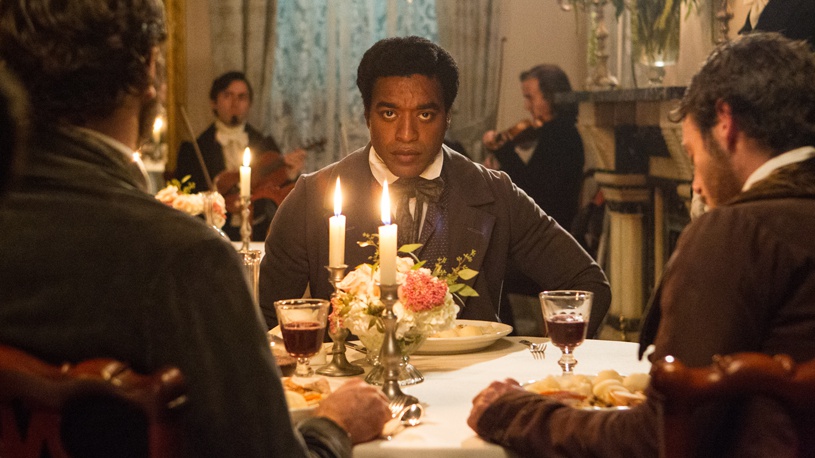
Based off the 1853 autobiography of the same name, 12 Years A Slave follows the true story of Solomon Northup (Chiwetel Ejiofor), a free black man who lives with his family and plays the violin in Saratoga, New York.

One evening, he becomes acquainted with two young gentlemen who claim to be circus performers looking to hire him for a one-night gig. When he wakes up the next morning, he is in chains, and realizes that he was drugged, kidnapped and sold into slavery by his captors. During his years as a slave, Northup goes from one owner to the next, from a kindhearted owner named William Ford (Benedict Cumberbatch) to a cruel, racist and mean-spirited pig named Edwin Epps (Michael Fassbender), who presents the greatest trials he must face if he is ever to survive.

12 Years A Slave is a film that not only lives up to all of its built-up hype and expectations: in many ways, it exceeds them.

Its quality as a work of art is so striking and powerful that it can be compared to other historical tragedies, including The Pianistand Schindler’s List.

Director Steve McQueen, who made the morally reprehensible and eerily bleak film Shame back in 2011, redeems himself here as a filmmaker. McQueen, in collaboration with cinematographer Sean Bobbitt, is not only masterful with framing his articulate, beautiful shots with 12 Years A Slave, but also brilliant with orchestrating scenes between his actors, showing us the bleak realism and truth of the slavery years in America.

Ejiofor, who portrays Northup in 12 Years A Slave is endlessly captivating. In moments where you think he might just be phoning it in, or just going along with the motions, he surprises you and releases an emotional intensity in ways no other actor has this year, not even Forest Whitaker in Lee Daniels’ The Butler. Newcomer Lupita Nyong’o plays a young female slave in this movie so passionately that you forget she’s an actress and slip into her character’s tragedy as a human being more than you do as a movie character.

Most noticeable perhaps is Michael Fassbender as Edwin Epps, who is so hateful and so spiteful in this role that all of the audience’s energy, anger and frustration is focused on him and his sadistic acts. Fassbender was brilliant in his portrayal, and I sincerely hope that he at least gets an Academy Award nomination for his performance.

Every other aspect of this film can be praised endlessly. The script by John Ridley, who wrote Three Kings in 1999, was endlessly emotional and captivating. The score by Hans Zimmer was quiet, humble and breathtakingly beautiful, encompassing both the truth and tragedy of Northup’s heartbreaking story.

However, let there be a strong word of caution: 12 Years A Slave will elicit violent reactions from its audiences. You will laugh. You will weep. You will grind your teeth in anger and frustration, maddened by the many years of cruelty, prejudice and barbarism that no human being should ever have to experience. But it compels you to care for the character, to reach deep down in your heart to feel what he is feeling, to experience compassion and sympathy in ways almost no other film can do, not even with Schindler’s List. 

And let this be a testament to the film’s quality: at the end of the showing, there was a white man who could be heard weeping in the back of the theater. In between his hiccups, tears and hysterical reactions, he turned toward the black viewer sitting next to him, shook her hand and after introducing himself said to her, “I’m so sorry for what my race did to your ancestors.”

That man felt a powerful feeling of guilt and shame for the things that he saw in 12 Years A Slave.

That man was me.

Tagged , , , , , , , , , , , , , , , , , , , , , , , , , , , , , , , , , , , , , , , ,

“THE BUTLER” Review (✫✫✫✫)

A humble heart living through harsh times.  

When we watch movies like The Butler, we are reminded of our history and why we must never return to the horrible origins that we came from.  When I say that, I am saying that regardless of race.  The film is obviously centered around the issues of slavery, segregation, and racism, and asks us to feel sympathy towards the African population for all of the horrible things they’ve been through.  But the movie evokes a more powerful emotion from me personally, a deep sense of regret and shame that my own race, the Caucasians, were at one point responsible for all of the death and cruelty we inflicted upon our own African brothers.  And why?  Because they have a different pigment than us?  That’s the sort of hate and bias that lead us to World War II when Adolph Hitler led the Third Reich against the Jews.

Based on the career of real-life butler Eugene Allen, The Butler follows the story of Cecil Gaines, a black butler who grew up during the slave era, growed up learning how to be a white man’s servant, got a job at the White House, and continued to serve there for almost 35 years. Throughout his career he witnesses history unfold in itself, from President Dwight D. Eisenhower’s (Robin Williams) decision to enforce desegregation laws in Arkansas, to witnessing the assassination of John F. Kennedy (James Mardesen), to seeing the rise of the Ku Klux Klan and the Black Panthers, to the assassination of Martin Luther King Jr., to the eventual inauguration of Illinois Senator Barack Obama into office.

The Butler is an earnest, humble film, parts approachable and observant yet equally ambitious and honest. Like movies such as Ghandi, The Hurricane, and The Shawshank Redemption, this is a movie that looks into the reality of situations and shows them exactly how they were, no matter how tragic or heartbreaking those circumstances were.

Take, for example, the scene where the Ku Klux Klan is introduced.  During his college years, Cecil’s son Louis (wonderfully portrayed by David Oyelowo), was on a bus to protest against a racist Alabama.  While on their way, their bus stops suddenly as they stare at the white-robed, torch-bearing Klan staring at them with their hateful eyes.  Equal parts petrified and terrified, the protestors desperately tried to escape before the Klan started igniting the bus with fire and molotovs.

I sat there watching these scene, equally infuriated and enraged as I was emotional and mournful.  How could this be our country?  How could this have once been our land, our people who so hypocritically claimed to be the land of the brave and home of the free?

To watch these scenes and to incur such an emotion takes great skill and courage, and I think Lee Daniels does a great job orchestrating these scenes in ways that makes them so emotional and powerful.  Daniels, who was nominated for an Oscar in 2009 for Precious took quite a fall last year when he made Paperboy, a idyllic, preposterous, and morally reprehensible film that was anything except relevant, coherent, and well, good.  Here Daniels redeems himself, and leads a star-studded cast through such a gripping, overwhelming story that I think it surpasses his accomplishes even with 2009’s Precious.

Oh yes, the cast.  The cast is what makes this picture, but you already know that if you take the time to simply read the cast list.  Jane Fonda as Nancy Reagan.  Alan Rickman as Ronald Reagan.  John Cusack as Richard Nixon.  Liev Schriber as Lyndon B. Johnson.  Minka Kelly as Jackie Kennedy.  John Mardesen as JFK.  Robin Williams as Dwight Eisenhower.  Alex Pettyfr as a plantation owner.  Terrence Howard as Cecil’s neighbor.  Cuba Gooding Jr. as a head butler.  For Pete’s sake, Mariah Carrey is in the film as Cecil’s mother and she doesn’t even say a line of dialogue.

The best performances, however, are the lead ones by Forest Whitaker and Oprah Winfrey.  Whitaker, who won the academy award for The Last King Of Scotland in 2006, steals the show in every single scene he’s in, showing the still portrait of a man who is tired, weary, and emotionally strained, a man who has seen endless ages of wrongful suffering but can do little to change it because he’s worrying about himself and his family.  Winfrey is equally as striking as his wife Gloria, a woman who is also hurting and in deep suffering because of her situation and because of a drinking problem she has long struggled with.  Both of these characters are central and integral to the plot and to the progression of the story, and at many times, they’re the only ones carrying the movie through as a whole.

The Butler is one of the best films of the year.  Period.  I know there’s a lot of movies about African-American history being released later on this year (Such as Mandela: Long Walk To Freedom and 12 Years A Slave), but there’s no denying the power, drama, or the history the movie so brilliantly provides us.  Yes, there are some inaccuracies to the butler’s real-life story (Starting with his name, with the real name being Eugene Allen), but the fact that it is loosely told is the best asset Daniels has towards his narrative. Since the figure is so little-known in today’s world, it allows Daniels to let loose and tell the story that he wants to tell, not the story that he’s committed to tell.  This is a movie that shows the history of a great man and a humble servant who was simply trying to support his family and to get through the days of wrongful judgement and discrimination.

Tagged , , , , , , , , , , , , , , , , , , , , , , , , , , , , , , , , , , , , , , , , ,

“THE GREAT GATSBY” Review (✫✫✫)

Nice to see you again, old sport.  

When you sit and think about the character of Jay Gatsby, there is never a simple answer to define him and his purpose in The Great Gatsby.  Some people have cited him as a post-modern interpretation of Romeo And Juliet, in the aspect that the character is going through a romantic struggle that always ends in nothing but tragedy.  Others have viewed him as a representation of the roaring twenties, as a pioneer who emboldens and defines the industrial image of the 1920’s and their status as they faded away into the 1930’s.  Others see him more like an enigma, an image of the upper class and the bleak loneliness that comes with it.  Whatever you believe to see, Jay Gatsby is no simple character.  For all we know, he could be one or none of these things.  Or all of them.

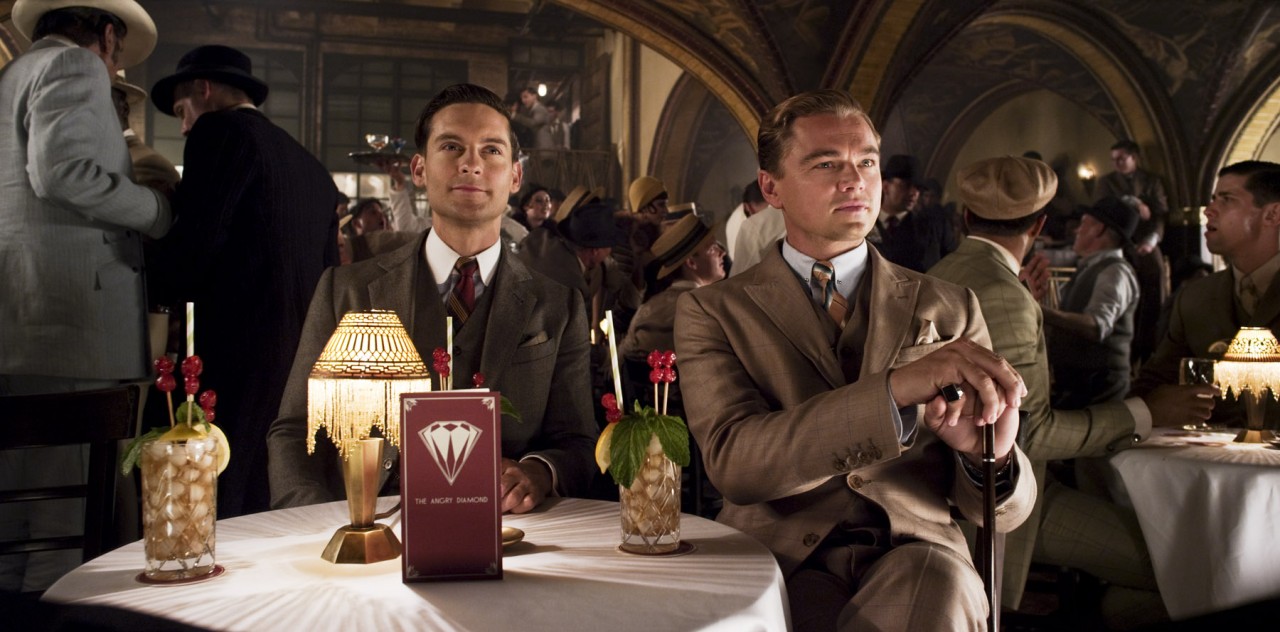
The fact that this film knows, respects, and acknowledges that makes me appreciate this movie, and hope that others can appreciate it too through DiCaprio’s performance and the mythology being revisited here.  Those who read the book should already know the story: a 1920’s bond salesman and struggling writer named Nick Carraway (Tobey Maguire) moves into New York city, where he learns of his rich next door “neighbor” named Jay Gatsby (Leonardo DiCaprio).

I put “neighbor” in quotations because Nick never actually sees Jay Gatsby in the beginning of the film.  All he ever sees of his estranged, self-secluded neighbor is a man looking behind some curtains and holding lavish parties in his mansion in the cool of midnight.  All he ever hears of him is scandalous rumors and war stories about a man many people haven’t met either.  The more Nick lives in his lonely little house, the more he questions if Mr. Gatsby even exists.

Eventually, Mr. Gatsby of course does introduce himself, but not as the host of the party, but rather, as a humble servant who offers Nick a drink on a plate of beverages.  As Nick becomes more familiar with Mr. Gatsby and his lifestyle, he soon learns the truth of Mr. Gatsby’s past and the reasons he really came to New York.

When I first heard of another Great Gatsby picture being made, my first reaction was excitement and anticipation.  How could it not be?  From the creative mind of F. Scott Fitzgerald and the many politics and emotions he makes you feel in his novel, it sounded like this movie was going to be a home run for both fans and non-fans of the book.

Then I learned that Baz Lurhmann was writing and directing.  And then bowed my head and uttered a long, dubious groaaannnn.  Lurhmann, who is most known for directing 1996’s Romeo + Juliet and 2008’s Australia, is commonly remembered as a director who abuses style over substance.  With the previous films I just mentioned, not only are they silly, soupy, and sappy menial dramas: they fail to even attain interest, and are extremely forgettable in a line of much better romantic dramas, including Titanic and the 1968 Romeo And Juliet by Franco Zeffirelli.

Note: Okay, I’ll admit I haven’t seen his 2001 film Moulin Rouge!.  Does it matter though, when out of his entire filmography, that’s the only film he can really brag about?  

The beginning of The Great Gatsby, much like Luhrmann’s other pictures, also suffers from this case of style over substance, with its overly boisterous parties and distracting art sequences making no coherent sense or adding anything to the picture overall.  What I found interesting, however, is that the first act barely matters.  When Jay Gatsby is finally introduced, the film takes a sharp turn of interest and invigorates the audience with new energy, almost like the character changes the entire tone of the film simply by him just being there.

I imagine this is the kind of Jay Gatsby that Fitzgerald would have wanted cast: the type that dresses in nice suits, stands straight with his chin up, and one who enters a room with such stillness that you could hear a penny drop.  The casting directors knew that their casting decision would be crucial to the film, and I think Fitzgerald would be pleased with the end result.  DiCaprio hits every single note dead-on this fascinating character, and just by sheer appearance, demeanor and dialect does he inhabit the character of Jay Gatsby and allow audiences to slip into his conscience and feel what he is feeling.

Oh, I won’t deny everyone else is good in this movie.  Joel Edgerton is effective as the antagonist, and even though he’s an industrial pioneer much like Gatsby is, he has such a hateful energy about him that makes you just want to run him over with a yellow beetle.  Carey Mulligan is good as Gatsby’s love interest, and perfectly shows all the innocence and indecisiveness of her character in the midst of all the ruckus.  Maguire, as well, is perfect as Nick Carraway, not as a character in himself, but as a silent observer, a passive voice who quietly watches over the scene, acting as the audience’s eyes and ears in this third-person narrative.  But its DiCaprio who sucks us in, DiCaprio who winds us up and plays us like a record as he asks us to sit through this tender, emotionally captivating journey that serves as a metaphor for the wealthy and for the industrial era.

And don’t worry, I’ll give Luhrmann credit too.  This film would not have survived without his writing or directing, as he has such reverence for the book and a great fear from deviating from it that the movie functions more as a love letter to Fitzgerald than it does as a strict book-to-movie adaptation.

Regardless, there’s only one person who shines the most here.  DiCaprio made this movie, and through his performance we were able to identify with a character that struggles with his past, his wealth, his love, and the deepening sadness that he hides behinds his warm, welcoming smile.

Tagged , , , , , , , , , , , , , , , , , , , , , , , , , , , , , , , ,

“STAR TREK” (2009) Review (✫✫✫✫)

To go where no Trekkie has gone before.  

When I first heard about J.J. Abrams rebooting the Star Trek series with another movie outing, my immediate reaction was rolling my eyes.  “Not ANOTHER Star Trek movie!” I remember thinking.  Indeed, wasn’t that everybody’s reaction?  Star Trek lived and had its time, and it seemed like the only people who would enjoy this new release were the Trekkies that were faithful to the series since episode one.

Nothing, however, would have prepared me for how immersive and fantastic this new movie is.  It’s more than just another Star Trek movie: its a science-fiction epic.  It’s an energetic and revamped take on a series that severely needed a new direction.  The story is original, the characters are fresh, and the vision is as bold and fearless as it possibly can be. Its success doesn’t just rely on CGI and visual effects (although believe me, it doesn’t fail in either category).  It’s one of those rare treasures where the characters and their dialogue is more appealing than the action scenes we have to go through every twenty minutes.

The plot originated from an idea that was had way back in 1968.  Back when the series was first spawning its popularity, original creator Gene Rodenberry started early writing for a prequel to his own science-fiction series.  But just like superhero movies Watchmen and Sam Rami’s Spider-man, it was stuck in development hell until finally creative writing team Roberto Orci and Alex Kurtzman were hired to write the script for the new mysterious Star Trek prequel.

This was a smart move.  They are the same writers behind movies as successful as Mission Impossible III, Transformers, and Eagle Eye, and their proficiency as writers shines here more than ever.  They compose a story as brilliant as it is exciting, a plot that is as action-packed, captivating, explosive, humorous, and in-cheek as possibly can be.  They do more than just adapt this universe: they pay tribute to it.  They pay homage to the classic series, pulling inspiration and ideas from all corners of the galaxy in the Star Trek universe.  We can tell this through tidbits of plot and dialogue that Orci and Kurtzman insert throughout the movie that reveal intimate details of the Star Trek universe we might not have known before, such as how Kirk came to become enrolled in Star Fleet, the origins of Spock, or how James McCoy got his famous nickname “Bones”.

This isn’t just another action film where the characters are just shoved aside for the action and explosions: Orci and Kurtzman are just as careful with developing character and dialogue as they are story.

Still though, if we have Orci and Kurtzman to thank for the vision, we have director J.J. Abrams to thank for the realization of it.  To date, this is only his second time in the director’s chair (his first being Mission Impossible III), but his skills as a filmmaker shine here of blockbuster-esque proportions.  Every minute of this film is fueled by both ambition and excitement, with every minute being tense, exciting, funny, exhilerating, and action-packed all at once.  Nothing is ever dull or boring or repetitious in this film: every second is filled with character appeal and visual spectacle that hasn’t been matched since George Lucas’ Star Wars series, or recently James Cameron’s Avatar.  I cannot recall a single moment in the film where I was bored or irritated.

If we’re talking about science-fiction epics, it flat out doesn’t get much better than this.  Star Trek is a great movie for many reasons, both obvious and not obvious.  The obvious reasons would involve its visual effects, make-up, and art direction.  The film is obviously visually ambitious, and like the U.S.S. Enterprise, transports you to many worlds of visual color, dazzle, fantasy, and wonder that is ever-present in the constantly-changing genre of sci-fi.  Another obvious reason would probably involve the performances: Chris Pine and Zachary Quinto do a great job at portraying the next-generation versions of James Kirk and Spock, and their chemistry with each other reflects their rivalrous spirit with both great tension and comedy.  Eric Bana also, deserves great props as the lead antagonist.  He portrays a villain so passionate and deadly that I pray the Wrath of Khan would never have to face him.

But those reasons makes the movie succeed: what makes the movie thrive are the unexpected reasons.  And those reasons are writers Orci and Kurtzman and director J.J. Abrams.  I’m not saying their careers don’t precede them: I’ve enjoyed Mission Impossible III and Eagle Eye, and I absolutely love the first Transformers movie (although the second one made me want to gouge my eyes out with a toothpick).

But the caliber of this work goes far beyond what was expected for them.  It’s typical to expect a good product from a good team: it’s rare to see exceptional work of this caliber from that exact same team.

Take this from a guy who isn’t a Trekkie.  I’ve seen a few episodes of “Star Trek” in the past, but I never became interested enough to follow the series as a direct fan.  Watching this movie makes me wonder what I might have been missing out on.

Tagged , , , , , , , , , , , , , , , , , , , ,