Category Archives: Reviews

“MEMENTO” Review (✫✫✫✫)

Like solving a puzzle backwards and then back together.

I’ve never been so attentive to a plot in a way that I was with Christopher Nolan’s Memento.  I’ve never been so immersed, so mesmerized, so hypnotized by the plot, by the narrative, by the structure, and by the character himself and everything he has to struggle with.  When I asked a friend of mine what it was like watching Memento, he said to me “It’s like reading a book, except chapter one is the epilogue, the epilogue is chapter two, and chapter one is sprawled out throughout the book until it reaches the end of the book, which in reality, is the beginning.”

I know, I know, it sounds confusing.  But believe me, the structure of storytelling in this film only adds to the fascination that I feel for the main character.  The film begins with a photograph, a small photo showing a dead body lying on the ground with his brains blown out.  The man holding it shakes it a couple of times, but after a couple of seconds the celluloid fades to white, as if it just came out of the camera stock.

Blood shifts along the ground.  Glass forms back together.  A bullet floats off of the ground and enters itself back into the chamber of a gun.  As the man fires it and cocks it, the corpse he shot on the ground lifts his head, blood flows from the ground back into his head, and his glasses form back together just in time for him to shout “NO!” at the man in front of him before he points the gun at him.

If you’re confused at this, don’t be.  This sequence is shown in reverse, inverted from the normal time stream of what would normally be happening in this situation.  Even though the scene plays backwards, we understand the basic points of it: a man shoots someone and takes a picture of his dead body.

Consider this an outline for the rest of the film.  Leonard Shelby (Guy Pearce) is a man who struggles with short-term memory loss.  He suffers from this condition after sustaining a severe injury from an unknown assailant who stormed inside his house, slammed his head against the mirror, raped his wife, and then killed her while he was passed out.

Fast forward to the present as Leonard suffers from his current condition.  He remembers who he was, where he came from, and how he got to the place he’s now at, but due to his condition he is incapable of making new memories.  Depite this, he’s now on a quest to find the man who killed his wife and stole his memory by leaving himself notes, taking photographs, and marking tattoos on his body to serve as his reminders that his irreversible memory condition won’t allow him to remember.

Written and directed by Christopher Nolan, the same guy who made the 1998 neo-noir film FollowingMemento is the sort of movie that can define a career.  This is a plot as heavy, thick, and deceptive as they come, a clever and concise thriller that is exciting and interesting in every pulse-pounding moment of the film.  Much of this has to do with the film’s structure, and Nolan’s expert timing with the film’s plot.

Take, for instance, his decision to structure the story in reverse order.  Many would look at this and think that this would lead to a confusing, convoluted story.  I think that’s the opposite of what we see here.  Imagine it like you’re watching a police detective working at the scene of a crime: he always starts at the end, but if he follows the right path, he’ll always end up where the story began.  That’s exactly how Memento plays out, and the payoff at the end (beginning?) couldn’t have been greater when all is revealed by the film’s conclusion.

Another thing that makes this film stand out is Guy Pearce.  Here he portrays a disturbed man, a man haunted by his past and by his situation so much that it taints his mind like it does the blood on his jacket.  I heard from a friend that the role was originally intended to be portrayed by an A-lister like Brad Pitt or Aaron Eckhart, but Nolan eventually opted for a lesser-known actor that would bring as much energy and enthusiasm to the role.  His decision was a smart one.  Guy Pearce is perfect as Leonard, capturing the right amount of turmoil and paranoia that comes with people taunted by mental disorders while at the same time retaining the emotion that shows that he is a confused, misunderstood man.

But again, his struggle only leads back to the films structure.  And no matter how Nolan formats his story, I’m surprised at how much it holds up despite the unstable nature of the film’s narrative.

I challenge you to study the plot in this film.  Not to just watch it and react to it, but to look into it and analyze it.  Observe the film as Nolan transitions from one scene to another.  Try to find one plot hole in this film.  Not four, not three, not even two.  One.  I’ll bet you $100 bucks that you won’t find a single plothole in this film.  Not one.

If you think you found one, I bet you $150 that someone can find an opposing argument, and $200 that you’ll end up being wrong.

I keep twisting this film inside and out.  I keep going back to it, looking through it, rewatching it, trying to pick it apart and find any possible flaw I can point out with this movie.  I cannot.  Every single frame of every single second in Memento is tense, fascinating, and mesmerizing, capturing both your attention and your mind early in the film and refusing to let go until the very last slide of the end credits roll.  It’s one of those movies you watch that as soon as you’re done watching it, you go back to the theater just so you can experience it again.

Tagged , , , , , , , , , , , , ,

“LINCOLN” Review (✫✫✫✫)

A man, not a monument, named Lincoln.

I’m rarely made more aware of what Lincoln was in history than what this powerful biopic reminds me: Lincoln was a man.  He wasn’t a fable.  He wasn’t a myth.  He wasn’t some sanctified holy figure that was crowned with solely freeing the slaves.  He wasn’t even technically honest Abe.  Abraham Lincoln was, solely, earnestly, realistically, the 16th President of the United States.  He was for the Union, he despised slavery, he was humble on approach, and he always fought intently for the things that he believed in: the things that he thought were right.

Depicting the final months of Lincoln’s presidency, including the end of the civil war and the abolishment of slavery, Lincoln is a very personal view of the final months of Abraham Lincoln’s life.  In that period Lincoln pushed for african freedom, dealt with conflicting opinions of his cabinet, sought peace negotiations with the confederacy, managed an entire union, and was in a state of emotional grief with his family after the recent death of Lincoln’s middle child, Willie.  If you told me that Lincoln had an easy time during his term as American president, I would call you grossly inaccurate.

In this drama-driven biopic, Daniel Day-Lewis portrays Abraham Lincoln.  When you watch him in this movie, I guarantee you that you won’t recognize him.  Day-Lewis doesn’t just portray the famous president: he embodies and embraces Lincoln’s spirit on every possible level, from the weariness in his voice to the hunch in his back.  His performance is so acute, there is barely any indication that he even is Daniel Day-Lewis.  For two and half hours he disappears into his role, and we briefly witness the miraculous resurrection of Lincoln through Daniel Day-Lewis.  The film lives and breathes on Daniel Day-Lewis’ performance.

Even then, a great actor cannot do anything without great material.  Enter Steven Spielberg and screenwriter Tony Kushner.  Kushner, who co-wrote Spielberg’s earlier history epic, Munich returns here to compose a story that is as complex and insightful as it is dramatic and informative.  Speilberg obviously needs no introduction.  For a decade-defining career as Speilberg’s, and for a project as personal to Spielberg as Lincoln, its obvious he would pay as much attention and focus to this era as he would with Schindler’s List or Saving Private Ryan.

Even then, I’m surprised at Spielberg’s role in this movie.  He’s effective as a director with this film, but he’s not the highlight.  He kind of takes a backseat to Kushner’s screenplay and Day-Lewis’ performance, with him serving as the production’s moderator rather than their visionary.

Which believe me, I’m fine with that.  At times, a director must learn to step back and just let the production flow into place.  Here, Spielberg is a great moderator, carefully directing Day-Lewis through Kushner’s fragile, elaborate script and always making sure he never takes the wrong step along the journey.  It isn’t like Spielberg’s previous films where it relies on flashy effects and CGI: this film is carefully paced through revealing dialogue and personal character development.  While it’s a step out of Speilberg’s comfort zone, it more than works for this production.  Lincoln is one of Spielberg’s most personal and most effective works to date.

The film’s only problem: pace.  Because this film relies on dialogue and performance as its greatest assets, there are times where the film becomes so muddled within its political kurfuffle and babbling that at times its hard to keep track of all at once.  You should know what I’m talking about: Senators and Congressmen shout and babble about to each other in such incoherent conversation that our ears zoom out for a bit and miss some key information we’ll need to remember later on.  This will be a problem for some viewers in the audience, as it will be difficult for some people to be hooked on the beginning of Lincoln’s story because of its slow, slow, slow pace.

But even then, I’m so absorbed into Lincoln’s story and Day-Lewis’ performance that I don’t even care about this minute fault.  The one thing that defines this film, the one thing Spielberg, Kushner, and Day-Lewis got right more than anything else is Lincoln’s compassion, his character, and his humanity.

I remember an interview Speilberg and Day-Lewis gave to Yahoo!Movies earlier this year.  When asked about the gravity of the challenge of bringing Lincoln’s legacy to life on the big screen, Spielberg had this to say about his lifelong dream project:

“…we have a big responsibility in telling the story,” Spielberg said. “And we determined that we didn’t want to make a movie about a monument named Lincoln, we wanted to make a movie about a man named Lincoln.”

A man.

Tagged , , , , , , , , , ,

“LES MISERABLES” Review (✫✫✫1/2)

An opera of unexpectedly epic proportions.  

The first thing that crossed my mind while watching Tom Hooper’s Les Miserables is that this entire story is based around truth.  Not a true story, mind you, but rather the truth about 1800’s great Britain.  In that time period, the country was engulfed in sadness, desperation, and revolution.  The rich outmatched the poor.  The sick and the hungry dominated the streets.  Employment was scarce.  In times like these, misery seemed to inhabit every dark corner, and God was hard to find in the shrinking light.

Perhaps this is also a metaphor for today’s world, but that’s besides the point.  Les Miserables shocked me with its energy, its spirit, and its mature handling of its subject matter.  If the film industry was a railroad, and the train is Les Miserables, Tom Hooper is the conductor, and he’s taking me through a roller-coaster of emotions that range from shock, to sadness, to grief, to anger, to loss, to laughter, and ultimately, to happiness.  How was I supposed to know that I would begin the film with a sulk as low as Russell Crowe’s beard and end the film with a smile beaming as brightly as the sun?

This is the kind of film that Les Miserables is: the kind that finds the light shining through the cracks in the concrete.  Based on both the original novel by Victor Hugo and the subsequent musical by Claude Schonberg, Les Miserables follows the story of Jean Valjean (Hugh Jackman), a convicted criminal in 1815, Great Britain who was put away nine years ago for stealing a loaf of bread.  After being released from prison and breaking parole, Javert (Russell Crowe) is tasked with finding him and imprisoning him once again.

But somewhere along the way, Jean’s hardened heart changes. He encounters Fantine (Anne Hathaway), a sick prostitute mother who greatly fears for what will become of her daughter Cosette (Isabelle Allen). After hearing her dying wish pleading for Cosette’s safety, Jean vows to find Cosette and raise her in the world as if she were his own child.

This is an emotion-stirring epic that is vast and grand beyond all comprehension. Directed by Tom Hooper, Oscar-winner for 2010’s The King’s Speech, Les Miserables is a movie that juggles emotional tensity with visual splendor and grandeur, with Hooper’s dignified set pieces shining brightly all over the place in a broadly dignified fashion.  The opening sequence in itself is bold and spectacular, beginning deep in British seawaters and lifting itself out of the water to show a view of British prisoners pulling a ship into the bay.  With the visua effects, there is a great historical context within this picture, focusing attentively to many issues in 1800’s France, including criminal treatment, poverty, child neglect and the French revolution.

At the same time though, this movie thrives as an aesthetic piece, with these characters conveying their thoughts and emotions through their powerful performances and voices through the film.  Russell Crowe is upright and stoic as Javert, a man committed to law and order to the point where it is almost inhumane and cruel.  Anne Hathaway is affectionate and masterful as Fantine, and her character is one of the more tragic characterizations I’ve come across in recent cinema.

Hugh Jackman, however, steals the show as Jean Valjean. He is a man who has experienced cruelty and unfairness firsthand and has hardened his heart so much just so he can survive in this world. But he is also a man who has gone through a change, a man who experienced a kindness and love that no one has shown him for so long. Jackman is brilliant in the lead role, and a powerful spiritual connotation is told through his fantastic, emotional journey through the perilous land of France.

Admittedly, the film is at times overly expressive, and the music is also overwhelming to the story. The plain and simple fact is that there’s too much of it in the picture: 98% of all of the performances in the film involve singing and music, and only one or two lines are spoken through lines of actual dialogue in this movie. Won’t people get tired of hearing just relentless music numbers one after the other?

But the important thing is that Les Miserables has the emotion to match the dramatic tension that is heard through the music. As far as story and character goes, Les Miserables is unparalleled, and draws in its viewer through the drama and tragedies the characters are experiencing.  I’ll admit, balance is an issue, and people might have trouble staying interested in a two-and-a-half hour musical.

This isn’t just a musical though. This is an opera of unexpectedly epic proportions.

Tagged , , , , , , , , , , , , , , , , , , , , ,

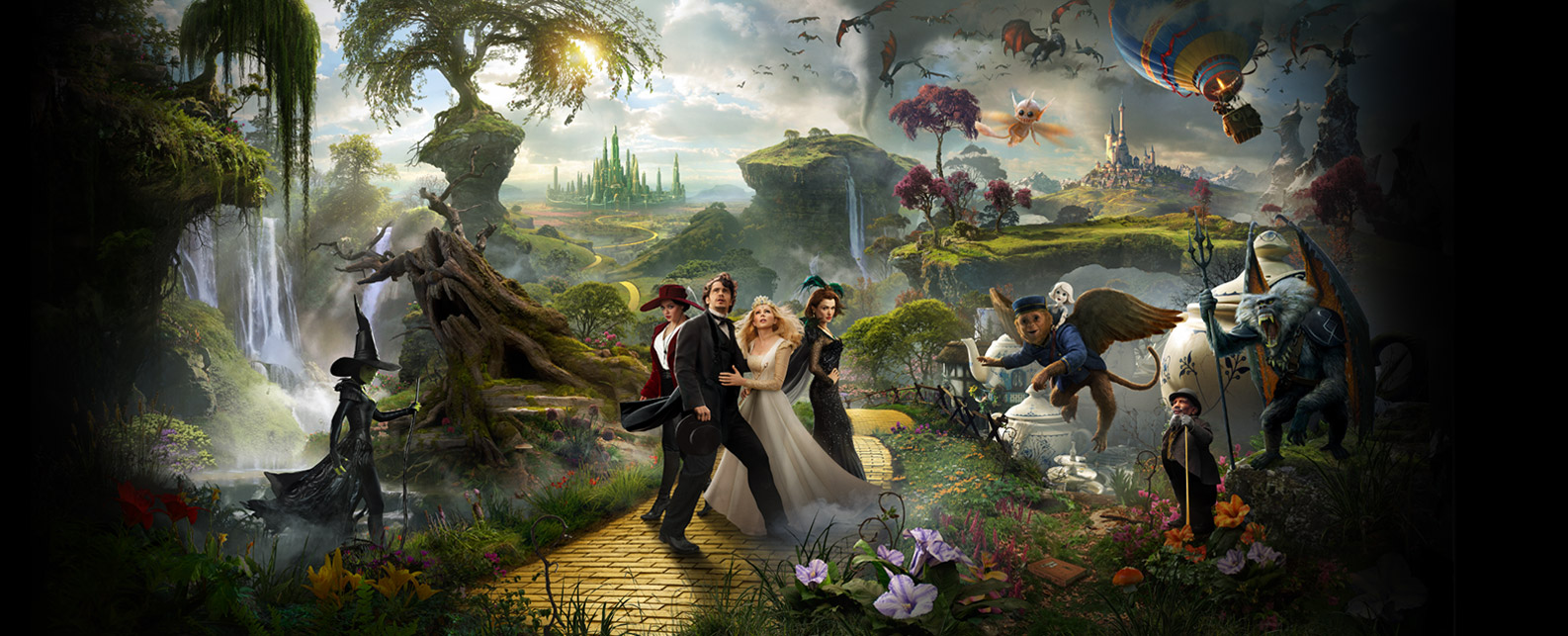
“OZ: THE GREAT AND POWERFUL” Review (✫✫✫)

Follow the yellow brick road down the rabbit hole.  

I was five years old when I saw Victor Fleming’s The Wizard Of Oz for the first time in my life. I remember that exact moment like it was yesterday. My mother held me in her lap, our dog Sandy lay in mine, my father was laying on his couch sipping a cup coffee, and they would both tell me all the wonderful memories they have of watching that movie growing up. Those memories would eventually become mine as I now recount all of the joyous times I was transported to Oz every time I watched that fantasy classic. I would eventually go on to name that film as one of  best movies ever made.

Now here I am, 15 years later, recounting my memories of watching the original and am now watching its prequel Oz: The Great and Powerful”and judging it with the same fairness as I did with the original. My verdict? It’s a good prequel, but Oz fell a little too far down the rabbit hole if you know what I mean.

Preceding the events of the fantasy classic The Wizard Of Oz by whatever-something-amount-of-years, Oz: The Great and Powerful follows the story of Oscar Diggs (James Franco), a struggling magician in a traveling circus who dreams of rising above mediocrity and amounting to greatness in the world.

Unfortunately, Diggs is also a crook and a womanizer. When he escapes a few enraged circus freaks by stealing a hot air balloon, he’s gets trapped in a whirling tornado that transports him to a place he’s never seen — Oz, the wonderful land of munchkins, emeralds and yellow brick roads. It is here where Diggs discovers he’s part of an ancient prophecy: that a wizard named after the land of Oz will descend onto the land, and free the people from the tyranny and evil of the Wicked Witch of the West.

Here is a movie that functions as an appropriate prequel, a good movie that actually fits into the magnificent story of The Wizard Of Oz  and makes it work within the established timeline. Co-Written by Tony award-winning writer David Lindsay-Abaire (who wrote both his stage and screen adaptations of Rabbit Hole), the plot in Oz: The Great and Powerful can be defined in adjectives to the first movie: traditional. Imaginary. Creative. Dynamic. Classic. Every piece fits into this puzzle, and ultimately adds up to what is a straightforward prequel that provides background for the first movie, even if it wasn’t needed before.

The cast is strong here as well, with James Franco shining the most out of a cast list that consists mostly of women. Here he portrays a spirited man, a man full of charisma and humor that makes the screen vibrate with his very presence. Both his energy, his passion and his kindness is contagious with other characters, and the end result is a near-flawless chemistry with every character on-screen (with the exclusion of the Wicked Witch of the West, who I felt was severely miscast in this film. I dare not spoil it though by telling you who it is).

As a movie and as a prequel, this film succeeds. The plot is enjoyable, the cast is skilled in both vocal and physical performance and the visual effects reach out and dazzle you with its many bright colors and details that instantly transport you to a land of fantasy and wonder (Even though it is a little too resemblant of the art direction in Tim Burton’s Alice In Wonderland).

The biggest problem with the film, however, is its balance. Director Sam Raimi (who is most known for the Evil Dead and Spider-man trilogies) is the visual effects master behind this film, but unfortunately, he depends too much on it. The most enjoyable moments of this film involved Oscar displaying his joy and humor through his energetic and witty dialogue with other characters, which was both affectionate and entertaining at the same time. Everything else was overdone, and at times Raimi depends on the visual aspect of his film as if its the only thing it has going for it.

The last 40 minutes of the film especially becomes so redundant and prolonged, dragging out a scene of conflict between the munchkins and the witches just to provide action and flashy effects. This part of the film doesn’t seem to have purpose or motivation in mind, and the reptition of visual effects and CGI eventually becomes dizzying and nauseating.

My recommendation: Don’t go into this movie expecting it to be the masterpiece that The Wizard Of Oz is. You’re setting yourself up for disappointment and inevitable failure. Instead, see Oz: The Great and Powerful for what it is: a charming, ambient and lively prequel to the original fantasy classic made 74 years after its original release. When looking through that perspective, the return to Oz couldn’t be more glorious, even though the yellow brick road now looks more like a green screen rather than a stage set.

Tagged , , , , , , , , , , , , , , , , , , , ,