Category Archives: Reviews

“FROZEN” Review (✫✫1/2)

The Snow Queen: The Musical

Good news first: Frozen will please its core audience. It’s a cute, cuddly little fairy tale movie with a lot of music and a lot of misplaced optimism. Kids will enjoy it, and there’s a solid chance that the parents might enjoy it too. The bad news: It’s the same Disney Princess movie you’ve seen for the past 50 times now.

Based loosely on the Danish fairy tale “The Snow Queen”, Frozen follows the story of two princess sisters, Anna (Kirsten Bell) and Elsa (Idina Menzel). Being enclosed in a castle all of her life, Anna is a cheery, energetic, happy and overly-optimistic princess who would marry a man after getting to know him for just one day.

Elsa, however, does not have the luxury of being optimistic. Cursed with the ability to create snow and ice at a young age, Elsa has soon realized that she cannot control her powers and decides to escape before she does her kingdom, and her sister, any harm. Now determined to find her sister and mend the relationships that were shattered long ago, Anna sets out with a ice picker named Kristoff (Johnathon Groff), his reindeer Sven and an animate snowman named Olaf (Josh Gad) to find Elsa and save the kingdom.

Written by Jennifer Lee (Wreck-It Ralph) and co-directed by Chris Buck (Tarzan), Frozen is by definition, a family movie. It’s driven by a childish energy, a lively and undiminished spirit that fills children with joy through its wonderful music and its bright, colorful animation.

The characters are enthusiastic (at times, annoyingly so), with the most likable character being a midget snowman called Olaf. Olaf is just funny. He’s the kind of oblivious, clumsy snowman that bumbles around like a lego stick figure, losing his body parts every five minutes, stumbling to get them all back together, and put it on straight before the snow monster eats him. “Go! I’ll distract him!” his head said in one scene as everyone ran away, including his body. “No! Wait! Not you! I was talking to them!”

He also has a ironic fascination to the sun, fire and heat, not realizing what effect they have on snow.

All in all, Frozen is a fun movie. But if you’ve seen Tangled, then you’ve already seen Frozen before. The two movies are so similar, so mirrored in appearance, character, story and animation that the only real difference in between both is that Frozen takes place in a winter wonderland.

See, the problem doesn’t exist in the movie itself: the problem exists in what earlier Disney movies did first and better. Tangled is not the only movie where we’ve seen this story about self-discovery and relationship building. Look at virtually any other Diseny Princess movie on their filmography, including Brave, Mulan, Pocahantus, Princess and the Frog, etc etc. No, none of those movies deals with the theme of sisterhood, but does it need to? Those movies are still so similar in personalities, humor and musical numbers that the story becomes a copy-and-paste convenience rather than an original pleasure.

However, understand that this is not a critical observation of the movie, but rather a neutral one. I stress this point again: this movie will please its core audience, which is little children, the parents of those children and the hardcore Disney lovers. By all means, if you want to see the movie, go ahead and see it. Chances are you’ll enjoy it more than this Scrooge going “Bah humbug” in the corner of the newsroom.

Tagged , , , , , , , , , , , , , , , , , , , , , , , ,

“THE BOOK THIEF” Review (✫✫✫)

“I am haunted by humans.”

For ages now, World War II and the Holocaust have served as powerful inspirations for some of the greatest stories ever told on film. Schindler’s List. Sophie’s Choice. The Pianist. The Thin Red Line. Saving Private Ryan. Here, we have another entry into the holocaust/WWII sub-genre through The Book Thief, and even it doesn’t measure up to the mastery of the previously mentioned pictures, its captivation and its emotional grandeur is more than enough to absorb audiences into its narrative and into its spellbinding story.

Based on the book of the same name by Markus Zusak, The Book Thief follows the story of Liesel Meminger (Sophie Nélisse), a young girl abandoned by her parents to foster care who lost her brother on the way to her new home. Her foster parents, Hans (Geoffrey Rush) and Rosa  Hubermann (Emily Watson) at first intimidate her at her arrival, but after Hans spends some time with her at night teaching her how to read, she soon becomes more accepting and even compassionate towards her new family, even though she can never recover from her brother’s death.

The Book Thief is a wonderful picture, blissfully tragic and eerily optimistic at the same time. It weaves from one emotion to another in, from that of heartbreaking tragedy to that of childlike innocence and joy. Just like the 1997 film Life Is Beautiful, the movie has its fair share of smiles, laughs and tears.

Much of this is credited to the inspiration of the original novel, whose freshness of emotion is retained faithfully in this adaptation. The movie is wonderfully filmed, tightly-edited and affectionately made, its shots lingering on long pauses, allowing us to sit still and silently reflect on the tragedies these characters are experiencing. One of the best scenes in this movie is one where Liesel is simply laying on her mattress in her bedroom, stare lingering on the empty bed next to her. No narration is given, no words are said, yet we can still tell from the sadness in her eyes that she’s thinking about and missing her brother.

Many scenes in the movie are like this, where the best language given is one that isn’t spoken. The cast is brilliant with exhibiting this non-verbal language, with Nélisse and Rush having near-flawless chemistry with each other. Rush specifically has the highlight performance. His character is so upbeat, supportive and optimistic that he reminds us of Robin Williams from movie roles including Good Will Hunting and Patch Adams.

The imposing element, however, is the musical score by John Williams. His music is so effective at highlighting dramatic moments that at times the sound of beautiful strings fills us with more emotion than anything we can watch on screen.

It’s only shame is that the movie doesn’t reach the same level of emotional complexion that the book does. Because it tries to cram everything from the book into the movie, and because its trying to do this in a 125-minute runtime, there are moments that are too quick or even rush to feel the emotional gravity of the situation, especially when it comes to the third act.

Regardless, The Book Thief aims to be a emotional historical epic, and it is an emotional epic indeed. It’s a powerful allegory about a young girl trying to find peace in a world full of chaos.

Tagged , , , , ,

“PACIFIC RIM” Review (✫✫✫)

Transformers meets a whole lotta Godzillas.  

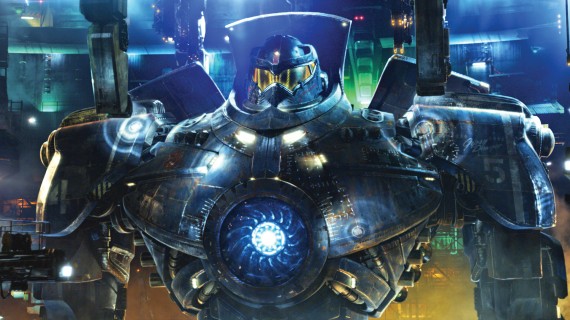
Pacific Rim is an action movie for the action fan, a movie so overblown with giant-sized robots, monsters, explosions and destroyed buildings that I wonder how the planet is still intact by the film’s conclusion. It’s not a bad thing, mind you, that there’s this much action in a movie like this, especially with the release of Man Of Steel earlier this summer. It just means that this is a specific movie for a specific audience: one that is very stylish, visually stunning and hella lot noisy.

The premise is something of a Independence Day meets Transformers. These mythical creatures called “Kaiju”, who are the biological equivalent to the Godzilla monsters, come from a portal deep in the pacific ocean called “The Bridge”, and it is this portal where the Kaiju stem from to attack the human populace. They start at specific locations at first: San Francisco. Hong Kong. Amsterdam. The more frequent the attacks, the more the humans realize that they need a battle plan to counterattack the Kaiju.

Enter the Jaeger program. “Jaeger”, from what we’re told, is German for “Hunter”, and that’s exactly what this program is. It’s a military initiative designed by the world’s leader, combining their resources to make a weapon to fight the Kaiju with, which in this case, is an army of giant, imposing robots that would make Optimus Prime explode in his diaper.

I know what you’re thinking: “Why use the resources on a robot army instead of finding a way to close the portal?” Because then we wouldn’t have our movie, now would we? The most experienced of these Jaeger pilots is Raleigh Becket (Charlie Hunnam), a retired Jaeger pilot who quit after losing his twin brother in battle. With their resources dwindling by the hour, however, Raleigh is recruited by Commander Stacker Pentecost (Idris Elba) back into the fray, to defend the earth before it is forever lost to the Kaiju army.

Sounds like a movie by Michael Bay, right? No? Well, how about Roland Emerich? Alexander Pryas?  Andy and Lana Wachiowski? All wrong. This movie is written and directed by spanish filmmaker Guillermo Del Toro, who is most known for movies including HellboyPan’s Labyrinth and The Devil’s Backbone. What exactly, convinced him to step out of those realms to traverse into a science-fiction action movie like Pacific Rim?

Doesn’t matter. This is a good movie. A very good movie. How good, you might ask? So good that when you watch the movie, you can’t help but be blown away. It’s the sort of explosive, massive, beat-em-up action movie that functions as a sort of love letter to classic Japanese manga and anime, with shows such as Voltron and Gundam seeming to serve as the inspiration for these crazy monster fights. The fight scenes in the movie are big and boisterous, its level of scale and destruction so disastrous that it made movies like Godzilla and King Kong classics. I remember when I saw the 1939 King Kong for the first time five years ago and being impressed by what they accomplished visually despite the lack of technologies they had back then. Hear me, fellow reader: what Merian Cooper and Ernest Schoedsack did with King Kong, Guillero Del Toro did with Pacific Rim.

In this day and age though, its easy to just focus on a film visually and forget to invest time in the story and characters as well. That’s where most action movies fail and what makes us frustrated by the majority of them, including the Transformers sequels and any Stephen Sommers movie. Here, Del Toro is smart enough to craft an actual story with his visuals, and for this I appreciate his effort. It isn’t just mindless action we’re watching on the screen here: Del Toro takes careful consideration in crafting a smart and interesting story to keep viewers interested, starting with the first day the Kaiju came to earth, to looking deeper into the troubled histories of many of these Jaeger pilots. There was one scene specifically that sticks out in my mind, a troubling and disconcerting memory of one of the female pilots recounting their experiences as a child when a Kaiju came and destroyed her home and her family, all while her male co-pilot tries his best to console her while crying helplessly like a lost child.

This is what turns the movie from good to memorable: the presence of these characters are rich, charismatic and dramatic, a nice combination of an involving, epic story with that of over-the-top stylish and exciting action scenes. Rarely do we get a combination this effective, and Del Toro does a great job delegating both parts of the story when the time calls for it.

It’s a shame, though, that Del Toro doesn’t keep up with that balance all the way through. There is a common problem this movie shares with many other action movies, and that is a final 30-40 minute action sequence that becomes repetitive, boring and predictable that loses all of the momentum and excitement it had at the beginning of the film.  What happened? It’s overstuffed, dear reader. The end sequence takes place in the pacific ocean with two Jaeger’s fighting against an army of Kaiju. There are two things I know for a fact here: 1) The good guys are going to win, and 2) The main character, Raliegh, is going to live. I know thats how its going to end because the film would receive backlash if it ended any other way.

I’m fine with a predictable ending as long as it emotionally satisfies me, but why drag it out this long with action that loses its momentum? I know its for the viewers that just like to see big things blow up on screen and nothing more, but the ending sequence dragged out way too long. It became less of a story about humanity and survival and more of a video game watching things punching each other and screaming.

Okay, now before any sci-fi die-hards pounce on me like a wildcat, let me wrap this up. There may be some problems with this movie. Nevermind that. Take out the huge explosions. Take out the prolonged action scenes. Take out the cheesy dialogue and any of the movie’s supposed faults and just look at the film from the action fan’s perspective. This is an action movie that is exciting, suspenseful, involving, visually stunning, and mind-blowingly spectacular. This is an action movie that has been done right, not that Michael Bay would know about anything like that.

Tagged , , , , ,

“ALL IS LOST” Review (✫)

All Is Lost? You have no idea. 

I’m about to save you twelve dollars and about two hours of your life. Robert Redford lives.

Frustrated? Good. You’re supposed to feel frustrated, because that’s all the movie makes you feel. Out of all of the survival movies you will ever see, expect All Is Lost to be a bare, boring, and mindlessly pointless experience.

Here is the premise of the movie: Robert Redford is on a boat, trying to survive against storms at sea.

That’s it. That’s as much depth and interest as you’re going to get with this film’s premise. Make no mistake fellow reader: All Is Lost is aggressively bad. It is the most boring film of the year. It is the most forgettable film of the year. If the Academy Awards had an award for Most Mundane Picture of The Year, All Is Lost wouldn’t only be the winner of the category, it would be the only film nominated.

And yet, strangely enough, the movie has been mostly well-received by critics. The movie has a 94 percent rating on Rottentomatoes and an 88 percent on Metacritic, so there will be no shortage of people trying to defend it. Here are the most popular arguments defending the movie:

“The film is great at latching your attention despite limited dialogue.”

It’s true that the first 20 minutes are exciting enough to do a good job at latching you’re attention. The other hour and a half, however, could not be more repetitive or frustrating. Only two lines of dialogue are spoken throughout the film: “This is Virginia Gene with an S.O.S. call, over?” and profanity. That’s it. The rest of the movie is Redford staring out into an empty ocean with a deep, dreary melody playing in the background. Oh boy! Music! That sure will keep us interested!

“J.C. Chandor was masterful as a writer/director.”

It’s hard to make an argument that he even wrote this. The screenplay was a little more than 31 pages, barely any material to substantiate a feature-length motion picture. Chandor, who is most known for the intelligent and conversational Margin Call in 2011, was great as a writer, making an intelligent, well-crafted picture filled with character depth, dialogue and dimension. Now, he has reverted to making All Is Lost. Why? What convinced him to step out of his comfort zone as a writer? With the clever, intelligent and enticing dialogue now missing from Margin Call, his sense of style is just as absent, and it gives the film an empty feeling that feels like it’s just half complete. It’s better, in fact, to describe the movie as a feature-length short film, meaning it’s a 30-minute television special stretched out to feature length simply to enhance profit.

“Robert Redford was incredible in the movie.”

Yes, I see Redford is in the movie. Thank you for pointing out the obvious. He is completely and utterly useless. Notice with the plot synopsis, I never called him by his character name. That is because his character doesn’t have a name, credited as “Our Man” on the international movie database. Redford is not acting here. He is modeling, staging and positioning himself in meager, idle positions and actions as Chandor commands him to flip from one side of the boat to another. The character is so impersonal, so thinly written and so emotionally bleak that there is little reason to care about him or be motivated by his journey. So thanks, Chandor, for casting Redford in a character nobody gives two rips about.

Compare this to any survival movie written and produced in the past 30 years. JawsCast Away127 HoursThe GreyGravity. Look at all of those movies and try to remember the emotions you felt while watching them. What is it about those movies that latched everyone’s attention? What captivated audiences and compelled them to care for these characters to survive?

That’s exactly it: Characters. We cared about Chief Brody when his son barely missed the shark’s jaws. We care about Chuck and Wilson because Chuck needs to get home to his girlfriend Kelly. We care about Aaron Ralston because of how estranged he was with his family, with John Ottoway when we realize his wife is dying, or with Doctor Stone when we realize what became of her daughter.

We care about these characters not because of their situations, but because of their inner turmoils that compelled them to keep living: They all had something to live for.

What reason does Robert Redford have to live for? We are told nothing except for that he’s “Our Man.” Riiiiiiight.

It’s movies like Jaws and Cast Away that keeps us away from the ocean, but it’s movies like All Is Lost that keeps us away from the movie theater. All Is Lost? You have no idea.

Tagged , , , , , , , , , , , , , ,

“12 YEARS A SLAVE” Review (✫✫✫✫)

Over a decade of injustice and cruelty.

12 Years A Slave is quite possibly the best film of the year.

It is also the most disturbing.

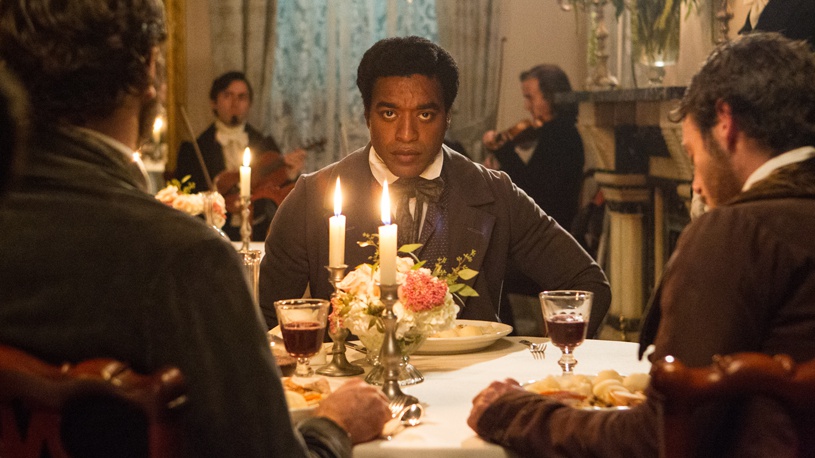
Based off the 1853 autobiography of the same name, 12 Years A Slave follows the true story of Solomon Northup (Chiwetel Ejiofor), a free black man who lives with his family and plays the violin in Saratoga, New York.

One evening, he becomes acquainted with two young gentlemen who claim to be circus performers looking to hire him for a one-night gig. When he wakes up the next morning, he is in chains, and realizes that he was drugged, kidnapped and sold into slavery by his captors. During his years as a slave, Northup goes from one owner to the next, from a kindhearted owner named William Ford (Benedict Cumberbatch) to a cruel, racist and mean-spirited pig named Edwin Epps (Michael Fassbender), who presents the greatest trials he must face if he is ever to survive.

12 Years A Slave is a film that not only lives up to all of its built-up hype and expectations: in many ways, it exceeds them.

Its quality as a work of art is so striking and powerful that it can be compared to other historical tragedies, including The Pianistand Schindler’s List.

Director Steve McQueen, who made the morally reprehensible and eerily bleak film Shame back in 2011, redeems himself here as a filmmaker. McQueen, in collaboration with cinematographer Sean Bobbitt, is not only masterful with framing his articulate, beautiful shots with 12 Years A Slave, but also brilliant with orchestrating scenes between his actors, showing us the bleak realism and truth of the slavery years in America.

Ejiofor, who portrays Northup in 12 Years A Slave is endlessly captivating. In moments where you think he might just be phoning it in, or just going along with the motions, he surprises you and releases an emotional intensity in ways no other actor has this year, not even Forest Whitaker in Lee Daniels’ The Butler. Newcomer Lupita Nyong’o plays a young female slave in this movie so passionately that you forget she’s an actress and slip into her character’s tragedy as a human being more than you do as a movie character.

Most noticeable perhaps is Michael Fassbender as Edwin Epps, who is so hateful and so spiteful in this role that all of the audience’s energy, anger and frustration is focused on him and his sadistic acts. Fassbender was brilliant in his portrayal, and I sincerely hope that he at least gets an Academy Award nomination for his performance.

Every other aspect of this film can be praised endlessly. The script by John Ridley, who wrote Three Kings in 1999, was endlessly emotional and captivating. The score by Hans Zimmer was quiet, humble and breathtakingly beautiful, encompassing both the truth and tragedy of Northup’s heartbreaking story.

However, let there be a strong word of caution: 12 Years A Slave will elicit violent reactions from its audiences. You will laugh. You will weep. You will grind your teeth in anger and frustration, maddened by the many years of cruelty, prejudice and barbarism that no human being should ever have to experience. But it compels you to care for the character, to reach deep down in your heart to feel what he is feeling, to experience compassion and sympathy in ways almost no other film can do, not even with Schindler’s List. 

And let this be a testament to the film’s quality: at the end of the showing, there was a white man who could be heard weeping in the back of the theater. In between his hiccups, tears and hysterical reactions, he turned toward the black viewer sitting next to him, shook her hand and after introducing himself said to her, “I’m so sorry for what my race did to your ancestors.”

That man felt a powerful feeling of guilt and shame for the things that he saw in 12 Years A Slave.

That man was me.

Tagged , , , , , , , , , , , , , , , , , , , , , , , , , , , , , , , , , , , , , , , ,

“RUSH” Review (✫✫✫✫)

Don’t think.  Don’t pause.  Just drive.  

I couldn’t have thought of a better title for the movie Rush, because that’s exactly what it is: an unstoppable and uncontrollable rush of energy, excitement, and gravitas, a movie that starts on a high note and simply refuses to let up all the way through.  I hear a lot of complaints that there are biographical movies that are more concerned with cashing in on people’s legacies rather than making an authentic account of a person’s true story, such as Jobs or The Iron Lady.  Here is a break from all of that, a refreshing and ideal account of two racers who live every moment of their life trying to figure out how to beat the other guy, while understanding that their symbiotic relationship is what made them both great racers in the first place.

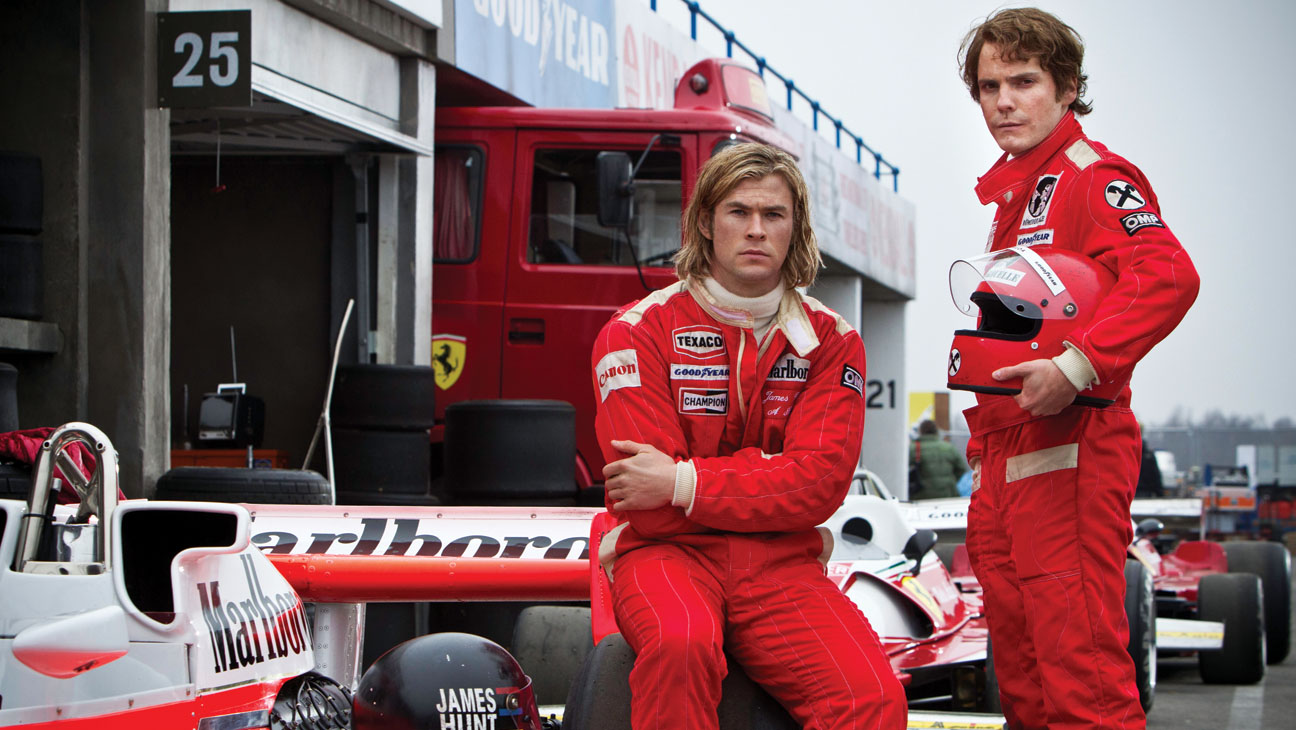
Focusing on the 1976 Formula One Grand Prix season, Rush follows the story of two different racers, both with polar opposite personalities and complexions.  James Hunt (Chris Hemsworth) is a hard-headed racer who races with passion instead of brains, and a playboy who drinks a lot, smokes a lot, and sleeps with beautiful women, a lot.  Nicki Lauda (Daniel Bruhl) is a intelligent, smart, and crafty german who is just as focused and analytical as he is rude and ignorant. The film chronicles the contempt they feel for each other and the mutual respect that makes them strive to be better than the other man.

Before you go and see this picture, I encourage you to go online and google the names “James Hunt” and “Nicki Lauda” and look at their images.  Got it?  Okay, now that you’ve done that, go and watch the movie.

If you actually took the time to open up another tab and look at the images, you will be just as shocked as I was.  Comparing the sight of Lauda and Hunt with that of Bruhl and Hemsworth isn’t comparing them at all: they look exactly like the same characters, from the red jackets around their back to the color and hairstyles that we see on their heads.

I love it when movies do this: when movies are so accurate to the real-life figures that they copy their appearance so accurately, it is nearly impossible to differentiate from them.  We’ve seen this from The Fighter in 2009, and recently from Daniel Day-Lewis in Lincoln.

Here is yet another example of a movie that is compelled by truth and driven by accuracy, pun intended.  Rush is exhilarating.  Exciting.  Edgy.  Anticipative.  Emotional.  True.  Everything about this movie is a heart-pounding, sweat-pouring adventure, and what’s truly impressive is not that the movie makes us feel this way: its the fact that it really happened, and that really director Ron Howard is just documenting it rather than retelling it.

One of the highlights in the film are easily its lead actors.  Not only do Hemsworth and Bruhl look exactly like the people they are portraying: they act like them too, with their rivalry and their edginess apparent in every fraction of a scene.  Sometimes their clashes are funny, like the dialogue bits between Mark Zuckerberg and Eduardo Saverin in The Social Network, while at other times its strikingly serious like the James Braddock/Max Baer rivalry in Cinderella Man.  Whatever the situations, these actors do well at remaining in tense situations and they never, ever break their character.  Hemsworth is energetic, lively, and egotistical as Hunt, a man whose only loves are beautiful women and racing.  Bruhl is equally as egotistical, but he’s got a sly smartness about him you can’t help but appreciate.  There’s one great scene where Hunt calls Lauda a rat and he responds by saying “You think I’m hurt that you call me a rat, Hunt?  Rats are ugly, but they are smart.  Intelligent.  I am proud of that.”

The film doesn’t slow down at their performances, however, and filmmaker Ron Howard (Apollo 13, A Beautiful Mind) and screenwriter Peter Morgan (The Queen, Frost/Nixon) are quick to follow up on the pace of these two fine actors.  The guys who made Fast And Furious could take a hint or two from this movie. Morgan and Howard not only succeed in making the movie exciting and suspenseful through key moments in races, press conferences and private, vulnerable moments when these racers are all by their lonesomes: they’ve managed to make it gripping and relevant, a grounded drama thats equal parts and insightful into these two men’s lives that we feel like we’re witnessing their story upfront in the pit, not viewing it from far away on the sidelines.

Oh, I could go on all day praising this film and how all the elements culminate into a near masterpiece.  The soundtrack by Hans Zimmer is tense, unsettling, and noble, defining these men’s relationship just as well as the movie does.  The editing is tight, crisp, and clean at the hands of collaborators Daniel Hanley and Mike Hill.  For Pete’s sake, even the cinematography by Anthony Mantle was so good at capturing emotions and details so intimate, Howard would probably have missed some of them if Mantle wasn’t there to point them out.

Bottom line: Rush is entirely, unforgettably awesome.  It’s a strong and powerful tale about two passionate racers who knew what they were after and were willing to sacrifice whatever they could to go after it.  We see why they want to beat each other.  We understand who they are and why they are racing.  We know what makes them tick and we want to see them make it through every pulsating moment of the film in order to accomplish their dreams.  Trust me, you’re going to want to sit in on this race.  Oh, and bring your seatbelt.  You’re going to need it.

Tagged , , , , , , , , , , , , , , , , , , , , , , , , , , , , , , , , , , , ,

“DON JON” Review (✫✫✫)

Oh, Donnie boy…

 “There’s only a few things I really care about in life,” a rich, deep boston voice says as we look at him staring  at his bright laptop screen shirtless in a dark room. “My body, my pad, my ride, my family, my church, my boys, my girls, and my porn.”

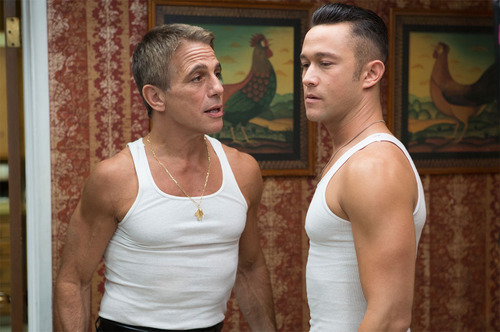
That last one doesn’t really belong there, but whatever, its in there.  The man we are looking at is Joe Martello (Joseph Gordon-Levitt), a thick, cut, and strongly appealing young man who has a slick, black haircut and a grin on his face that looks like he just finished up business in the bedroom.  His friends call him “The Don” because he’s able to score “dimes” on the weekends, which is another way of saying “That woman is a ten!”

One night in the bar, Donnie meets the best dime he’s ever seen: Barbara Sugarman (Scarlett Johansson), a beautiful blonde bombshell that turns heads and raises attention everywhere she goes.  To Donnie, this is simply another case of trying to score a hot night, but Barbara isn’t that easy.  She wants something more meaningful than just a one-night stand: she wants an affectionate, fairytale relationship, the cheesy kind you see in those unbearable romantic comedies starring Anne Hathaway and Channing Tatum.

So Donnie takes a deep breath and waits it out, hoping for her to come around eventually and give him the chance to slip under the covers with her.  The more time he spends with her, however, the more his addiction to pornography gets in the way and stops him from having a more meaningful relationship.  Now conflicted between his feelings between Barbara and his dependency on pornography, Donnie needs to figure out which is more important to him before she leaves him and all he has left is his laptop and his internet wifi.

Before I continue, let me issue a short disclaimer.  If you do not like R rated movies, do not watch this movie.  If you don’t like looking at nudity, do not watch this movie.  If you don’t like swearing, do not watch this movie.  And if you don’t like movies about sex, DEFINITELY do not watch this movie.  This is a picture stuffed to the mouthful with sex, nudity, T&A, F-words, censored and uncensored pornography to the point where I believe it deserved, and should have been rated, NC-17.

The only reason I issue this warning is because I know my readers, and the majority of my readers do not appreciate sexually explicit films that make jokes about the male/female anatomy and what goes on inside the bedroom.  Their views are warranted, and in many ways I share many of those same views with my readers.  I, however, am not as close-minded to this idea if it means not enjoying Don Jon, and believe me, that is a very hard thing to do.

That’s probably the worst word I could have used to describe this picture just now, but nevermind.  Don Jon is good.  Very good.  How good?  So good that it made me, a conservative reviewer who hates excessive nudity, enjoy it very, very much.  Trust me, I am not easy to please.  If you don’t believe me, you will when I tell you I rated The Hangover as the worst picture of 2009.

I find it interesting how effective Gordon-Levitt is here as a filmmaker.  His writing is fresh, fun, and original, exercising dialogue that is both clever and witty while at the same time being deeply meaningful and expressive.  The cast is equally brilliant, as their charismatic portrayals breathe life into these characters in ways that not even an animated rendition could do.

What I find more interesting, however, is how Gordon-Levitt handles this film as a director, using space and situations in his film to define Jon’s character and to show what sort of emotional state he’s in.

For instance, look at how he shows Jon’s everyday routine.  When Jon wakes up in the morning, he cleans his room the best way a bachelor knows how, he drives to Church, he goes to confession, he eats lunch with his family, he works out at the gym, he goes to a club to meet some beautiful lady, and then he ends his nights watching a skimpy porn video.

Got it?  Okay, now look at the variations of this same routine shown throughout the film.  At first its just the same thing over and over again, but later as Jon’s character changes, so does how he behaves during his routines.  When he’s depressed, his room get messy.  When he’s excited, he sings to Marky Mark in the car.  When he’s optimistic, he exercises with other people when he goes to the gym.  But what remains consistent in all of these sequences is him going to confessional and confessing his sins to the Catholic Priest he’s never met, hoping one day to have a clean slate in the eyes of the father.

I don’t think this movie is about a man struggling with his addiction to pornography.  I think this movie is about a man struggling between his lusts and sexual desires and the guilt he silently feels he needs to be redeemed from.  Think about it for a second.  Why else would he go to Church so frequently despite his promiscuous lifestyle?  He’s a grown man, he knows he doesn’t have to go to church if he doesn’t want to.  So why does he go so frequently even though his lifestyle isn’t congruent to that of a catholic?  There’s a deepness developing silently to Don Jon that can only be barely noticed, and if you don’t look out for it, it will slip you past you.

There’s obviously the negative element of watch a movie about pornography, and I would be the first to agree with you.  Even though the pornography is at times censored, its still there, and we can’t help but visualize everything because we’re seeing a rendition of it on the screen.

Still, since we’re talking about pornography, let me retaliate with another film that is also about addiction: a 2011 film titled Shame, starring Michael Fassbender and directed by Steve McQueen.  Like Don Jon, Shame is about a man who holds an unsatiated lust for porn and sex, and his life sinks into a swamp of sadness and depression because of his unsatiated hunger.  Unlike Don Jon, however, Shame is downtrodden, depressing, sickening, despicable, ugly, demeaning, and has no redeeming qualities whatsoever, outside of the acting and the composition.

Don Jon is different.  Unlike Shame, it is upbeat, energetic and joyous, and even though there are dramatic moments in the movie, there is never a moment that feels ugly, sickening, or unclean.  Don Jon is a stylish, articulate, and simply brilliant dramedy.  It is not only a film filled with clever dialogue and solid character development: it actually has a good, wholesome message to take away from the story, something to make you appreciate the small things in life that you never really notice.  I know some people are going to look at this movie from a first glance and ask “Why would I want to watch a feature-length pornography?”  Believe me, fellow reader, if this film can even be categorized as a pornography, its probably the best of its kind.

On a closing note, please don’t tell my mother.

Tagged , , , , , , , , , , , , , , , , , , , , , , ,

“THE BUTLER” Review (✫✫✫✫)

A humble heart living through harsh times.  

When we watch movies like The Butler, we are reminded of our history and why we must never return to the horrible origins that we came from.  When I say that, I am saying that regardless of race.  The film is obviously centered around the issues of slavery, segregation, and racism, and asks us to feel sympathy towards the African population for all of the horrible things they’ve been through.  But the movie evokes a more powerful emotion from me personally, a deep sense of regret and shame that my own race, the Caucasians, were at one point responsible for all of the death and cruelty we inflicted upon our own African brothers.  And why?  Because they have a different pigment than us?  That’s the sort of hate and bias that lead us to World War II when Adolph Hitler led the Third Reich against the Jews.

Based on the career of real-life butler Eugene Allen, The Butler follows the story of Cecil Gaines, a black butler who grew up during the slave era, growed up learning how to be a white man’s servant, got a job at the White House, and continued to serve there for almost 35 years. Throughout his career he witnesses history unfold in itself, from President Dwight D. Eisenhower’s (Robin Williams) decision to enforce desegregation laws in Arkansas, to witnessing the assassination of John F. Kennedy (James Mardesen), to seeing the rise of the Ku Klux Klan and the Black Panthers, to the assassination of Martin Luther King Jr., to the eventual inauguration of Illinois Senator Barack Obama into office.

The Butler is an earnest, humble film, parts approachable and observant yet equally ambitious and honest. Like movies such as Ghandi, The Hurricane, and The Shawshank Redemption, this is a movie that looks into the reality of situations and shows them exactly how they were, no matter how tragic or heartbreaking those circumstances were.

Take, for example, the scene where the Ku Klux Klan is introduced.  During his college years, Cecil’s son Louis (wonderfully portrayed by David Oyelowo), was on a bus to protest against a racist Alabama.  While on their way, their bus stops suddenly as they stare at the white-robed, torch-bearing Klan staring at them with their hateful eyes.  Equal parts petrified and terrified, the protestors desperately tried to escape before the Klan started igniting the bus with fire and molotovs.

I sat there watching these scene, equally infuriated and enraged as I was emotional and mournful.  How could this be our country?  How could this have once been our land, our people who so hypocritically claimed to be the land of the brave and home of the free?

To watch these scenes and to incur such an emotion takes great skill and courage, and I think Lee Daniels does a great job orchestrating these scenes in ways that makes them so emotional and powerful.  Daniels, who was nominated for an Oscar in 2009 for Precious took quite a fall last year when he made Paperboy, a idyllic, preposterous, and morally reprehensible film that was anything except relevant, coherent, and well, good.  Here Daniels redeems himself, and leads a star-studded cast through such a gripping, overwhelming story that I think it surpasses his accomplishes even with 2009’s Precious.

Oh yes, the cast.  The cast is what makes this picture, but you already know that if you take the time to simply read the cast list.  Jane Fonda as Nancy Reagan.  Alan Rickman as Ronald Reagan.  John Cusack as Richard Nixon.  Liev Schriber as Lyndon B. Johnson.  Minka Kelly as Jackie Kennedy.  John Mardesen as JFK.  Robin Williams as Dwight Eisenhower.  Alex Pettyfr as a plantation owner.  Terrence Howard as Cecil’s neighbor.  Cuba Gooding Jr. as a head butler.  For Pete’s sake, Mariah Carrey is in the film as Cecil’s mother and she doesn’t even say a line of dialogue.

The best performances, however, are the lead ones by Forest Whitaker and Oprah Winfrey.  Whitaker, who won the academy award for The Last King Of Scotland in 2006, steals the show in every single scene he’s in, showing the still portrait of a man who is tired, weary, and emotionally strained, a man who has seen endless ages of wrongful suffering but can do little to change it because he’s worrying about himself and his family.  Winfrey is equally as striking as his wife Gloria, a woman who is also hurting and in deep suffering because of her situation and because of a drinking problem she has long struggled with.  Both of these characters are central and integral to the plot and to the progression of the story, and at many times, they’re the only ones carrying the movie through as a whole.

The Butler is one of the best films of the year.  Period.  I know there’s a lot of movies about African-American history being released later on this year (Such as Mandela: Long Walk To Freedom and 12 Years A Slave), but there’s no denying the power, drama, or the history the movie so brilliantly provides us.  Yes, there are some inaccuracies to the butler’s real-life story (Starting with his name, with the real name being Eugene Allen), but the fact that it is loosely told is the best asset Daniels has towards his narrative. Since the figure is so little-known in today’s world, it allows Daniels to let loose and tell the story that he wants to tell, not the story that he’s committed to tell.  This is a movie that shows the history of a great man and a humble servant who was simply trying to support his family and to get through the days of wrongful judgement and discrimination.

Tagged , , , , , , , , , , , , , , , , , , , , , , , , , , , , , , , , , , , , , , , , ,

“THE GREAT GATSBY” Review (✫✫✫)

Nice to see you again, old sport.  

When you sit and think about the character of Jay Gatsby, there is never a simple answer to define him and his purpose in The Great Gatsby.  Some people have cited him as a post-modern interpretation of Romeo And Juliet, in the aspect that the character is going through a romantic struggle that always ends in nothing but tragedy.  Others have viewed him as a representation of the roaring twenties, as a pioneer who emboldens and defines the industrial image of the 1920’s and their status as they faded away into the 1930’s.  Others see him more like an enigma, an image of the upper class and the bleak loneliness that comes with it.  Whatever you believe to see, Jay Gatsby is no simple character.  For all we know, he could be one or none of these things.  Or all of them.

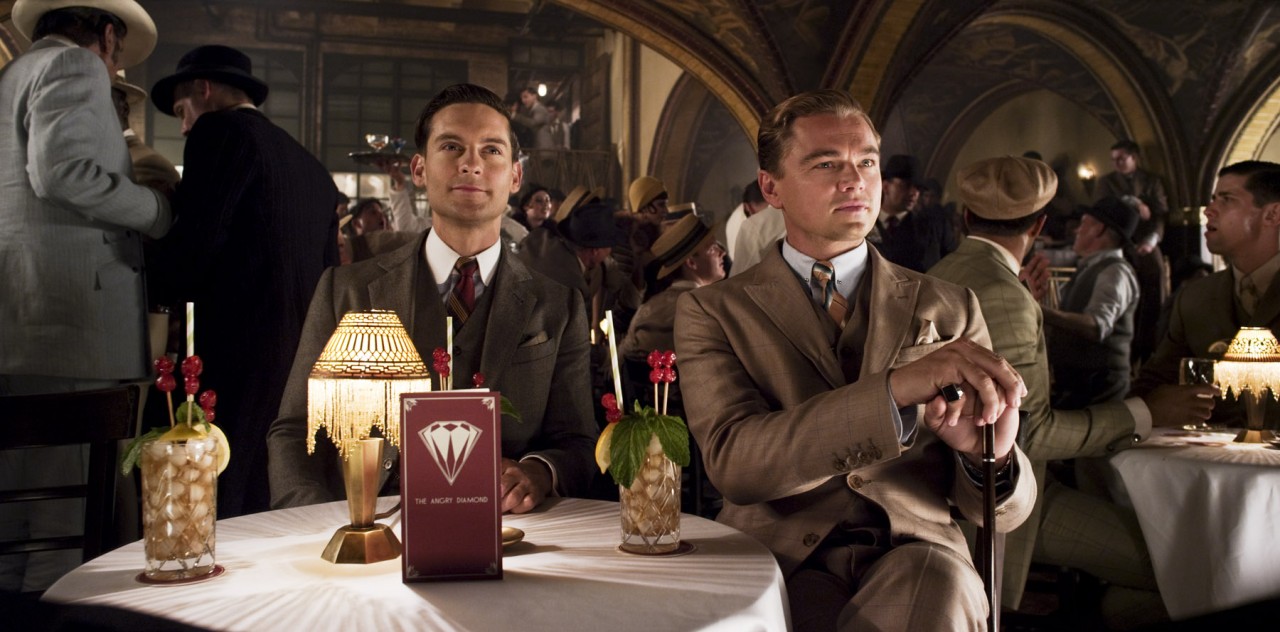
The fact that this film knows, respects, and acknowledges that makes me appreciate this movie, and hope that others can appreciate it too through DiCaprio’s performance and the mythology being revisited here.  Those who read the book should already know the story: a 1920’s bond salesman and struggling writer named Nick Carraway (Tobey Maguire) moves into New York city, where he learns of his rich next door “neighbor” named Jay Gatsby (Leonardo DiCaprio).

I put “neighbor” in quotations because Nick never actually sees Jay Gatsby in the beginning of the film.  All he ever sees of his estranged, self-secluded neighbor is a man looking behind some curtains and holding lavish parties in his mansion in the cool of midnight.  All he ever hears of him is scandalous rumors and war stories about a man many people haven’t met either.  The more Nick lives in his lonely little house, the more he questions if Mr. Gatsby even exists.

Eventually, Mr. Gatsby of course does introduce himself, but not as the host of the party, but rather, as a humble servant who offers Nick a drink on a plate of beverages.  As Nick becomes more familiar with Mr. Gatsby and his lifestyle, he soon learns the truth of Mr. Gatsby’s past and the reasons he really came to New York.

When I first heard of another Great Gatsby picture being made, my first reaction was excitement and anticipation.  How could it not be?  From the creative mind of F. Scott Fitzgerald and the many politics and emotions he makes you feel in his novel, it sounded like this movie was going to be a home run for both fans and non-fans of the book.

Then I learned that Baz Lurhmann was writing and directing.  And then bowed my head and uttered a long, dubious groaaannnn.  Lurhmann, who is most known for directing 1996’s Romeo + Juliet and 2008’s Australia, is commonly remembered as a director who abuses style over substance.  With the previous films I just mentioned, not only are they silly, soupy, and sappy menial dramas: they fail to even attain interest, and are extremely forgettable in a line of much better romantic dramas, including Titanic and the 1968 Romeo And Juliet by Franco Zeffirelli.

Note: Okay, I’ll admit I haven’t seen his 2001 film Moulin Rouge!.  Does it matter though, when out of his entire filmography, that’s the only film he can really brag about?  

The beginning of The Great Gatsby, much like Luhrmann’s other pictures, also suffers from this case of style over substance, with its overly boisterous parties and distracting art sequences making no coherent sense or adding anything to the picture overall.  What I found interesting, however, is that the first act barely matters.  When Jay Gatsby is finally introduced, the film takes a sharp turn of interest and invigorates the audience with new energy, almost like the character changes the entire tone of the film simply by him just being there.

I imagine this is the kind of Jay Gatsby that Fitzgerald would have wanted cast: the type that dresses in nice suits, stands straight with his chin up, and one who enters a room with such stillness that you could hear a penny drop.  The casting directors knew that their casting decision would be crucial to the film, and I think Fitzgerald would be pleased with the end result.  DiCaprio hits every single note dead-on this fascinating character, and just by sheer appearance, demeanor and dialect does he inhabit the character of Jay Gatsby and allow audiences to slip into his conscience and feel what he is feeling.

Oh, I won’t deny everyone else is good in this movie.  Joel Edgerton is effective as the antagonist, and even though he’s an industrial pioneer much like Gatsby is, he has such a hateful energy about him that makes you just want to run him over with a yellow beetle.  Carey Mulligan is good as Gatsby’s love interest, and perfectly shows all the innocence and indecisiveness of her character in the midst of all the ruckus.  Maguire, as well, is perfect as Nick Carraway, not as a character in himself, but as a silent observer, a passive voice who quietly watches over the scene, acting as the audience’s eyes and ears in this third-person narrative.  But its DiCaprio who sucks us in, DiCaprio who winds us up and plays us like a record as he asks us to sit through this tender, emotionally captivating journey that serves as a metaphor for the wealthy and for the industrial era.

And don’t worry, I’ll give Luhrmann credit too.  This film would not have survived without his writing or directing, as he has such reverence for the book and a great fear from deviating from it that the movie functions more as a love letter to Fitzgerald than it does as a strict book-to-movie adaptation.

Regardless, there’s only one person who shines the most here.  DiCaprio made this movie, and through his performance we were able to identify with a character that struggles with his past, his wealth, his love, and the deepening sadness that he hides behinds his warm, welcoming smile.

Tagged , , , , , , , , , , , , , , , , , , , , , , , , , , , , , , , ,

“MY NEIGHBOR TOTORO” Review (✫✫✫✫)

My name isn’t Totoro, kids.  It’s Hayao Miyazaki. 

Now this is what we’re supposed to get when we go in to see an animation picture.  My Neighbor Totoro is everything you expect it to be, and equally as much everything you don’t expect it to be.  This is definitely a kids movie, intended to fulfill the needs of the most innocent and simple-minded of younger viewers.  But this is a rare treasure for adults too, a film that is equally fulfilling and emotionally appealing to older audiences as it is upbeat and joyous for the younger ones.

Taking place in 1950’s Japan, My Neighbor Totoro follows the story of two young sisters named Satsuki and Mei (English dub by Dakota and Elle Fanning), who are moving into their new home with their father Tatsuo (Tim Daly) in order to be closer to their mother in the hospital, Yasuko (Lea Salonga).  Their mother has been sick with an unknown disease for quite some time, and it really concerns the girls because they can’t even get her home for a visit.  Most affected is Satsuki, because her father is always busy, Mei is painstakingly afraid that her mother will leave them, and Satsuki is forced to be the strong one during this time of hardship.

Deep in the forest though, the girls encounter strange beasts of wonder and splendor.  There are these small, darkly black fuzz balls called soot spirits, who hibernate from one dark spot to another.  There are two bunny-like creatures, one white young one who can phase through objects like a ghost, and an older blue one who carries a knapsack of acorns with her everywhere.  Most fascinating though, is a giant, loud, gray beast called Totoro (Frank Welker), a gentle-hearted forest spirit who loves nothing more but to sleep and play on his flute in the silence of the night.  The girls are at first afraid of Totoro’s large, intimidating appearance, but through his gentle, kind-hearted spirit, learn to appreciate him and become friends with Totoro and the forest creatures.

Written and directed by Hayao Miyazaki, My Neighbor Totoro is a rare animated film where the characters are as vibrant and colorful as the beautiful animation that is being expressed on screen.  You really just need to see these little girls in action: they’re one of the most energetic, emotional, endearing, and inspiring little characters I’ve ever seen.  I knew from the first moment I saw them that I would like them: they are these little oddballs of energy, two cute girls who are literally exploding with energy and enthusiasm as they run across the front lawn, or explore the mysteries of their upstairs attic.

The best moments, however, come from when the little girls encounter Totoro.  Looking from a straightforward perspective at Totoro, its a case of what you see is what you get.  He’s a big, fluffy creature who loves to eat, dance, fly, talk (and by talk, I mean roar loudly), and more than anything else, sleep.  If this were any other animated film, I would say the character was another interpretation of Garfield.

I, however, think Totoro is required for more fervent analysis.  I can’t help but look at Totoro like an emotional recompense for the girls, almost like an imaginary friend to distract them from the pain they experience everyday through their sick mother.  Kids with only one parent will know what I’m talking about: when the one you love is in pain or worse, they want everything in the world to distract them from the reality of what they are experiencing.  Its simply too painful for them to take in all at once.  They need something to distract them, to divert them from reality, and so the younger ones try to focus on something fictional that will put their mind at ease, like an imaginary friend for them to talk with.

Totoro reminds me of that imaginary friend.  Unlike an imaginary friend, however, Totoro is real, and this is proven through the interactions he has with the girls.  He is not just a simple-minded, unintelligent forest animal.  He is considerate towards the girls.  He cares for them.  He expresses real and genuine affection for the girls, and he shows this by dancing with them in the middle of the night, growing trees with them in their backyard, or by letting them ride his Cat Bus in cases of emergency.  Even though Totoro is fictional, he’s the most real thing in the movie, taking the girls story filled with hardship and tragedy and filling it with energy, enthusiasm, and life that cannot be faked in a movie.

Every single fiber of me wants to look at this movie and say it is a perfect film, but something stops me.  What is it?  It certainly isn’t the characters, the animation, the story, or the emotion being expressed on screen.  What is it then, if its none of the above?

Of course, I think.  Accessibility.  The weakness with this film, much like the stark foreign language films and the ancient black-and-white silent films, is that it strictly appeals to a certain audience.  You know what I’m talking about: what is the typical american viewer going to see, a boisterous and explosive action movie with big name actors starring in it, or some independent animated film made by some guy whose name they can’t even pronounce?  The weakness here is this: people who don’t like anime won’t like it, and probably shouldn’t see it, because this film mainly appeals to that same audience and culture through its story and through its execution.  Because of that, Totoro will lose some viewers in its audience.

But even then, is that the fault of the filmmaker for not conforming to their tastes, or the audiences for not being open about it?  Regardless of what you think, My Neighbor Totoro is a magical little film, an uplifting and wonderful fantasy that taps into the inner child in all of us, and in many ways reflects the behavior of children: animate, lifelike, endearing, sincere, and visually expressive.  It’s a movie whose characters are so precious and lifelike that a live-action portrayal couldn’t have been as real as this.  It’s a film that allows us to believe in miracles, even if we don’t necessarily believe in them.  And at the heart of it all is Totoro, a warm, fluffy forest spirit that only loves children more than he does sleeping on his favorite moss bed.

Tagged , , , , , , , , , , , , , , , , , , , ,