
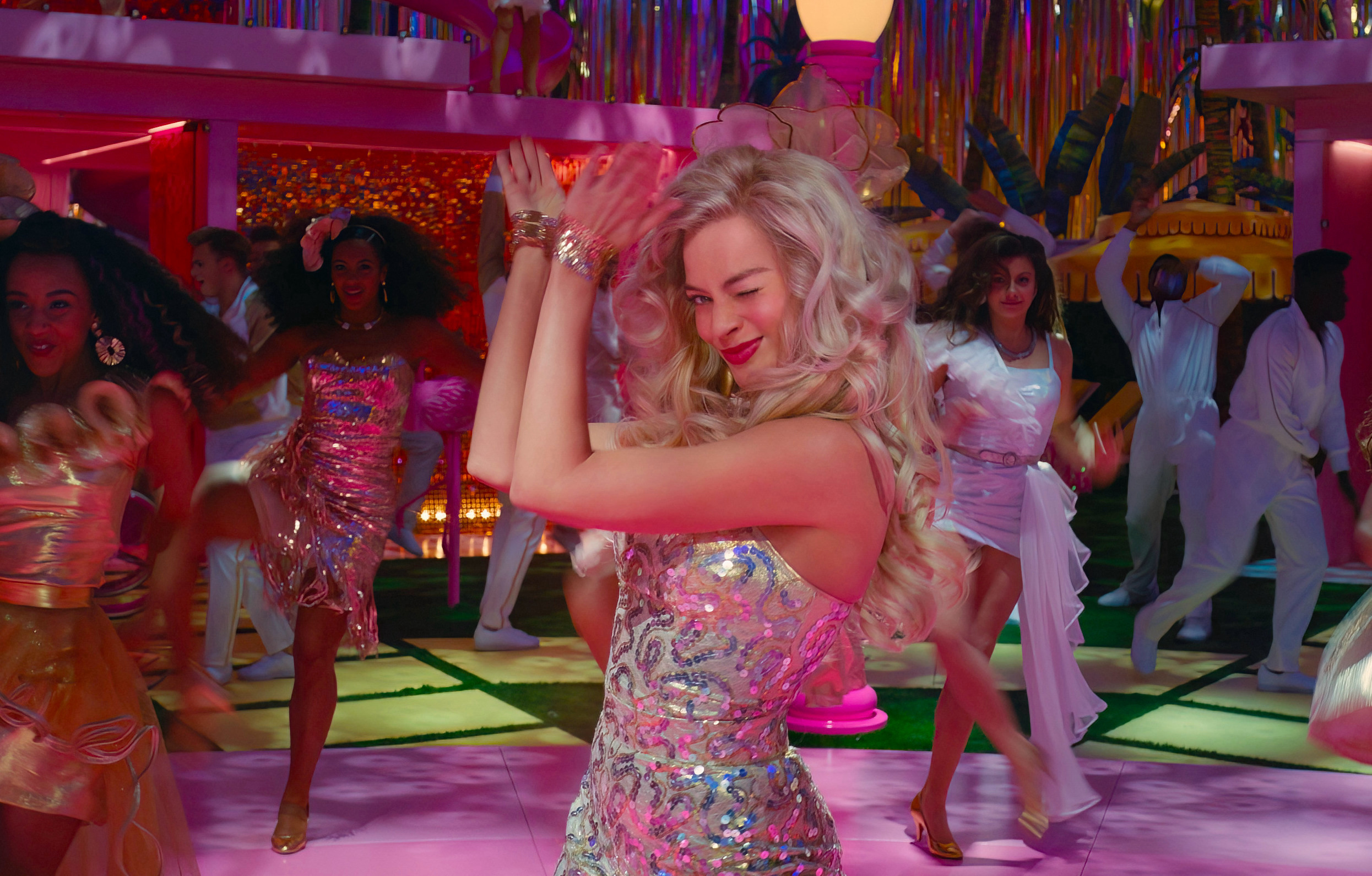
Introducing Existential Dread Barbie!
Barbie is an unexpectedly amazing and splendid little film, an equally joyful, imaginative, and heart-wrenching adventure in pink that combines the playfulness of Toy Story with the existential questions you’d find in 2001: A Space Odyssey. Like The Lego Movie and the recently released Dungeons & Dragons: Honor Among Thieves, Barbie proves that there is no such thing as bad ideas in Hollywood: only bad execution.
Based on the popular Mattel toy line, Barbie takes place in a magical world called Barbieland where all of the Barbies and Kens live and play. You see, when you play with Barbie dolls in the real world, they also interact with one another in Barbieland — and their world is incredibly different from ours.
For one thing, their government is made up entirely of women, from President Barbie (Issa Rae) all the way to the Barbie Supreme Court (which I imagine is giving Samuel Alito and Clarence Thomas a much-deserved migraine). Barbies lead all of the most important positions in Barbieland, from doctors and lawyers to physicists and pilots. And perhaps most significantly, Barbies aren’t expected to couple with any Kens if they don’t want to — which needless to say, is often.
One day, Stereotypical Barbie (Margot Robbie) notices strange things happening to her. For one thing, her feet go flat instead of her typical arched position (yes, that’s considered a serious health condition in Barbieland). She starts to notice cellulite on her thighs (an even more serious condition). But perhaps most oddly, she starts to think about death, a concept that all Barbies should be allegedly immune from. Together with her boyfriend Ken (Ryan Gosling), they venture into the real world to see what is happening and what is causing Barbieland to turn upside down.
Before I hop into this review, let me just say something for the sake of transparency: I hate Barbie. I hate Barbie with a passion. As a kid, I would kick, throw, and rip the heads off of every Barbie I could find because of her plastic, plain stare and her creepily real strains of hair. There’s a character in this movie called “Weird Barbie” who looks twisted, disheveled, and all-around messed up because she was played with too roughly in the real world. I probably made more Weird Barbies than I care to admit in my youth. I genuinely hate them that much. If younger me had a choice, he would probably bomb Barbieland and laugh while doing it.
And yet, I love this movie. Why? Well for one thing, this movie isn’t about Barbie. Or rather, it isn’t exclusively about Barbie. It’s more about the culture surrounding Barbie: the little girls whose faces light up around her, the mothers who reminisce on their childhood playing with her, and the corporate heads who can’t wait to make money off of her. It’s all a big, mesmerizing, messy picture, and it’s filled with pink dreams and fantasies right alongside harsh truths and realities.
One of the first things both fans and non-Barbie fans will appreciate about this movie is the level of detail that goes into its production and costume design. Barbieland itself feels like a child’s playset brought to life, with Barbiehouses, Barbiecars, and Barbiestreets all lit up in beautiful hues of pink and white. The sets all feel distinctly plastic, yet tangible and real. Even the waves stay static as Ken tries to “catch waves” (which in his case, means face-planting into the solid “water”). And the clothes all feel like real pieces of clothing you’d get in a Barbie set. They even have the names flash on the screen that shows which edition they belong to.
But the production value is one thing: these characters have to act and behave like Barbie too, and they are all exceptional. Margot Robbie gives the most nuanced performance as a Barbie who shines and glows at the beginning of the film, but as the movie goes on, she begins to gain sentience and experiences complex emotions for the first time. She isn’t so much “Stereotypical Barbie” as much as she is “Existential Dread Barbie,” because that’s exactly what she is and the kind of performance that Margot Robbie delivers.
Ryan Gosling is on a whole other level as Ken. He starts the film as a lovably oblivious oaf who constantly fawns over Barbie to win over her affection (“It’s Barbie AND Ken!” he exclaims at one point). But as he too gains independence, he becomes a massive, massive chode that isn’t unlike some frat bros who take pride in demeaning women and looking masculine in front of other guys. I don’t know what it’s like to be a woman in this age, but if all the guys girls met were a bunch of Kens, I understand their hesitations very well. I wouldn’t want to date Ken either.
Amazingly enough, neither Margot nor Ryan deliver my favorite performances in this film. It’s actually America Ferrera, who authentically portrays Barbie’s owner. She offers a powerful monologue describing what it’s like living as a woman and all of the contradictions that come with it. You need to put on makeup, but not too much makeup. You have to be thin, but not skinny. Smart, but not smarter than guys. Independent, but not bossy. She perfectly encapsulates all of the unreasonable expectations society places on women daily and the toll it takes on their mental and emotional well-being. She was absolutely incredible in the film, and I would personally argue she was the movie’s heart and soul.
But if America Ferrera was my favorite performance in the movie, Will Ferrell was my least favorite. Don’t get me wrong, I generally think he’s a funny and capable actor, but he feels so out of place here. He plays the Mattel CEO, and even though he belongs in our world, he behaves so obnoxiously that he feels like he should be CEO Ken in Barbieland. I get that the movie is trying to make a point of how stupid and tone-deaf bigwig CEOs can be, but unfortunately, it did too good of a job. A lot of restraint could have gone a long way, but as it stands, Will Ferrell is the most manufactured thing in the movie by far. Which is funny, because there are literal Barbie and Ken dolls in the film, and all of them feel more genuine and real than he does.
Outside of that, what I love most about Barbie is how it embraces her identity — how it embraces womanhood, how we view womanhood in general, and how womanhood blossoms when we nurture and care for it instead of judging it and objectifying it. This is the fourth film writer-director Greta Gerwig has centered around the subject, and while it isn’t her best one, it’s definitely the most accessible. The irony isn’t lost on me when men objectify women in the real world, only for Greta Gerwig to humanize a real object in Barbie. That take is infinitely clever and creative, and I wish that level of originality was present in many other modern-day IPs.
Barbie was not made for me — it was made for the growing girls who played with her when they were little, for the mothers who felt inspired by her, and for the grandmothers who saw themselves in her. Despite my gender barriers, I found Barbie to be a splendid movie, one that made me laugh, cry, and feel for everything that Barbie is and what she’s supposed to be. What else can I say? I’m just Film Critic Ken.
 DAVID DUNN